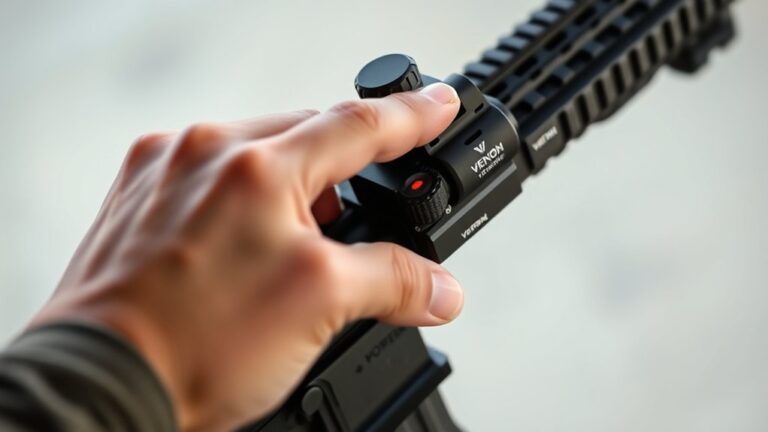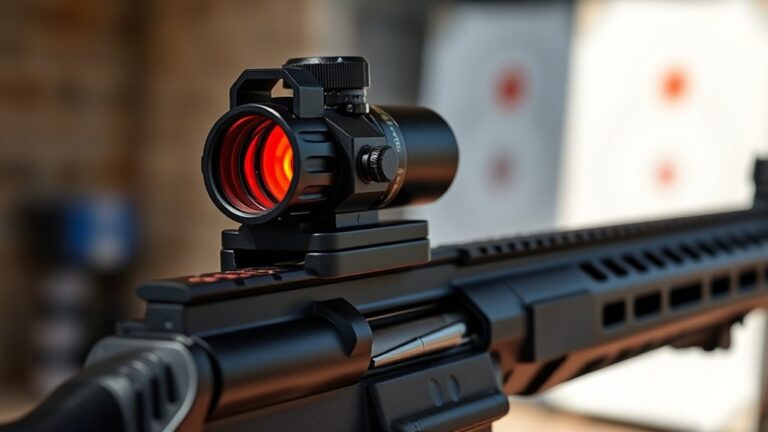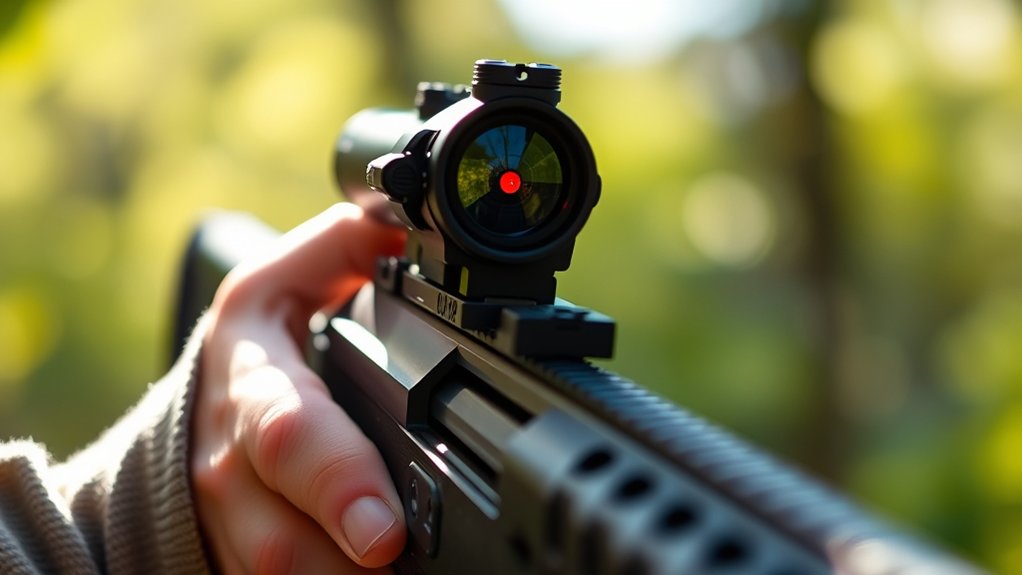
How To Aim A Red Dot Sight – Tips For Better Accuracy
To aim a red dot sight accurately, keep both eyes open and focus on your target, not the dot. Mount your sight securely at eye level and zero it regularly at practical distances. Using consistent sight alignment really helps.
Practice smooth press-outs and dry-fire drills to build muscle memory and confidence. Keep witness marks on screws to detect any shifts. Make sure to re-zero after handling or impacts.
Mastering these basics sets the foundation for faster acquisition and improved shooting precision. It’s all about getting comfortable and consistent with your setup and technique.
Key Takeaways
- Keep both eyes open and focus on the target, letting the red dot naturally align without fixating on it.
- Mount the sight at the dominant eye’s natural line of sight and securely tighten screws to maintain consistent zero.
- Regularly verify and re-zero the red dot at practical distances, especially after handling or impacts.
- Practice smooth press-outs and dry-fire drills to build muscle memory and improve trigger control.
- Use witness marks on screws to detect movement and ensure consistent sight alignment for reliable accuracy.
How to Get a Clear Sight Picture With Your Red Dot
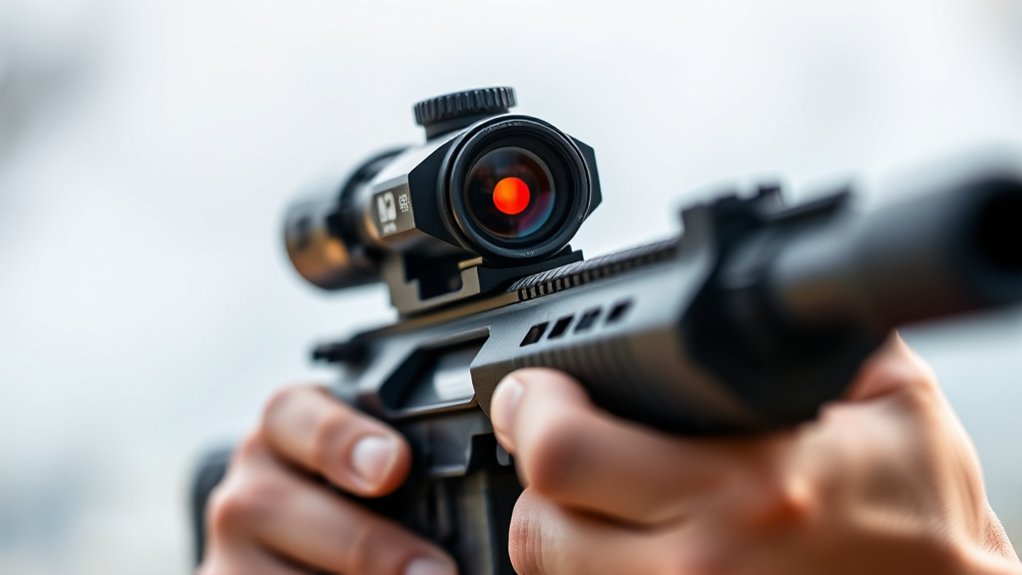
How do you achieve a clear sight picture with your red dot? First, keep both eyes open and focus on the target. Let the red dot sight naturally align without forcing sight alignment.
Make sure your red dot is zeroed, placing the dot exactly where your rounds hit for consistent accuracy. Center the dot in the lens and keep a relaxed head position with a steady mount to avoid blurring.
Ensure your red dot is zeroed, centered, and maintain a relaxed, steady position for clear accuracy.
Use the reticle’s large circle to quickly find the dot and acquire your target efficiently. Regularly check your zero and adjust the dot’s brightness so it stays crisp and visible against different backgrounds.
Following these steps will give you a clear, reliable sight picture that helps you shoot precisely every time.
Why Focus on the Target, Not the Dot
You’ll get quicker and more accurate by focusing right on the target, not the dot. When you keep your eyes on the target, it stops you from getting distracted by the reticle.
Plus, the dot will naturally line up in your peripheral vision without you even trying.
This little change can really boost your situational awareness. And when things get intense, it helps you land more consistent shots.
It’s a simple trick that makes a big difference.
Target Focus Benefits
Although many instinctively focus on the red dot, concentrating on the target itself sharpens your situational awareness and speeds up target identification.
When you practice target focus, your eye naturally keeps the target clear while the red dot remains sharp and unobtrusive. This sight focus reduces reaction time and improves shooting speed without compromising accuracy.
By prioritizing the target, you avoid overloading your brain with reticle details, resulting in smoother, more instinctive shots.
Aligning your aim with natural visual behavior also reduces eye strain during extended shooting sessions.
Key benefits of target focus include:
- Faster target acquisition
- Enhanced situational awareness
- Reduced reaction time
- Increased shooting speed
- Intuitive sight focus for improved accuracy
Avoiding Dot Distraction
Shifting your focus from the red dot to the target itself eliminates unnecessary mental clutter and sharpens your aim. Dot distraction happens when you fixate on the red dot, causing mental clutter that disrupts your sight picture and lowers shot accuracy.
Instead, try to concentrate on the target. This keeps your brain aligned with where you want the bullet to hit and improves your aiming technique.
By training yourself to keep your focus on the target, you build better muscle memory and consistency. This makes your shots feel more natural and precise.
Plus, focusing on the target helps you stay aware of your surroundings during fast-paced shooting scenarios. That way, you can react quickly without losing accuracy.
Avoiding dot distraction is key to mastering shot placement and improving your overall accuracy with a red dot sight. Just keep your eyes on the target, and everything else will fall into place.
Enhancing Reaction Speed
How quickly you react in a critical moment often depends on where you focus your eyes. Prioritize target focus over the red dot sight itself to sharpen your reaction speed. When you look directly at the target, your brain processes visual information faster, enabling quick acquisition and reducing reaction time.
This aiming technique makes the red dot an extension of your sight, enhancing accuracy and situational awareness. Studies confirm shooters who maintain target focus engage threats up to 30% faster, improving decision-making under stress.
- Enhances visual processing speed
- Prevents attention shifts from threat
- Makes red dot an intuitive aiming aid
- Improves quick acquisition of targets
- Boosts situational awareness for faster decisions
Use Both Eyes Open for Better Accuracy and Speed
Keep both eyes open to get the most out of your binocular vision. It really helps sharpen your depth perception and speeds up how quickly you can spot your target.
Plus, it’s easier to stay aware of what’s happening around you and follow moving targets better.
When you train this way, you’ll notice your accuracy improves. And on top of that, you’ll reduce eye strain and fatigue, making it more comfortable to keep going for longer.
It’s a simple change that makes a big difference!
Benefits Of Binocular Vision
Although it might feel natural to close one eye while aiming, keeping both eyes open with a red dot sight really boosts your accuracy and speed. Binocular vision enhances depth perception, so you can judge distances more precisely and improve your shot placement.
Using both eyes open also sharpens situational awareness and target detection. It gives you a wider field of view and reduces eye strain during extended sessions.
Your reaction time benefits too, as your brain processes visual input more efficiently. Here’s what binocular vision offers:
- Improved depth perception for accurate distance judgment
- Enhanced situational awareness with a broader field of view
- Faster target detection and engagement
- Reduced eye strain and fatigue
- Quicker reaction time leading to better overall accuracy
Enhancing Target Awareness
Why settle for limited vision when you can enhance your target awareness by using both eyes open with a red dot sight? Keeping both eyes open expands your field of view, improving situational awareness and speeding target acquisition.
You focus with your dominant eye while your other eye maintains peripheral vision. This prevents tunnel vision and reduces eye strain.
Practicing smooth focus shift between the red dot and the target sharpens your accuracy and shot placement. This method helps you quickly identify threats and maintain control in dynamic scenarios.
| Benefit | Effect |
|---|---|
| Both Eyes Open | Wider field of view |
| Focus Shift | Faster target recognition |
| Peripheral Vision | Track multiple targets |
| Situational Awareness | Enhanced overall accuracy |
How to Press Out Smoothly to Find the Dot Faster
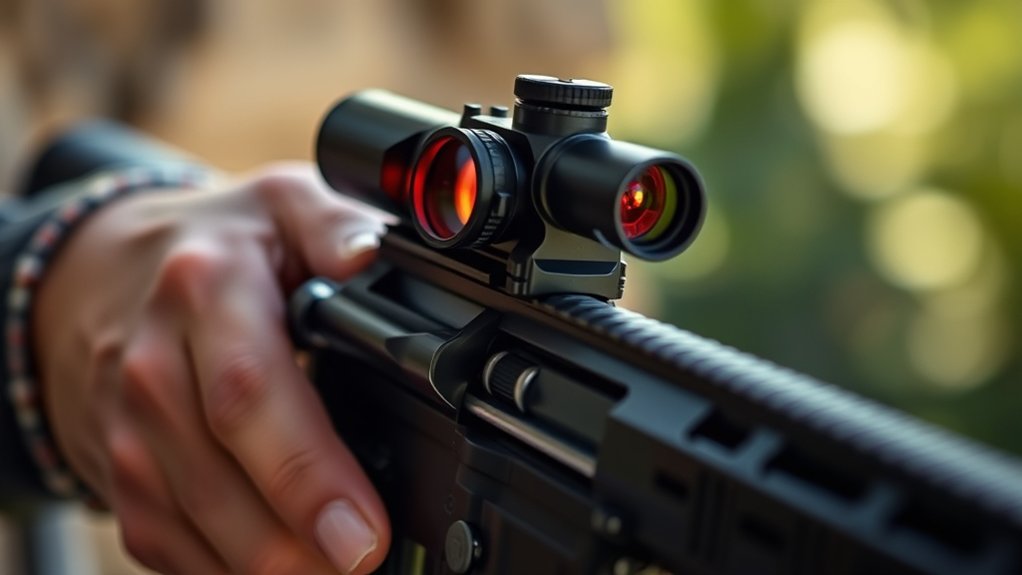
How can you develop a smooth press-out that helps you find the dot faster? Focus on aiming smoothly with a consistent grip and controlled press-out motion. This lets you naturally align your sight picture and find the dot quickly without unnecessary movement.
Building muscle memory through practice is essential. Dry fire at close range to reinforce a fluid extension while maintaining trigger control. Keep your eyes relaxed and focused on the target. The dot will come into view naturally as you extend your arm.
Practice dry firing to build muscle memory, maintain trigger control, and naturally focus on the target as you extend your arm.
- Maintain a consistent grip and smooth press-out
- Practice dry firing to build muscle memory
- Keep eyes relaxed, focus on the target
- Use slow, controlled motion to find the dot
- Repeat deliberately to improve trigger control and speed
Keep Your Red Dot Sight Aligned and Zeroed
Because consistent accuracy depends on it, you need to keep your red dot sight properly aligned and zeroed. Regularly verify your zero at practical distances. For pistols, 10 yards is ideal to maintain pinpoint accuracy.
Use a reliable mounting system that prevents shifts and guarantees stable alignment. After mounting or recoil, test your sight by shooting groups to detect any drift and adjust accordingly.
Mark your mounting screws with witness marks to easily spot any movement over time.
Always re-zero your red dot sight after cleaning, handling, or impacts. This confirms the reticle stays precisely aligned with your point of aim.
These steps preserve your red dot sight’s accuracy and ensure every shot hits where you intend.
Tips for Mounting and Adjusting Your Red Dot Sight
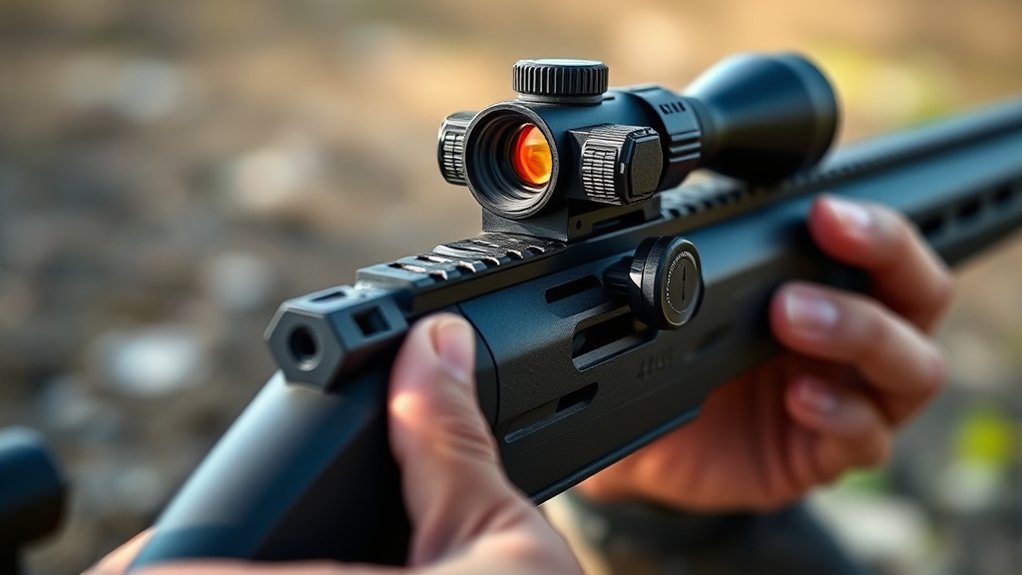
When mounting your red dot sight, make sure it sits at the right height to line up naturally with your dominant eye’s line of sight. This helps you acquire targets quickly and comfortably. Proper mounting and zeroing keep your sight accurate and reliable.
Secure your sight firmly to prevent any movement that could throw off your zero. After mounting, calibrate your sight carefully by making small adjustments, starting at close range. It’s a good idea to regularly check the alignment to keep your precision sharp.
Here are some tips to follow:
- Mount at a height that matches your dominant eye’s natural sight line
- Tighten all screws securely, and if you can, use a torque wrench
- Mark screw positions so you can verify zero after taking it apart
- Start zeroing at about 10 yards, making small, precise adjustments
- Recalibrate and confirm alignment after any impacts or rough handling
Following these steps will help you maintain consistent accuracy and confidence in your red dot sight.
Dry-Fire Drills to Improve Red Dot Aiming and Confidence
Mounting and zeroing your red dot sight set the foundation for accuracy, but building confidence and speed behind the sight requires consistent practice. Incorporate dry-fire drills that emphasize smooth, natural draws and placements, ensuring the red dot appears precisely where you expect.
Properly mounting and zeroing your red dot is just the start; consistent dry-fire practice builds true speed and confidence.
Use the tape trick during dry-fire exercises to shift focus from the reticle to your target. This helps enhance aiming speed and confidence.
Regularly simulate live fire scenarios to develop muscle memory for consistent presentation and sight acquisition.
Include target transition drills to maintain a steady sight picture and refine your grip and stance. These dry-fire routines sharpen your aiming skills, reduce hesitation, and improve overall accuracy.
Before you know it, your red dot sight will feel like a natural extension of your aiming system.
Overcoming Common Red Dot Aiming Challenges
Though red dot sights simplify aiming, many shooters struggle to acquire and maintain the dot because their eyes want to focus on both the target and the sight. This conflict is especially tough under stress. To get past these common aiming challenges, you need to train your eyes to focus on the target, not the reticle.
Proper sight alignment and mount height make sure the dot appears naturally, which helps reduce inconsistencies. Also, zero your red dot at the engagement distance to minimize parallax errors.
Incorporating dry fire drills and the tape trick will build muscle memory and make your presentation feel more natural.
Here are some key tips to help you overcome aiming challenges:
- Focus on the target, not the reticle
- Guarantee proper mount height and eye relief
- Zero sight at intended range
- Practice dry fire regularly
- Use consistent sight alignment and presentation
Using these techniques will boost both your accuracy and confidence with a red dot.
Frequently Asked Questions
What Batteries Work Best for Red Dot Sights?
You’ll want to use lithium coin cell batteries like the CR2032 for your red dot sight because they balance size, capacity, and longevity well. These batteries often last 1 to 2 years, which is pretty convenient.
If you need longer battery life or have a higher drain model, go for CR2450 batteries. They pack more power and can keep your sight running longer without a hitch.
Always pick high-quality, brand-name options to guarantee consistent brightness. This helps avoid unexpected power failures during critical moments.
Also, check your sight’s manual for any rechargeable battery compatibility.
How Long Do Red Dot Sight Batteries Typically Last?
Red dot sight batteries can last like a marathon runner, going strong between 20,000 to 50,000 hours depending on your model and settings. If you dial down the brightness, you’ll stretch that runtime even further.
Keep an eye on battery indicators and swap batteries before they die to avoid surprises. Some sights even let you recharge, giving you a sustainable edge.
Staying proactive guarantees your red dot stays sharp when you need it most.
Can Red Dot Sights Be Used in Low Light or Nighttime Conditions?
Yes, you can use red dot sights in low light or nighttime conditions. Many models offer automatic or manual brightness adjustments, so the reticle stays visible without straining your eyes.
Green reticles often work better in the dark, and some red dot sights even support night vision devices for covert ops.
Just make sure your sight is properly zeroed and illuminated. That way, you can acquire targets quickly and accurately in any lighting.
Are Red Dot Sights Compatible With Night Vision Devices?
Oh sure, just slap any red dot sight on your night vision and expect perfect harmony because that’s how technology works, right?
Actually, most red dot sights aren’t compatible with night vision devices unless they’re specifically designed for it.
You’ll need a night vision-compatible sight with green or IR reticles to avoid blinding your NV gear.
Always check the manufacturer’s specs to guarantee compatibility.
This way, you avoid damaging your expensive equipment or losing effectiveness in the dark.
What Is the Difference Between Reflex and Holographic Red Dot Sights?
You’ll notice reflex sights are simpler, lighter, and show a 2D LED dot on a clear lens. This gives you a wide field of view, which is great for quick target acquisition.
Holographic sights, on the other hand, project a 3D reticle using a laser on a holographic plate inside a sealed housing. This setup offers better precision and depth perception.
Reflex sights are perfect for close-range use and are generally more affordable.
Meanwhile, holographic sights excel in longer-range accuracy but tend to cost more and are a bit more complex.
Conclusion
Mastering your red dot sight means focusing on your target, not just the dot, and keeping both eyes open for faster, more accurate shots.
While some believe zeroing guarantees perfect hits, real-world variables like recoil and lighting prove otherwise. Consistent practice and smooth trigger control truly make the difference.
Keep your sight aligned, train with dry-fire drills, and adjust confidently. This approach guarantees your red dot becomes a reliable extension of your aim, not just a fancy accessory.