When Were Red Dot Sights Invented – History And Development
You can trace red dot sights back to around 1900 when Howard Grubb designed an optical system that projected a reticle inside lenses for faster aiming.
Their modern form began in 1975 with Aimpoint’s introduction of the first electronic red dot sight. This invention really changed the game by making target acquisition faster and easier. It did this by eliminating the need for precise eye alignment and solving parallax issues.
Through the 1990s, military and law enforcement adoption of red dot sights skyrocketed. This was driven by advances in LED technology and improvements in durability. These innovations helped shape the sights you see today.
Key Takeaways
- Red dot sight concepts originated around 1900 with Howard Grubb’s optical design projecting reticles onto lenses for improved aiming accuracy.
- Modern red dot sights began with Aimpoint’s 1975 launch of the Aimpoint® Electronic, founding the industry with LED-illuminated reticles.
- Aimpoint’s innovations included collimated dot projection and Mangin mirrors that eliminated parallax and improved reticle sharpness.
- The 1990s saw widespread military adoption, notably after 1991 U.S. military demonstrations and large procurement contracts for Aimpoint sights.
- Recent advancements focus on LED efficiency, miniaturization, night vision compatibility, and future integration of smart aiming technologies.
What Are Red Dot Sights and How Do They Work?
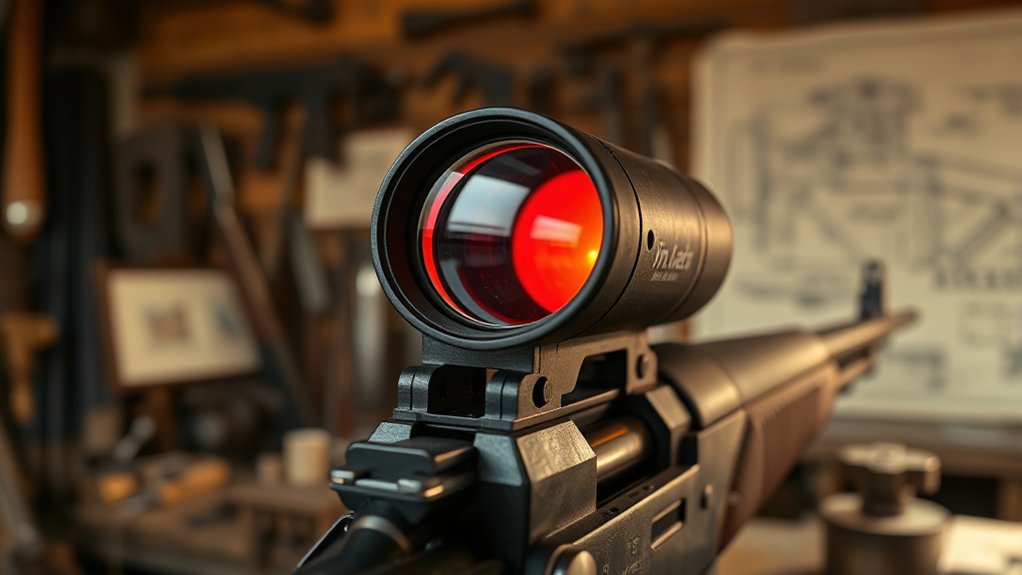
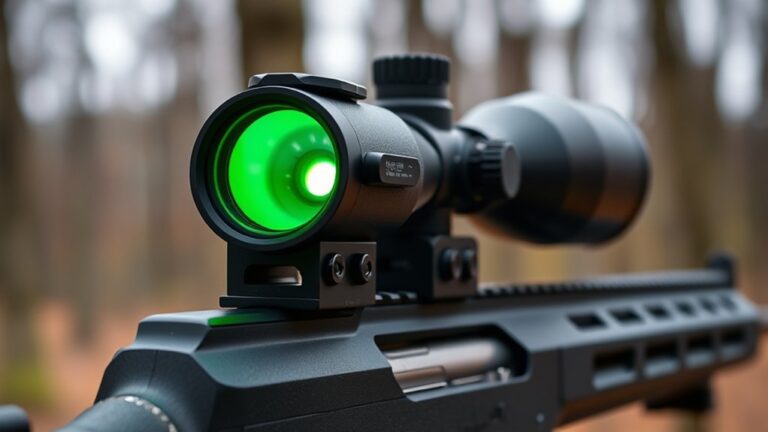
How exactly do red dot sights work, and what makes them so effective for aiming? Red dot sights are a type of reflex sight that project an illuminated reticle, usually a red dot, onto an optical reflector like a glass lens.
Inside, a red LED sits at the focus of collimating optics, which shapes the light into a parallel beam. This creates a virtual aiming point that appears at infinity.
A red LED focuses light into a parallel beam, creating a virtual aiming point at infinity.
The reticle reflects off a beam splitter or curved mirror, letting you see the dot superimposed on your target. Because these sights are parallax-free at infinity, the reticle stays aligned with your target no matter where your eye is positioned.
This combination of collimating optics and an illuminated reticle makes red dot sights really effective for quick and precise aiming. They help you line up your shot faster and more accurately, which is why they’re so popular.
Early Concepts and Precursor Reflector Sights
Although red dot sights seem like a modern innovation, their roots reach back to around 1900 when Irish optical designer Howard Grubb developed the earliest reflector sight concepts. Grubb’s design used sunlight and a second angled window to project a tiny reticle onto the interior of the objective lens. These early reflector sights aimed to improve aiming accuracy for small arms, aircraft, and naval guns.
By projecting the reticle directly in the shooter’s line of sight, Grubb’s invention allowed faster target acquisition without shifting focus.
Over time, these early concepts laid the groundwork for practical applications like the 1945 Nydar shotgun sight and the 1947 Giese electric gun sight. Their innovations paved the way for later, more compact and battery-powered red dot sights.
How Did Red Dot Sights Revolutionize Aiming?

When you pick up a firearm equipped with a red dot sight, you’ll notice an immediate difference in how quickly you can acquire your target. Red dot sights revolutionized aiming by eliminating the need for precise eye alignment, which drastically reduces parallax errors. The optical collimator projects an illuminated reticle, making it easier to grab your target fast with great accuracy.
Advancements in optical technology and LED reticle illumination during the late 20th century really stepped up visibility in all kinds of lighting conditions. This was especially helpful during rapid fire.
Plus, the compact and lightweight design of these sights made them super versatile across military, law enforcement, and civilian use.
Some key benefits include faster target acquisition compared to iron sights, reduced parallax errors at infinity, and enhanced reticle illumination in every lighting situation. They also improve aiming accuracy when firing quickly and can be mounted on firearms in a compact and versatile way.
Aimpoint’s Founding: The First Commercial Red Dot Sight
The rapid improvements in aiming technology set the stage for a breakthrough in the mid-1970s. In 1974, Swedish inventor Arne Ekstrand founded Aimpoint, inspired by a simple prototype involving a toilet roll and light reflection. Ekstrand’s invention aimed to boost aiming accuracy by creating the first commercial red dot sight, a reflex sight designed for hunters and shooters.
Limited funding led him to partner with Gunnar Sandberg, who provided workspace and essential support. By 1975, Aimpoint launched the Aimpoint® Electronic, marking the founding of the red dot sight industry.
This early optical device combined simplicity and effectiveness, laying the foundation for modern red dot sights. It really changed the game, revolutionizing how you engage targets with improved precision and speed.
The invention made aiming easier and faster, which was a big deal for hunters and shooters alike. So, Aimpoint’s creation wasn’t just another gadget—it was the start of something that’s still shaping aiming technology today.
Key Optical and Electronic Innovations in Red Dot Sight Design
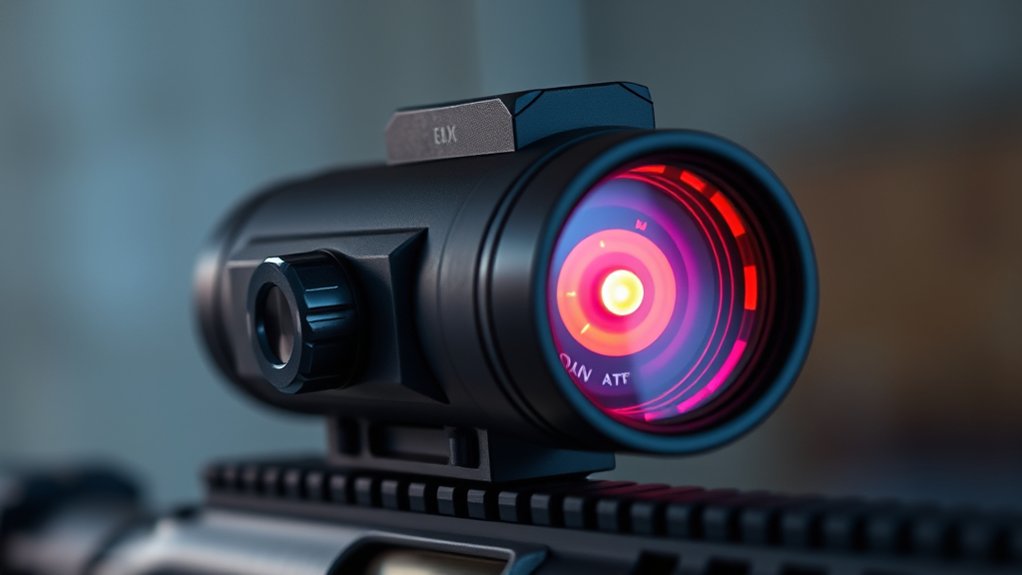
You’ll first notice that collimated dot projection really changed the game for red dot sights. It created a reticle image focused at infinity, which means you can quickly acquire your target no matter where your eye is positioned.
Then came the Mangin mirrors, which helped fix spherical aberrations and made the reticle much clearer and sharper.
And finally, energy-efficient LED sources took over from older illumination methods. This not only extended battery life but also kept the reticle bright and easy to see.
Collimated Dot Projection
Although many sights rely on traditional optics, red dot sights stand out by using collimated optics to project a virtual aiming point that appears at infinity. This collimated projection guarantees your reticle stays perfectly aligned with targets, regardless of your eye position. It delivers a parallax-free experience.
The design uses key optical elements like a beam splitter or a collimating mirror to reflect the reticle into your line of sight while letting background light pass through. An optical collimator set, paired with an LED at its focus, illuminates the red dot reticle without distorting the image.
Key features include:
- Virtual aiming point appearing at infinity
- Beam splitter or collimating mirror for image reflection
- LED-illuminated reticle in reflex sight design
- Parallax-free aiming for rapid target acquisition
- Integration of optical elements for clarity and precision
Mangin Mirror Corrections
When you seek enhanced image clarity in red dot sights, Mangin mirror technology plays a crucial role by correcting spherical aberration that traditional optics struggle with. This optical design utilizes a meniscus glass element with a reflective rear surface, serving as both a lens and mirror to improve aberration compensation.
It’s incorporated into the collimator assembly of advanced red dot sights, where the Mangin mirror refines the optical system. The result? A sharper, distortion-free virtual reticle that improves your shooting experience.
Energy-Efficient LED Sources
Since the late 20th century, energy-efficient LED sources have revolutionized red dot sight design by replacing traditional incandescent bulbs with solid-state illumination. This shift has brought significant improvements in reliability and power consumption.
You’ll notice these key advances: long-lasting LED diodes delivering over 50,000 hours of illumination, low power consumption that extends battery life from months to years, and high-brightness red diodes with adjustable brightness for versatile use.
Plus, the compact, lightweight designs are made possible by small, efficient LED components. Enhanced reticle visibility comes with precise brightness control, and these are even compatible with night vision.
How the Military and Police Adopted Red Dot Sights in the 1990s
As advancements in LED technology and compact optical designs improved reliability, military and police forces began embracing red dot sights in the 1990s for their rapid target acquisition and parallax-free aiming. The US military’s interest really took off after General Schwarzkopf’s 1991 demonstrations highlighted how these sights could enhance combat effectiveness.
By the late 1990s, massive procurement contracts confirmed the military’s adoption of red dot sights. At the same time, law enforcement agencies saw the value in these optics for quick response and ease of use during dynamic situations.
| Aspect | Impact in the 1990s |
|---|---|
| Military Adoption | Tens of thousands of units procured |
| Police Use | Improved reaction times and accuracy |
| Optical Design | Compact, reliable, LED-powered |
This decade marked a pivotal shift, with red dot sights becoming an essential part of both combat and law enforcement gear.
Major Production Milestones and Market Growth
You’ll notice that Aimpoint’s mass production really picked up in the late 1990s after they secured some big government contracts.
Then, by 2007, they scored a major US military deal for over 565,000 units. That was a real turning point for their market growth.
This huge boost in military orders helped spread their adoption far and wide, paving the way for expansion into civilian and law enforcement markets.
Mass Production Expansion
How did red dot sights transform from niche tactical tools to widely accessible aiming devices? It started in the late 1980s when mass production kicked off, making these sights more affordable and available for both military use and the civilian market.
Aimpoint led the charge, introducing the 1000 series in 1987 with improved battery life and a compact design.
Some key milestones include Aimpoint’s 1997 US government tender for 100,000 sights, which really boosted production capacity. Then, in 1998, they opened new manufacturing facilities in Malmö to meet global demand.
There were continuous technological advancements that enhanced reliability, too. The market expanded rapidly into law enforcement and civilian shooting sports.
By the early 2000s, sales surged thanks to improved features and wider adoption.
All these developments together fueled the mass production expansion of red dot sights worldwide. It’s pretty impressive how far they’ve come!
Military Contract Growth
When did red dot sights become indispensable to military forces worldwide? The turning point came in 1997 when Aimpoint won a major U.S. military contract to produce 100,000 red dot sights. This milestone marked the start of large-scale mass production, prompting Aimpoint to expand its workforce from 3 to 40 employees in Gällivare to meet rising military demand.
Over the next decade, Aimpoint kept developing new models and mounting standards, which sped up adoption across global forces. By 2007, a landmark procurement deal for 565,000 sights dramatically increased production capacity.
This surge in military contracts fueled rapid market growth, solidifying Aimpoint’s role as a leader in the red dot sights sector.
The company’s strategic focus on innovation and large-scale production supported this sustained expansion. It’s clear that Aimpoint’s commitment to evolving their products and scaling up manufacturing made all the difference.
Modern Advancements and the Future of Red Dot Sight Technology
Although red dot sights have long been valued for their simplicity, recent advancements have really transformed their performance and versatility. Optical improvements now deliver sharper clarity. Plus, LED reticles combined with fiber optics help reduce power use and boost battery efficiency, sometimes lasting thousands of hours.
Red dot sights now offer sharper clarity and extended battery life through advanced optics and LED fiber optic integration.
Adjustable reticles and night vision compatibility also enhance usability in a variety of conditions. Manufacturers are focusing on miniaturization, making sights lighter for compact firearms.
Looking ahead, future developments aim to integrate smart features like wireless connectivity and ballistic calculations, which will increase precision and adaptability.
Key advancements include:
- Enhanced optical clarity and durability
- LED reticle with fiber optic integration
- Adjustable brightness and night vision compatibility
- Miniaturization for lightweight design
- Smart features with wireless and adaptive optics
Frequently Asked Questions
Can Red Dot Sights Be Used on Bows or Non-Firearm Equipment?
Yes, you can use red dot sights on bows, but you’ll need a compatible mounting system. This is often an aftermarket adapter or a custom mount.
Manufacturers also create laser or LED aiming devices designed specifically for archery, though traditional red dot sights are less common.
You’ll benefit from quick target acquisition thanks to their parallax-free design.
Just be cautious because unstable mounting or rough handling can cause misalignment or damage when used on non-firearm equipment like bows.
What Battery Types Do Red Dot Sights Commonly Use?
You’ll find that red dot sights commonly use lithium coin cell batteries, like the CR2032, because they offer long shelf life and stable voltage.
Smaller sights might use compact batteries such as the CR1632 or CR2025 to save space.
Nowadays, some models even incorporate rechargeable lithium-ion batteries or solar panels.
Advanced features like shake-awake technology also help conserve power, making battery life last several months to over a year depending on usage.
How Do Red Dot Sights Compare to Holographic Sights?
You’ll find red dot sights simpler and more affordable. They use a reflective reticle and offer longer battery life.
Holographic sights, on the other hand, project a 3D laser-illuminated reticle. This gives you a wider field of view, better parallax resistance, and improved precision at longer ranges.
While red dots excel in quick target acquisition at close to medium distances, holographic sights perform better in low-light or challenging conditions because of their advanced laser technology.
Are Red Dot Sights Waterproof and Fog-Resistant?
Yes, many red dot sights are waterproof and fog-resistant. Manufacturers design them with sealed, nitrogen-purged or argon-filled housings to prevent internal fogging.
You’ll find models rated for submersion up to 10 or 20 meters, often meeting IP67 or IP68 standards.
To keep your sight durable, use corrosion-resistant materials and maintain seals by cleaning regularly and avoiding extreme temperatures.
This helps guarantee reliable performance in harsh weather conditions. So, you can trust your red dot sight to hold up when things get tough outside.
Can Red Dot Sights Be Mounted on Rifles, Pistols, and Shotguns?
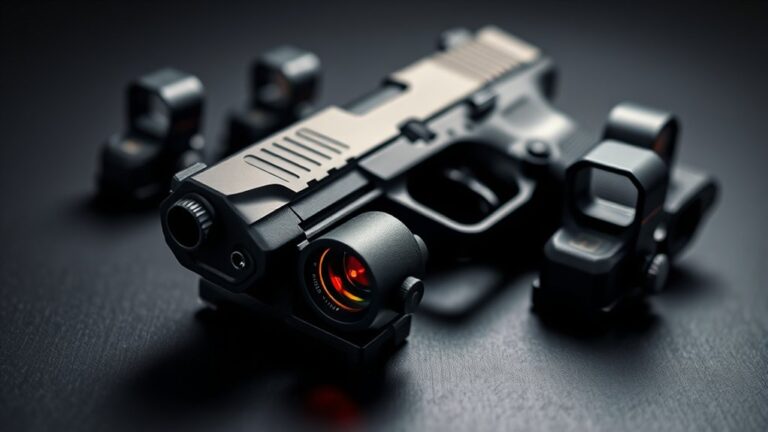
Yes, you can mount red dot sights on rifles, pistols, and shotguns. They come with versatile mounting options and standardized footprints like Aimpoint, RMR, and Doctor mounts.
Pistol red dots use smaller footprints like RMR or RMSc, which fit various handguns easily.
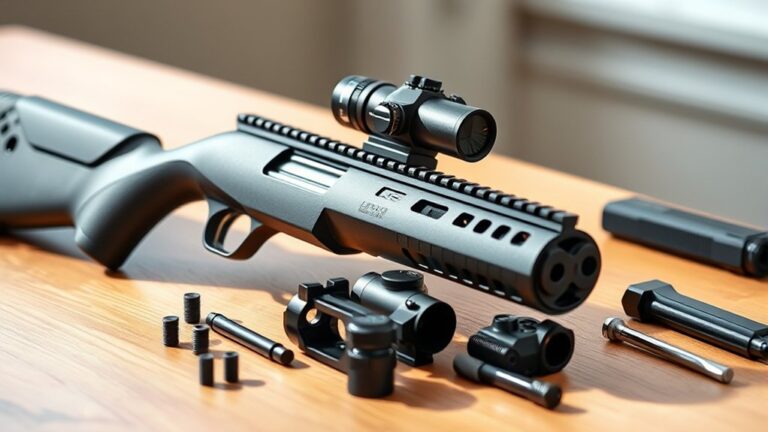
For shotguns, you’ll find specific bases or offset adapters to align sights properly.
These universal standards make switching red dot sights between firearms quick and efficient.
Conclusion
You’ve seen how red dot sights evolved from early reflector concepts to Aimpoint’s groundbreaking design in the 1970s. This innovation really changed the game for military and police by the 1990s.
Just like a knight relying on a GPS, modern shooters depend on advanced optics that blend electronics with precision glass. It’s pretty amazing how far the technology has come.
As technology marches forward, you’ll see even smarter, faster red dot sights shaping the future of targeting. Their lasting impact is clear—from past to present and beyond.