What Is A Red Dot – Definition And Overview
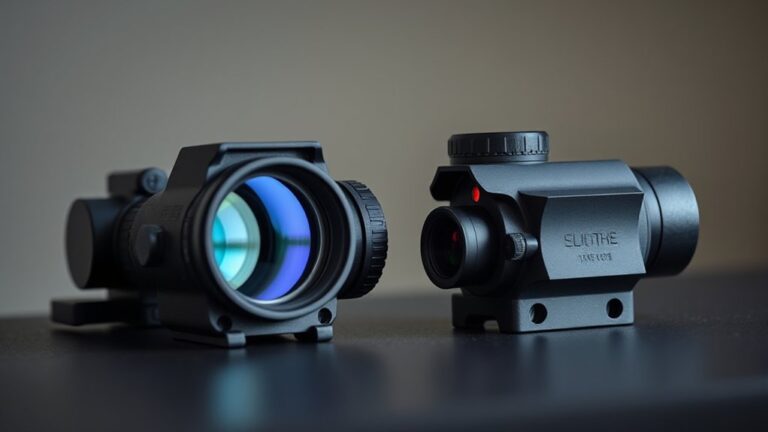
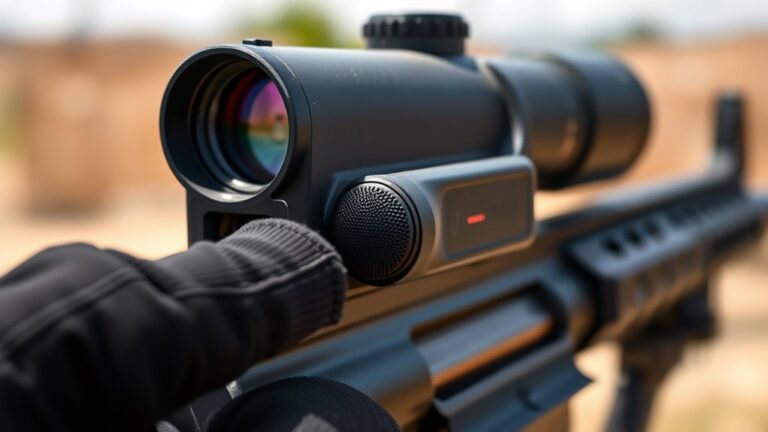
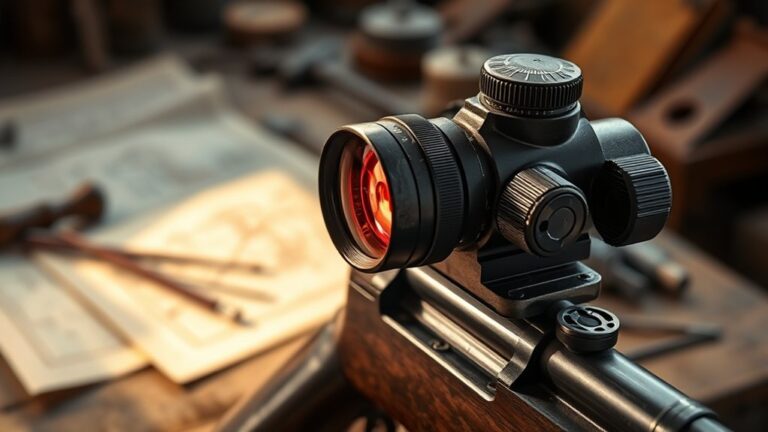
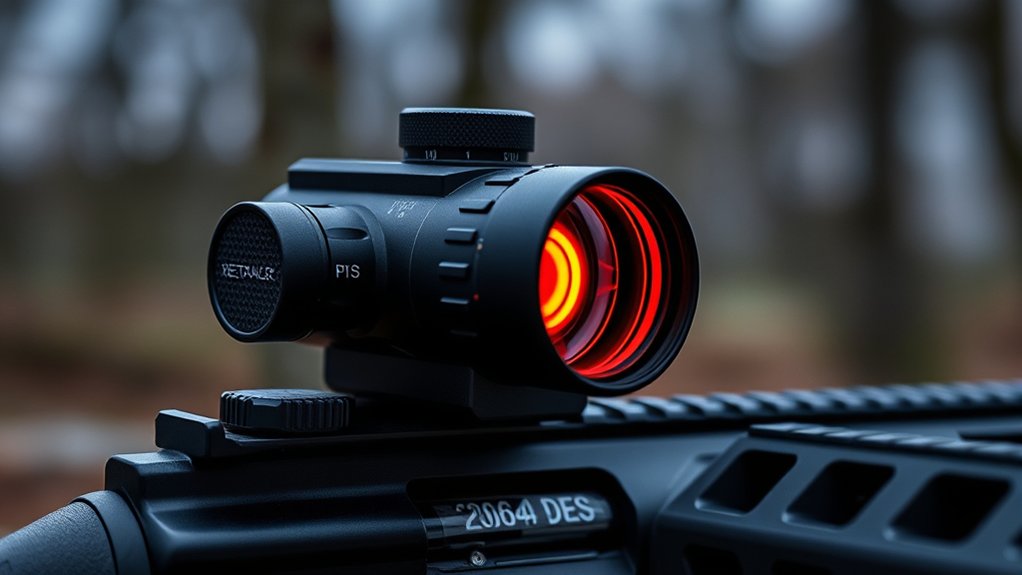
A red dot sight projects an illuminated aiming point onto a glass lens, letting you acquire targets quickly and precisely. It uses a red LED focused through collimating optics to create a reticle visible at infinity. Typically, the reticle is sized between 2 and 6 MOA for a good balance between accuracy and speed.
These sights are parallax-free, compatible with multiple firearms, and adjustable for various lighting conditions. Understanding its features and history will help you optimize your shooting performance and maintenance.
Getting to know how a red dot sight works can really make a difference when you’re out on the range or in the field. It’s all about making your shots faster and more accurate without fuss.
Key Takeaways
- A red dot sight projects an illuminated red aiming point onto glass for fast target acquisition.
- It uses a red LED and collimating optics to create a virtual reticle at infinity.
- Reticle sizes typically range from 2 to 6 MOA, balancing precision and speed.
- Red dot sights are parallax-free at infinity, ensuring accuracy regardless of eye position.
- Developed since early 1900s, modern red dots are compact, affordable firearm accessories.
What Is a Red Dot Sight?
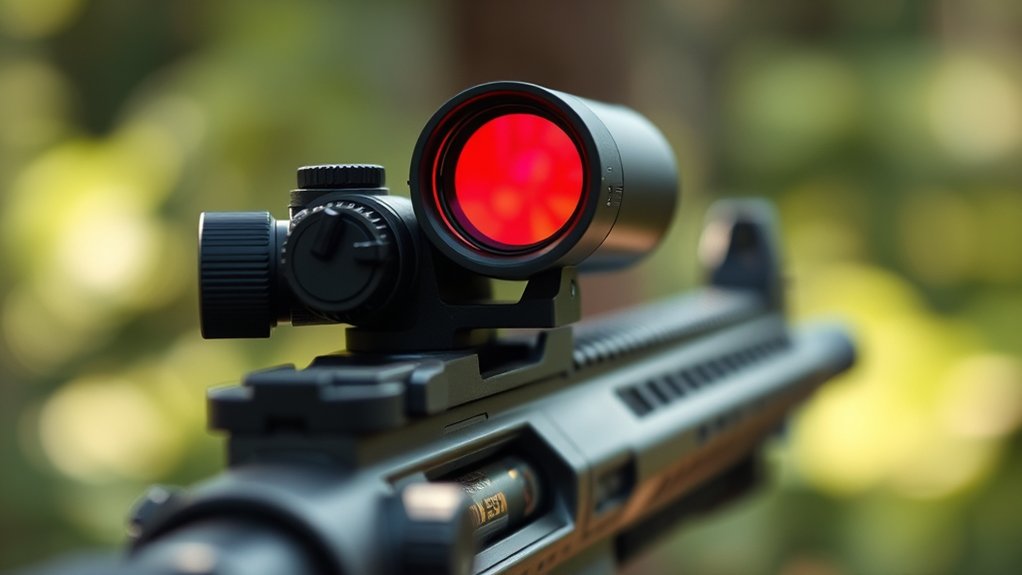
How does a red dot sight improve your aiming process? A red dot sight projects an illuminated aiming point onto a glass window, enabling rapid target acquisition without magnification. It uses a red LED positioned at the focus of collimating optics, creating a virtual reticle that appears at infinity.
This design guarantees the sight is parallax free at infinity, so you maintain accuracy regardless of your eye position. The reticle size typically ranges from 2 to 6 MOA, balancing precision with speed.
Because the aiming point remains aligned with your line of sight, you can quickly acquire targets across various firearms, including handguns, rifles, and shotguns.
The red dot sight’s simplicity and precision streamline your shooting, enhancing both speed and accuracy in diverse scenarios. It’s a straightforward tool that makes aiming easier and more efficient no matter what you’re using it on.
Top Features of Red Dot Sights
Although red dot sights appear simple at first glance, their top features combine advanced optics and user-focused design to enhance aiming performance. You’ll find an illuminated aiming point, typically between 2 to 6 MOA, optimized for rapid target acquisition.
The reticle sizes vary in MOA or milliradians, with smaller reticles offering precision and larger ones allowing quicker engagement.
Collimating optics paired with LED technology project a virtual red dot that remains aligned with the target regardless of your eye position. Adjustable brightness levels adapt to diverse lighting conditions, ensuring visibility from dawn to bright daylight.
Plus, some models use Mangin mirrors to minimize spherical aberration, which enhances image clarity and reticle sharpness.
All these features work together to improve your accuracy and speed, especially in dynamic shooting scenarios. It’s pretty impressive how much technology goes into something that looks so straightforward!
History of Red Dot Sights
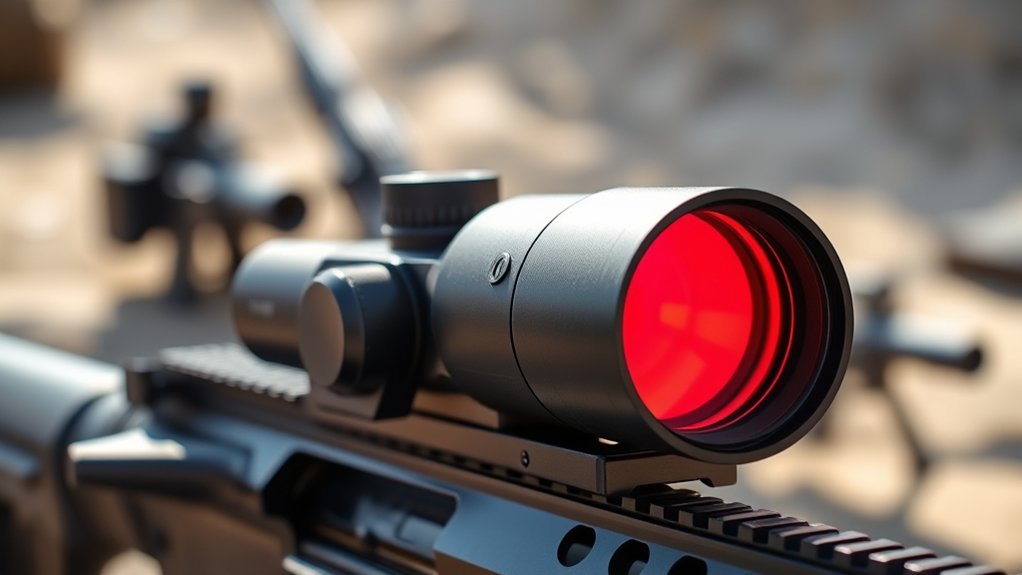
When did red dot sights first emerge, and what key innovations shaped their evolution? Red dot sights started development around 1900, initially using ambient light or battery-powered illumination for aiming. Early firearm accessories like the Nydar shotgun sight and Giese electric gun sight in the 1940s and 1950s laid the groundwork for electronic aiming devices.
A big milestone came in 1975 when Aimpoint AB introduced the first electronic red dot sight. They used LED technology and curved mirrors to project a clear reticle. This innovation really boosted aiming speed and accuracy.
By 2000, the U.S. military adopted Aimpoint’s CompM2 (M68) as a standard close combat optic. This showed how far red dot sights had come in terms of technology.
Over the decades, they evolved from bulky, expensive devices into compact, affordable firearm accessories that are widely used today.
How Reticle Sizes Affect Accuracy
Why does reticle size matter so much in aiming precision? Reticle size, measured in MOA, directly influences your accuracy and target acquisition speed.
A smaller reticle, like a 2 MOA dot, covers roughly 2 inches at 100 yards, allowing you to focus on fine details and make highly precise shots at long range.
Conversely, a larger reticle, such as a 6 MOA dot, spans about 6 inches at the same distance. This speeds up target acquisition but reduces pinpoint accuracy by obscuring more of the target.
When precision matters, especially at extended ranges, smaller reticle sizes provide superior accuracy.
But if rapid target acquisition in close quarters is your priority, larger reticles enhance visibility and speed, albeit at the expense of fine precision.
Balancing reticle size optimizes your shooting performance.
Common Mounting Types for Red Dot Sights
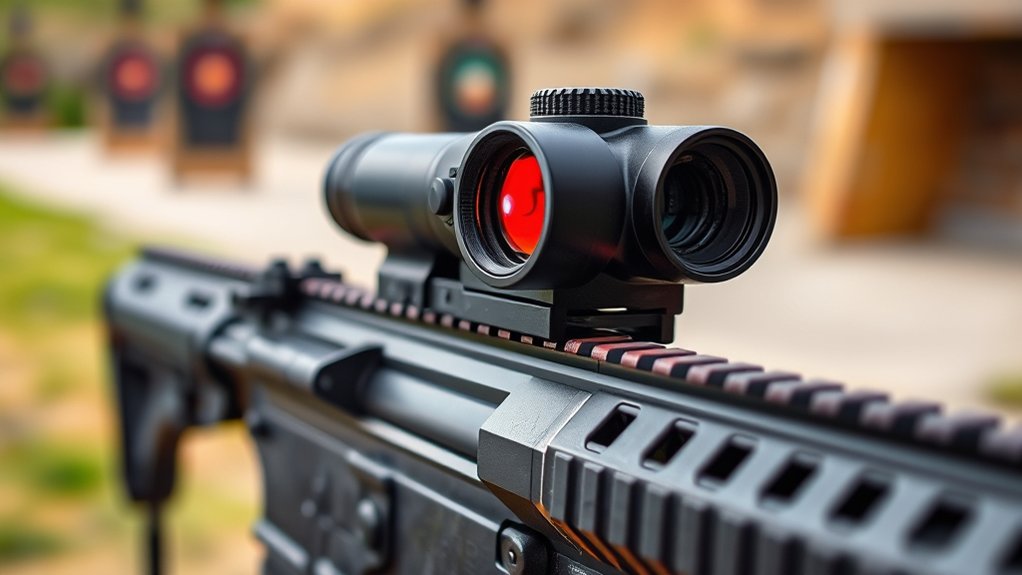
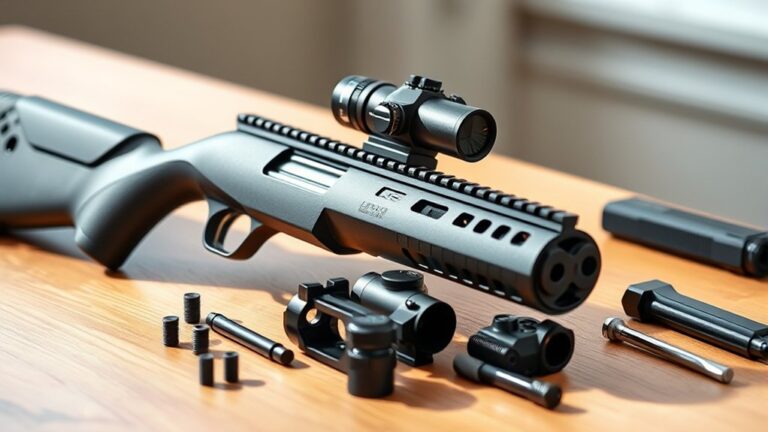
When you’re picking out a red dot sight, you’ll come across several mounting standards like the Aimpoint Acro rail, A-Cut, and Micro standard. Each one has its own unique dimensions and ways to attach.
It’s important to understand compatibility because proprietary footprints—like those from SIG Sauer and Holosun—often need specific adapters to fit properly.
Don’t worry, this section will break down these mounting types so you can easily figure out which sight works best for your firearm.
Mounting Standards Overview
How do you guarantee your red dot sight mounts securely and aligns perfectly with your firearm? Understanding mounting standards is critical.
Red dot sights use various systems like the Aimpoint Acro rail, which is a dovetail about 16.5mm wide. It works well with pistols, rifles, and shotguns.
The A-Cut standard has a wedge-shaped design for quick attachment. You’ll often find it in Aimpoint-Glock models.
Then there’s the Micro standard, established in 2007, which uses four screws and a cross slot. This one is great for rifles and shotguns.
Beyond these, there are proprietary footprints like SIG Sauer Romeo1 or Holosun Paralow. These require specific mounting adapters to fit and function properly.
Picking the right mounting standard and adapters ensures your red dot sight stays stable, keeps its zero, and performs its best in different conditions.
Compatibility And Footprints
Selecting the right mounting standard directly influences the compatibility between your red dot sight and firearm. Red dot sights use various mounting footprints like Aimpoint Acro rail, A-Cut, and Micro standard, which determine how they fit on specific firearm models.
For example, the Aimpoint Acro footprint features a 16.5mm dovetail design, making it ideal for pistols, rifles, and shotguns.
The Micro standard, common on modern rifles and shotguns, uses a four-screw cross slot to ensure a secure attachment.
There are also proprietary footprints such as SIG Sauer Romeo1 and Holosun Paralow. These require dedicated mounting plates or adapters to guarantee proper installation.
To make sure everything fits perfectly, you need to match the sight’s mounting footprint exactly to your firearm’s mounting system.
Or, use the correct mounting plates and adapters designed specifically for your firearm model.
Advantages of Red Dot Sights for Shooting
Because red dot sights eliminate the need to align traditional iron sights, you can acquire targets much faster and with greater precision.
The red dot sighting system streamlines target acquisition by projecting an illuminated reticle that remains parallax-free. This means the dot aligns perfectly with your target regardless of eye position.
This precision reduces eye strain and minimizes movement errors, making your shooting more consistent. Plus, the illuminated reticle offers clear visibility across varying lighting conditions, from low light to bright daylight.
At intermediate distances, typically up to 200 yards, red dot sights enhance accuracy markedly, especially when paired with smaller reticle sizes.
Adjusting Red Dot Brightness and Settings
Although red dot sights are designed for simplicity, adjusting their brightness and settings is crucial to maintain ideal visibility across different lighting conditions. You’ll find most red dots feature adjustable illumination levels, allowing you to increase brightness for fast target acquisition in bright daylight or decrease it for precision in low-light environments.
Adjusting red dot brightness is key for clear visibility in varying light conditions.
Many models include active controls like buttons or dials, while others use ambient light sensors to automatically adjust brightness based on surrounding lighting.
Some offer multiple brightness presets, enabling quick shifting between settings tailored to environment or distance. Proper calibration ensures the reticle remains clear without washing out or causing eye strain.
By mastering these settings, you optimize your sight’s performance and maintain consistent target clarity regardless of lighting variations. It might take a little practice, but once you get it right, your shooting experience improves a lot.
Maintaining Your Red Dot Sight
To keep your red dot sight performing reliably, you need to maintain it regularly by cleaning the lens, checking mounting screws, and replacing batteries as recommended. Start by cleaning the lens with a microfiber cloth and lens cleaner to remove dirt and smudges that impair visibility.
Periodically inspect and tighten mounting screws to ensure the sight remains securely zeroed. Replace the battery according to manufacturer guidelines, usually every 1 to 3 years, to avoid unexpected power loss.
Don’t overlook seals and O-rings; inspect them for wear to maintain water and dust resistance.
Proper maintenance extends the lifespan and accuracy of your sight. It really pays off in the long run.
- Use a protective case to prevent environmental damage and scratches.
- Perform lens cleaning in a dust-free environment.
- Document maintenance intervals and battery replacements for consistency.
Frequently Asked Questions
Can Red Dot Sights Be Used Effectively in Low-Light Conditions?
Yes, you can use red dot sights effectively in low-light conditions if you adjust the brightness properly. Many models offer night mode settings and compatibility with night vision devices, which really helps with visibility in the dark.
You’ll want to calibrate the brightness to avoid glare or a dot that’s too dim. It’s also important to keep your sight in good shape by cleaning the lenses and checking the batteries regularly.
High-quality coatings and bright LEDs make a big difference too, improving clarity when the light is low.
How Do Red Dot Sights Compare to Holographic Sights?
You’ll find red dot sights are lighter, more affordable, and offer longer battery life. They rely on LED illumination for reticle projection.
Holographic sights, however, provide superior image clarity, reduced parallax, and better reticle visibility in low-light or dynamic conditions because they use laser-based holograms.
Though heavier and pricier, holographic sights give you a wider field of view and enhanced precision.
They’re especially useful when rapid target acquisition and environmental adaptability are critical.
Are Red Dot Sights Waterproof and Fog-Resistant?
Yes, many red dot sights are waterproof and fog-resistant. They’re designed with sealed housings that can handle submersion depths ranging from about 20 to 66 feet.
Fog resistance is usually achieved by purging the inside of the tube with nitrogen or argon, which helps prevent internal condensation.
To keep these features working well, you’ll want to maintain the O-ring seals and clean your sight regularly.
It’s also a good idea to check the IPX or IP ratings to make sure the sight meets your specific waterproof and fog-resistant needs.
What Batteries Are Commonly Used in Red Dot Sights?
When it comes to power, you’ll find CR2032 lithium coin batteries are the bread and butter of red dot sights. They offer a compact size, stable voltage, and low self-discharge, often lasting 1 to 3 years.
Some models use CR1632 or AA batteries, while advanced sights might include solar or hybrid systems.
Battery life really depends on brightness and the model you choose. Top-tier units can deliver up to 50,000 hours of use on low settings.
Can Red Dot Sights Be Used on Shotguns or Rifles?
Yes, you can use red dot sights on shotguns and rifles by mounting them with appropriate plates or dovetail adapters. Many modern firearms come with optics-ready receivers for easy installation.
You’ll benefit from long eye relief and parallax-free aiming, which allows quick target acquisition.
Just make sure to choose the right reticle size for your shooting needs. Also, be certain of proper mounting and zeroing.
Advanced shock-resistant designs handle recoil effectively for reliable performance.
Conclusion
Just like a seasoned archer trusts their sight to hit the bullseye, you can depend on a red dot sight to enhance your precision and speed. Understanding its features, history, and adjustments guarantees you wield this tool effectively.
Whether mounting or maintaining it, your attention to detail will pay off in accuracy. Embrace the red dot sight as your modern-day guiding star in shooting, sharpening every shot with clarity and confidence.