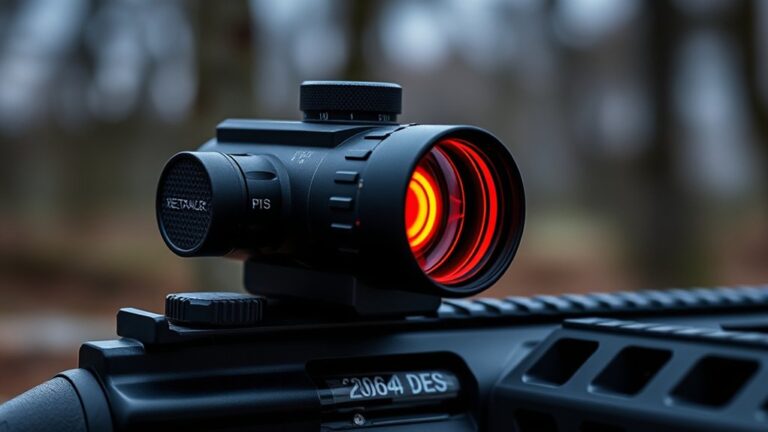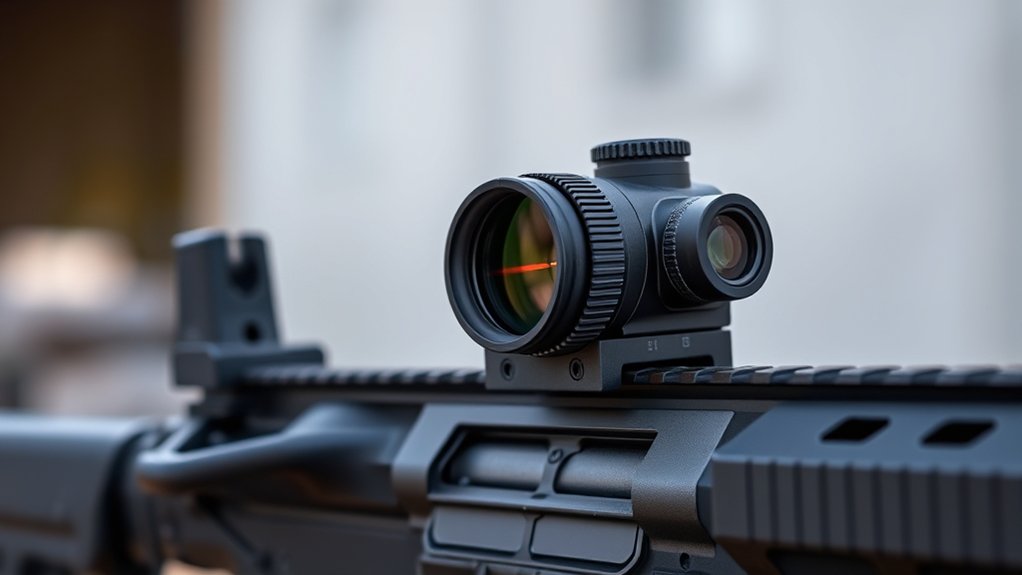
What Is A Closed Emitter Red Dot – Features And Benefits Explained
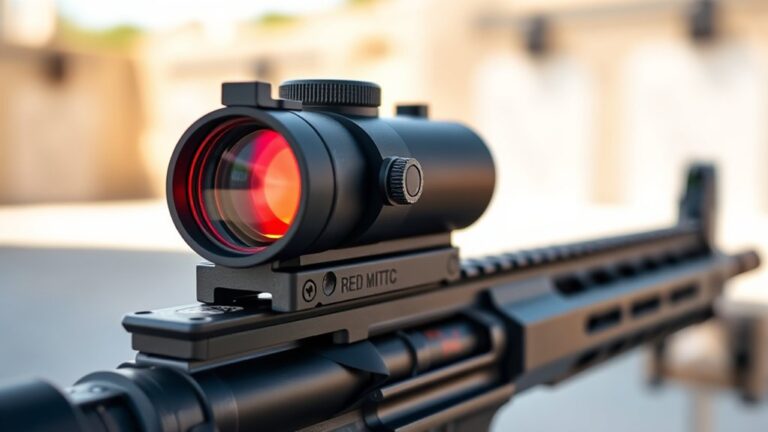
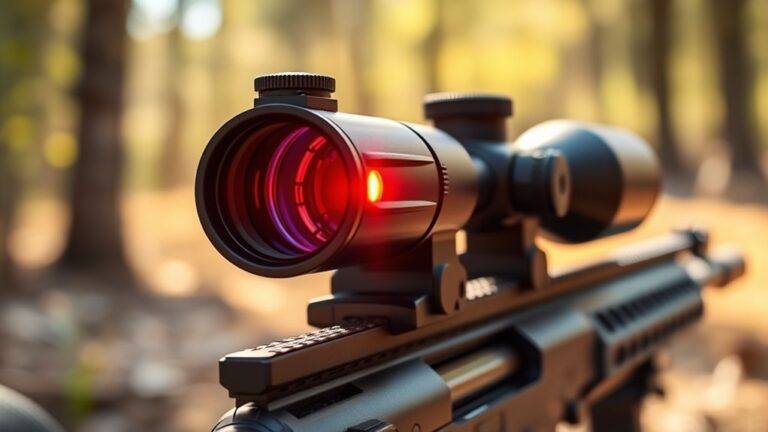
A closed emitter red dot fully encloses the LED within a sealed housing, protecting it from dirt, moisture, and debris. This design uses dual lenses to project a clear, reliable reticle, ensuring visibility even in harsh weather or fog. You’ll benefit from enhanced durability, reduced maintenance, and superior environmental resistance compared to open emitter sights.
While typically larger and heavier, these sights excel in demanding conditions. Explore further to understand compatibility, care, and performance optimization for your setup.
Key Takeaways
- Closed emitter red dots fully enclose the LED emitter inside a sealed housing, enhancing protection from dirt, water, and debris.
- They use dual lenses to project the reticle without exposing the emitter, ensuring clear visibility and preventing environmental interference.
- These sights offer superior durability, fogging resistance, and weatherproof reliability, ideal for demanding outdoor and tactical conditions.
- Closed emitter designs typically have larger footprints and require compatible holsters, impacting carry and mounting choices.
- Maintenance is minimal due to sealed construction, with benefits including improved impact resistance and consistent reticle performance.
How Closed Emitter Red Dot Sights Work
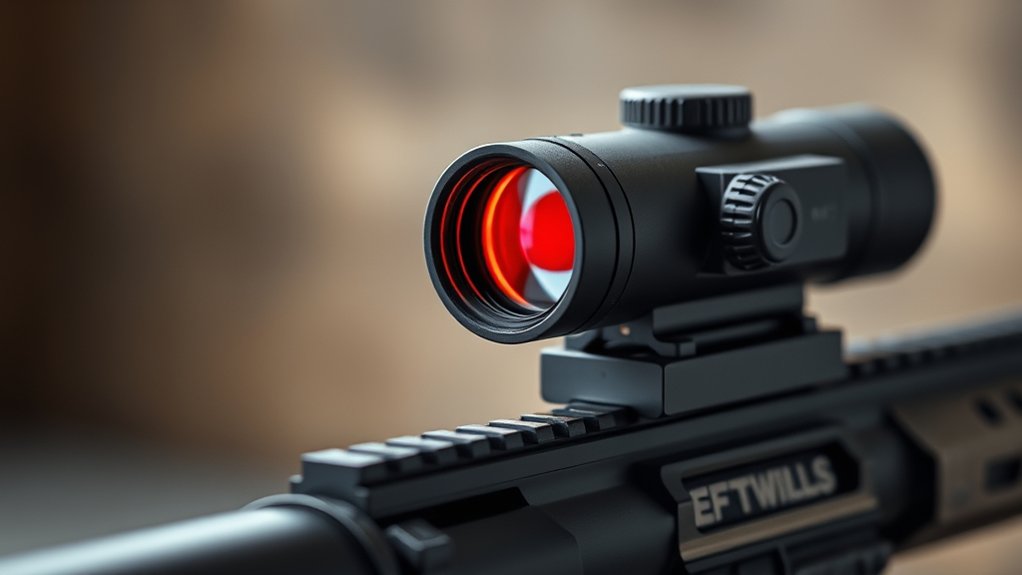
Although both open and closed emitter red dot sights project the aiming reticle onto the lens, closed emitter models fully enclose the LED or laser emitter within a sealed housing. This enclosed emitter sits inside a protective case that shields internal components from environmental hazards like dirt, water, and debris.
The system uses two lenses—a rear window and a front lens—to project the reticle onto the front lens without exposing the emitter. This design ensures the reticle stays visible by preventing any obstruction.
It also boosts environmental resistance, protecting against fogging, corrosion, and physical impact. By isolating sensitive parts, closed emitter sights stay durable and reliable even in tough conditions.
Comparing Closed and Open Emitter Red Dot Sights
You’ll notice that closed emitter red dots fully enclose the LED within a sealed housing.
On the other hand, open emitters expose the LED behind a single lens to keep things compact. This design difference really affects how they perform.
Closed emitters do a better job resisting dirt and moisture, which means they’re more reliable in tough environments.
Open emitters, however, tend to be lighter and can help you acquire targets faster. The trade-off is they’re more prone to getting obstructed by debris when conditions get demanding.
Design Differences Explained
When comparing closed and open emitter red dot sights, you’ll notice that the primary design distinction lies in how the LED or laser emitter is housed. A closed emitter fully encloses the diode within a robust protective casing, shielding internal components from environmental factors. This design incorporates dual lenses for precise reticle projection and enhanced durability.
On the other hand, open emitters expose the diode behind a single lens. This reduces weight but comes at the cost of some environmental protection. So, while you get a lighter sight, it might not hold up as well against debris or rough conditions.
| Feature | Closed Emitter | Open Emitter |
|---|---|---|
| Emitter Housing | Fully enclosed protective casing | Exposed behind a single lens |
| Lens System | Dual lenses for reticle projection | Single lens |
| Environmental Protection | High, shields internal components | Limited, vulnerable to debris |
| Durability | Enhanced due to sealed design | Less durable, more exposed |
Performance In Various Conditions
Understanding the design distinctions between closed and open emitter red dot sights sets the stage for evaluating their performance under varying environmental conditions.
The closed emitter design excels in environmental sealing, effectively preventing dust, dirt, and moisture ingress that commonly impair open emitters. This sealing guarantees superior fogging resistance and weatherproof reliability, maintaining a clear reticle in harsh conditions, including rain and high humidity.
Open emitter sights, on the other hand, are vulnerable to environmental interference. Rain can refract the dot, while dust and lint accumulate on the lens, degrading visibility.
Because of this, closed emitter red dots provide consistent, unobstructed performance across diverse temperature and weather scenarios.
Key Benefits of Closed Emitter Red Dot Sights
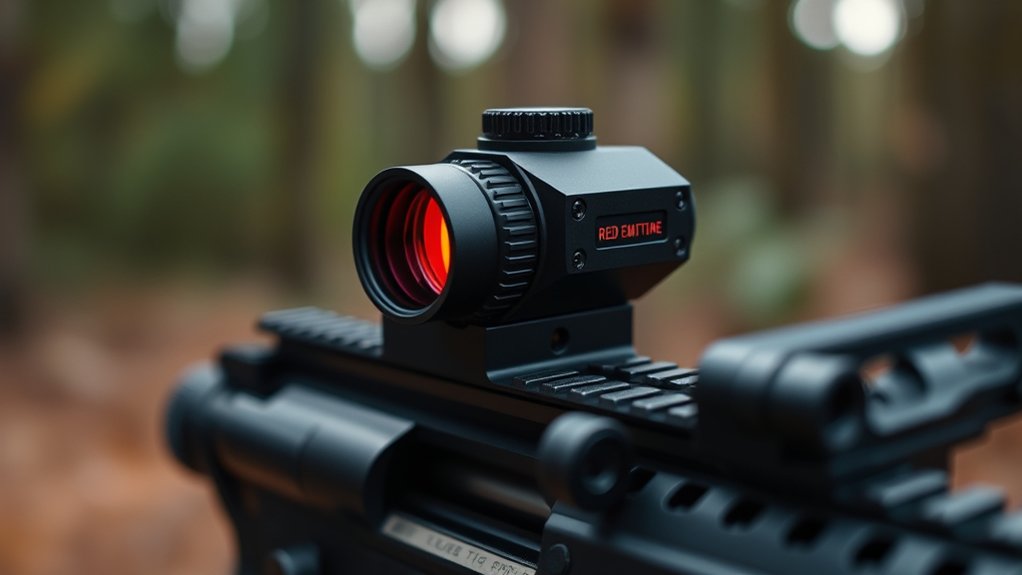
Although many red dot sights offer reliable performance, closed emitter models provide distinct advantages that enhance durability and functionality in demanding environments.
With a closed emitter, the LED is fully enclosed, ensuring superior environmental protection against dirt, water, and debris. This sealed construction considerably improves impact resistance and overall durability, allowing the sight to endure harsh conditions without performance degradation.
Plus, the enclosed design minimizes fogging and prevents internal lens contamination, which helps maintain consistent reticle visibility.
You’ll find closed emitter sights deliver enhanced reliability, making them ideal for tactical, hunting, and duty applications where exposure to environmental hazards is frequent.
How Closed Emitters Boost Durability and Weather Resistance
Closed emitter red dot sights achieve superior durability and weather resistance through their fully sealed housing. This design shields the LED or laser from contaminants like dirt, water, mud, and debris. Because of this, environmental elements don’t interfere with the aiming reticle, ensuring consistent optical clarity even in harsh conditions.
By minimizing internal lens fogging and contamination, the design extends the sight’s lifespan and keeps performance reliable. These sights also offer waterproof capabilities and enhanced shock resistance. That makes them highly durable for rugged tactical and outdoor use.
You can count on closed emitter red dots to perform well in rain, snow, mud, and extreme environments. Their engineered weather resistance and robust construction protect critical components from damage and degradation. So, they’re built to last and ready for whatever you throw at them.
Maintenance and Cleaning Tips for Closed Emitter Red Dot Sights
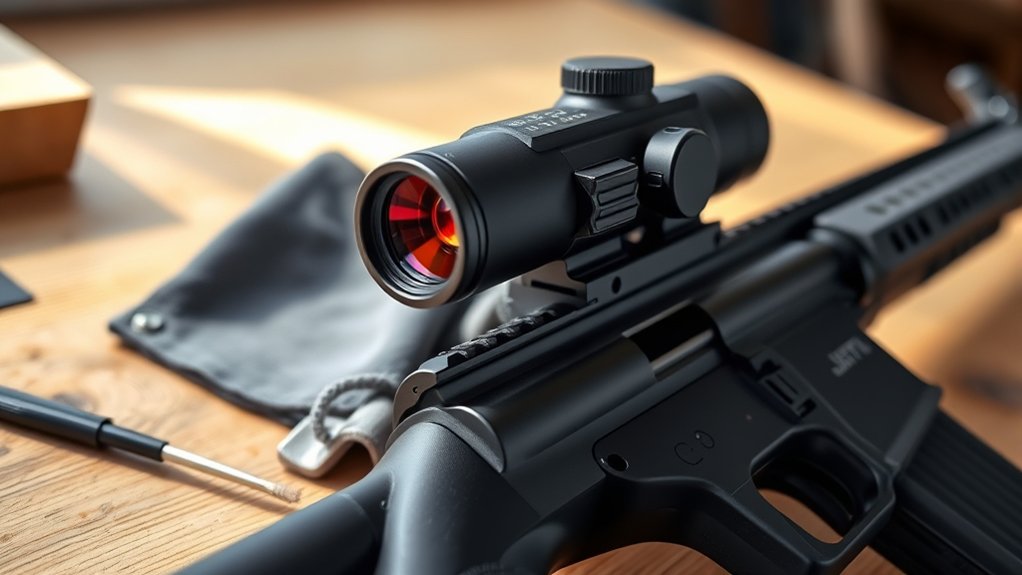
When maintaining your emitter red dot sight, regularly inspect the seals and gasket integrity. This helps prevent moisture ingress and internal fogging. Any compromise in these barriers can lead to condensation that affects optical clarity.
Use a soft, lint-free cloth with an appropriate lens cleaner to gently remove dirt and oils from the lens. Avoid abrasive materials that might scratch the sealed glass surface.
Gently clean lenses with a soft, lint-free cloth and lens cleaner; avoid abrasives to prevent scratches.
Make sure to replace the battery periodically to keep the brightness consistent. This ensures reliable sight function in all conditions.
Also, check that all screws and mounting hardware stay tightly secured to preserve zero and improve durability.
Following these maintenance tips will maximize your closed emitter red dot’s performance. It also helps extend its lifespan and protects it from environmental damage.
How to Choose the Best Closed Emitter Red Dot for Your Firearm
Since your firearm’s compatibility directly affects performance, you should start by verifying the mounting footprint, whether it matches ACRO, RMR, DeltaPoint, or other patterns. Next, assess durability factors like waterproofing, shock resistance, and fog-proof design to guarantee reliability under harsh conditions.
Analyze reticle options such as 3.3-MOA, 4-MOA, or multi-reticle systems tailored to your target acquisition needs. Battery life is critical; models offering up to 50,000 hours reduce maintenance frequency. Finally, consider size and weight for ideal concealment and maneuverability.
| Factor | Key Considerations | Impact |
|---|---|---|
| Mounting Footprint | ACRO, RMR, DeltaPoint patterns | Ensures secure fit |
| Durability | Waterproof, shock, fog-proof | Enhances operational life |
| Reticle Options | Dot size, multi-reticle systems | Precision and speed |
| Battery Life | Up to 50,000 hours | Long-term reliability |
| Size and Weight | Compactness, lightness | Concealment, tactical use |
Holster Compatibility for Closed Emitter Red Dot Sights
Selecting the right closed emitter red dot sight involves more than just matching the optic to your firearm; holster compatibility plays a big role in keeping your carry secure and your draw quick.
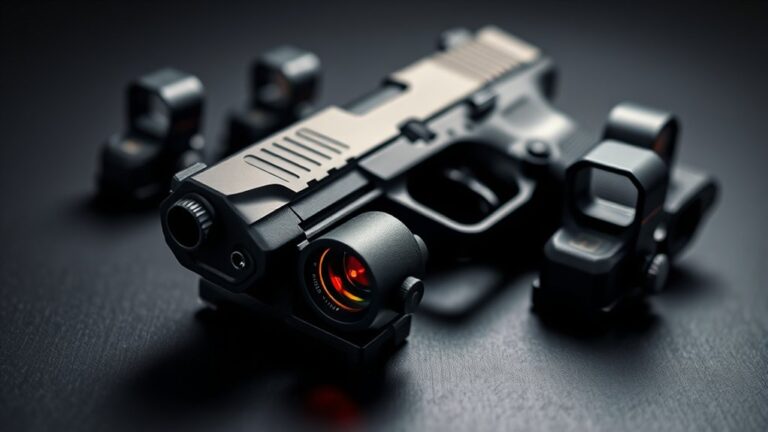
Modern holsters are increasingly designed to fit closed emitter red dot sights, especially those with larger footprints. But remember, holster fit really depends on the size and shape of your optic.
Holsters today often accommodate closed emitter red dots, but exact size and shape remain crucial for proper fit.
For example, holsters like the Safariland 7TS have extra-large covers made for bigger closed emitter red dots, which helps keep your carry secure. It’s important to check if your holster is compatible before upgrading your sight.
Older holsters often need modifications or even replacement.
Matching your holster to your red dot’s exact dimensions preserves retention and makes sure you can access your firearm quickly. So, holster compatibility is definitely a key factor when setting up your closed emitter red dot.
Common Drawbacks of Closed Emitter Red Dot Sights and Solutions
Although closed emitter red dot sights offer enhanced protection against environmental debris and reduce maintenance, they do come with several drawbacks that users should consider. You might notice increased weight and bulk, which can make carry and concealment more complicated. Adjustment buttons are sometimes small or awkward, making quick brightness changes a bit tricky.
Also, the cost is often higher compared to open emitter models, and mounting may require specialized adapters. These are things to keep in mind when deciding if a closed emitter sight is right for you.
| Drawback | Solution |
|---|---|
| Increased weight | Choose lightweight models |
| Adjustment buttons | Practice adjustments pre-use |
| High cost | Evaluate budget vs. necessity |
| Mounting issues | Use appropriate adapters |
Understanding these trade-offs helps you optimize your closed emitter red dot sight’s performance while minimizing inconveniences. It’s all about finding the balance that works best for your needs.
Frequently Asked Questions
Can Closed Emitter Red Dots Be Used With Night Vision Devices?
Yes, you can use closed emitter red dots with night vision devices, but you need to make sure the sight offers adjustable brightness to very low levels that work with NVGs.
Look for specific night vision modes or infrared emissions that won’t wash out your reticle.
The sealed design helps keep things reliable in tough conditions.
Still, always check the manufacturer’s specs for NVG compatibility before you rely on it in low-light or tactical situations. It’s better to be safe than sorry!
What Is the Typical Battery Life of Closed Emitter Red Dot Sights?
Battery life for closed emitter red dot sights typically ranges from 13,000 to over 50,000 hours, depending on the model and settings. You’ll find models like the Steiner MPS lasting around 13,000 hours, while the Aimpoint ACRO P-2 can stretch up to eight years on medium brightness.
Features like auto-brightness and shake awake tech help squeeze extra hours. Just keep in mind, higher brightness drains the battery faster, so plan replacements accordingly.
It’s all about balancing your needs with how long you want the sight to last.
Are Closed Emitter Sights Compatible With Prescription Shooting Glasses?
Yes, closed emitter sights generally work well with prescription shooting glasses. Their enclosed design helps reduce glare and refraction, so you get a clear reticle through your lenses.
If your glasses have thick or unusual lenses, though, you might need to tweak the sight’s mounting or adjust the eye relief.
Manufacturers usually design these sights with a generous eye box to comfortably fit glasses.
Still, it’s a good idea to test the sight with your specific eyewear or check with the manufacturer. That way, you can be sure everything works perfectly for you.
Do Closed Emitter Red Dots Affect Firearm Balance or Weight Significantly?
Balance and weight shifts whisper subtly when you add a closed emitter red dot. You won’t notice a dramatic change since these optics generally add just 1.8 to 3.5 ounces.
However, on ultra-light firearms, that small weight can slightly alter balance and feel.
You’ll find handling and recoil remain mostly unaffected. But for precision or concealed carry, choosing a compact model helps maintain ideal firearm balance and maneuverability.
Can Closed Emitter Red Dot Sights Be Zeroed for Long-Range Shooting?
Yes, you can zero closed emitter red dot sights for long-range shooting by carefully adjusting windage and elevation turrets.
Their enclosed design helps maintain zero by protecting internal components from environmental shifts.
To achieve precise alignment at extended distances, follow manufacturer guidelines on target range and adjustment increments.
Remember, smaller reticle sizes improve precision.
Also, secure mounting on a stable platform is essential to prevent zero drift during long-range engagements.
Conclusion
Choosing a closed emitter red dot sight is like locking in precision under a protective vault. You’ll benefit from enhanced durability, weather resistance, and consistent performance, even in harsh conditions.
While they may have minor drawbacks, understanding their design and maintenance guarantees you’re equipped for reliability. By weighing features carefully, you’ll select a sight that truly elevates your firearm’s accuracy and resilience.
This makes every shot count with technical confidence and tactical advantage.