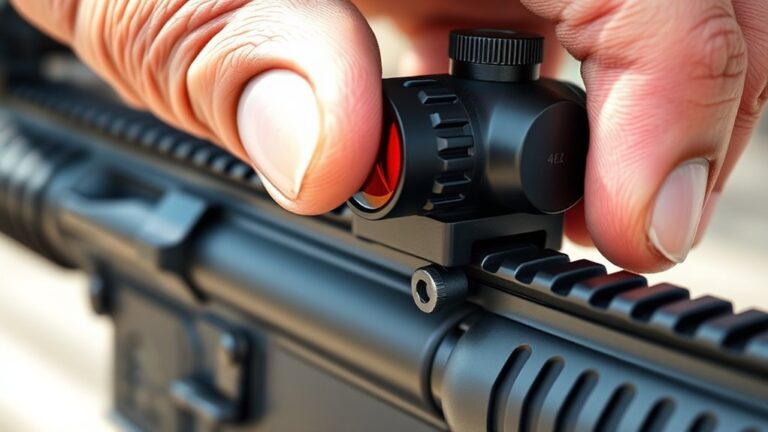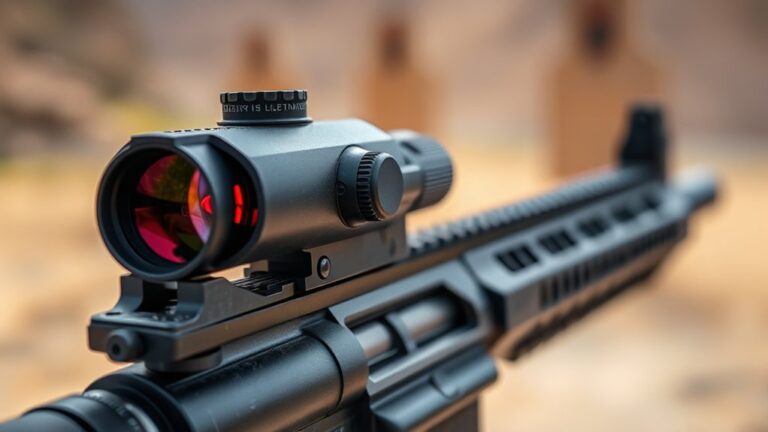
What Distance To Zero Pistol Red Dot – Recommended Zeroing Distances
You should zero your pistol red dot where it best matches your shooting needs. For close-range defense, zeroing at 10 yards keeps your shots within critical zones during rapid fire.
The most popular choice is 15 yards. It offers a balanced, flat trajectory with minimal adjustments out to 25 yards.
If you need longer-range precision, 25 yards flattens bullet drop and reduces holdovers further. Keep following to discover how to select and perfectly zero your sight.
Key Takeaways
- Zeroing at 10 yards is ideal for close-range home defense and rapid target acquisition within confined spaces.
- A 15-yard zero is most popular, balancing close-quarters and moderate-range accuracy with minimal holdover adjustments.
- Zeroing at 25 yards flattens bullet trajectory, improving mid-range accuracy and reducing windage and holdover needs.
- Shorter zero distances create steeper bullet trajectories, requiring more holdover for targets beyond the zero range.
- Regular zeroing maintenance is essential after recoil or equipment changes to maintain alignment and shooting confidence.
What It Means to Zero a Pistol Red Dot and Why It Matters
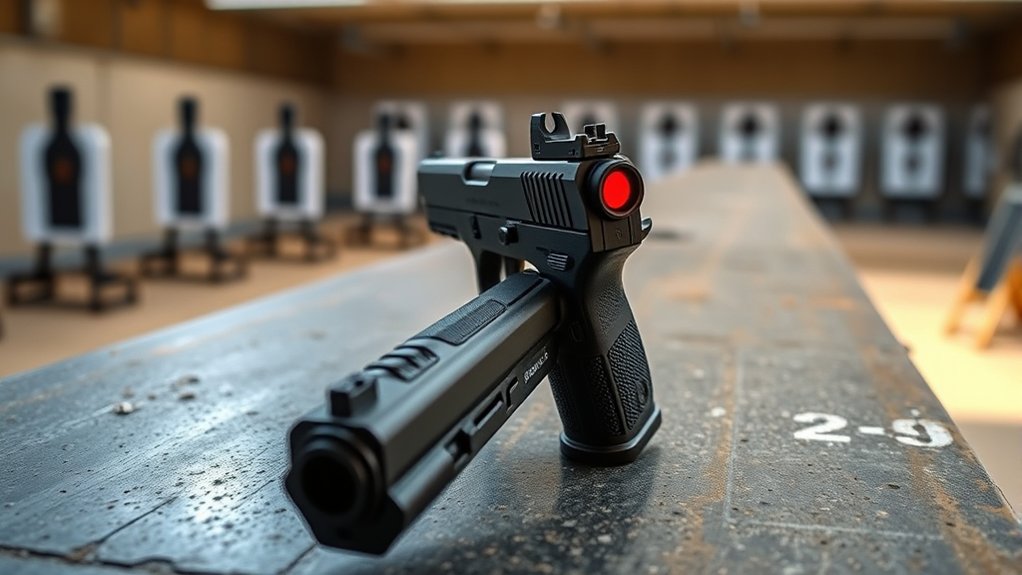
When you zero a pistol red dot, you align its reticle with the bullet’s point of impact at a specific distance. This guarantees your shots land exactly where you aim. Zeroing is vital because it matches your red dot’s point of aim to where the bullet actually strikes, eliminating guesswork.
Zeroing a pistol red dot ensures your reticle aligns perfectly with the bullet’s impact, guaranteeing precise shots.
You’ll find typical zero distances range from 10 to 25 yards, each suited for different shooting scenarios. Proper zeroing boosts your confidence, sharpens accuracy, and speeds up target acquisition. This is true whether you’re shooting defensively or competitively.
Remember to maintain your zero by regularly checking and adjusting it, especially after recoil or equipment changes.
Mastering zeroing at the right distances ensures your pistol red dot performs exactly as intended every time you pull the trigger.
How Bullet Trajectory Influences Your Zero Distance
Since bullet trajectory changes as distance increases, choosing the right zero distance directly affects where your rounds land relative to your point of aim. You’ll notice that a shorter zero distance creates a steeper trajectory curve, causing impact points to rise above your aim at longer engagement ranges. This often means you have to use holdovers.
Conversely, zeroing farther out flattens the trajectory, aligning impact points closer to your aim over more distances.
| Zero Distance (yards) | Bullet Impact Behavior |
|---|---|
| 10 | Hits high beyond zero, more holdovers needed |
| 15 | Flatter trajectory, moderate holdovers |
| 20 | Balanced trajectory, fewer holdovers |
| 25 | Flattest trajectory, minimal holdovers |
| 30+ | Bullet drop significant, requires adjustment |
Understanding bullet trajectory helps you pick a zero distance that matches your engagement ranges and reduces holdovers. It’s all about finding that sweet spot for your shooting needs.
Zeroing at 10 Yards: Pros and Cons for Close-Range Defense
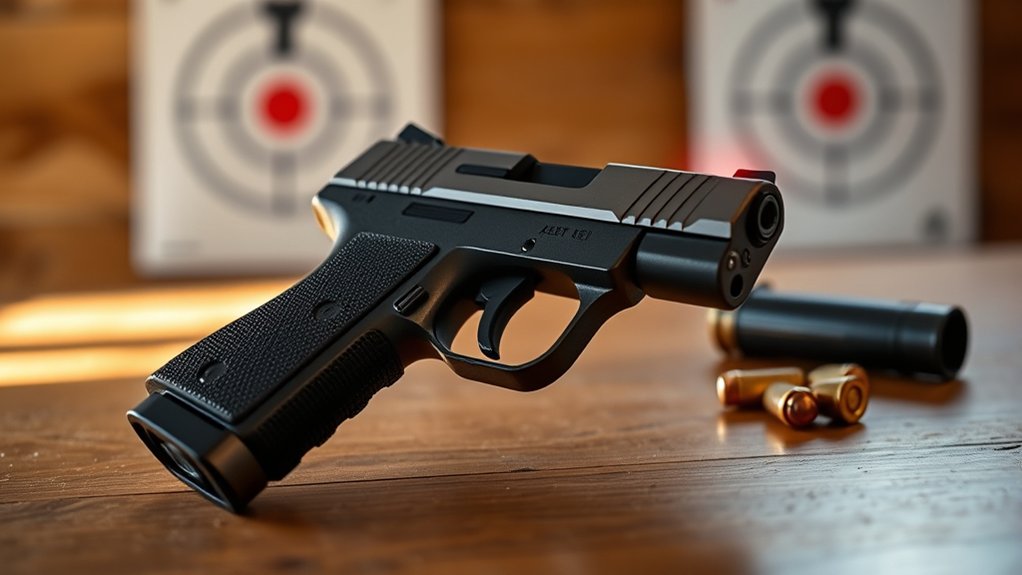
Although zeroing your pistol red dot at 10 yards limits ideal accuracy beyond close range, it offers quick, dependable shot placement where it matters most, in self-defense situations inside your home.
Zeroing at 10 yards ensures your bullet impact stays centered within the crucial zone, maximizing effectiveness in close-range defense. This zero distance simplifies aiming during rapid shooting and reduces the need for holdovers.
Consider these key points:
- Provides reliable shot placement for home defense within 15 yards.
- Minimizes adjustments during rapid shooting in tight spaces.
- Bullet impact remains consistent at this zero distance.
- May require compensation beyond 10 yards for precise shot placement.
Zeroing at 10 yards is especially practical for beginners focused on close-range defense. It’s a straightforward way to get consistent results where it counts most.
Why 15 Yards Is the Most Popular Zero Distance
Zeroing your pistol red dot at 15 yards strikes the ideal balance between close-quarters effectiveness and accuracy at moderate distances.
When zeroing a red dot at this range, you achieve an impact point that stays within 0.2 inches of your point of aim up to 25 yards. This 15-yard zero means your shots remain consistently accurate with minimal bullet rise or drop.
That’s essential for close-range shooting and typical self-defense scenarios. Using a Red Dot Pistol zeroed here simplifies training and real-world use by reducing the need for holdover adjustments.
It’s no wonder the 15-yard zero is the most popular choice, offering you reliable, straightforward performance across a broad range of practical distances.
When and Why to Zero at 25 Yards
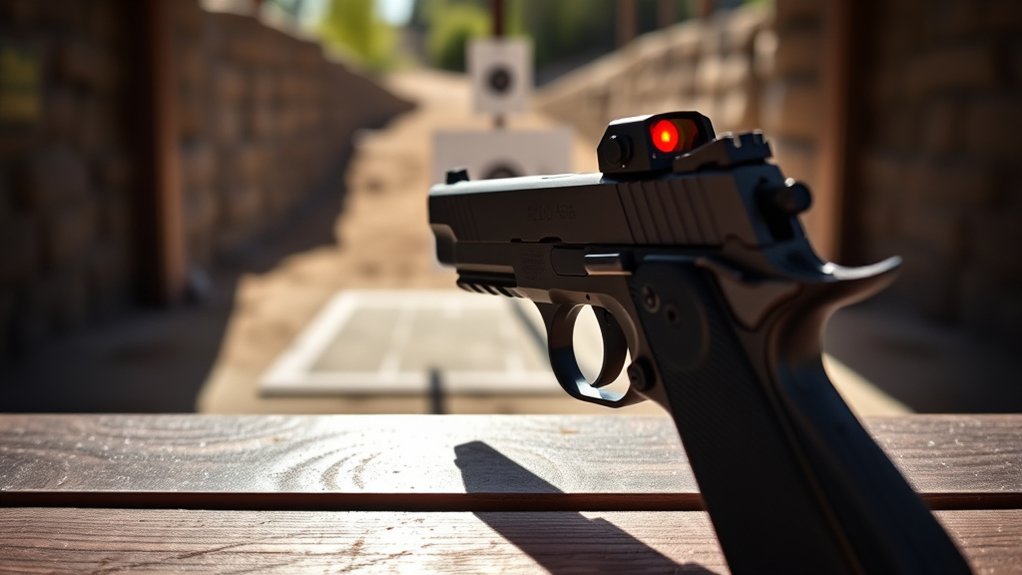
When you need flatter trajectories and greater precision at longer distances, setting your pistol red dot to zero at 25 yards is the smart choice. Zeroing at 25 yards enhances accuracy for mid-range shots by minimizing bullet drop and ensuring consistent impact points.
This zero distance suits duty, competition, and advanced training where longer engagements occur.
Here’s why zeroing at 25 yards benefits you:
- Provides a flatter trajectory that improves shot placement beyond close range.
- Results in impacts only inches high at 50 yards, aiding precise follow-up shots.
- Reduces holdover and windage adjustments, simplifying aiming at varied distances.
- Optimizes accuracy for scenarios demanding reliable mid-to-long range performance.
Choose 25 yards when your shooting needs demand dependable impact and trajectory control at extended distances. It’s a solid choice for anyone serious about accuracy beyond the close range.
How to Choose the Right Zero Distance for Your Shooting Needs
Since your shooting scenarios vary, picking the right zero distance depends on where and how you’ll use your pistol most often. When choosing the right zero, consider your typical engagement ranges and proficiency.
For close-quarters, a 10-yard zero distance aligns your point of aim with impact. It’s ideal for home defense.
A 15-yard zero offers a balanced setup, suitable for both self-defense and training. It helps ensure your shots hit consistently.
If your shooting scenarios include longer distances or precision work, zeroing at 25 yards makes more sense. Though, it’s less practical for close-range use.
Step-by-Step Guide: How to Zero Your Pistol Red Dot
Although it may seem straightforward, properly zeroing your pistol red dot requires careful attention to detail and a methodical approach. The zeroing process assures your red dot sights are aligned for accurate pistol engagements at your chosen zero distance.
Follow these steps:
- Secure your pistol in a stable rest to maintain consistent aim.
- Align the red dot with the point of impact at your preferred zero distance, such as 15 yards.
- Fire a 3-5 shot grouping to evaluate shot grouping relative to the reticle.
- Adjust windage and elevation incrementally based on your shot grouping, then confirm by firing additional groups.
This precise process guarantees your pistol red dot delivers consistent accuracy when it counts. Just take it step by step, and you’ll have it dialed in before you know it.
Essential Tools and Tips for Accurate Zeroing
To achieve precise zeroing, you’ll need the right tools and a steady setup to keep your pistol perfectly still. Use a stable shooting rest, sandbags, or a vice to eliminate movement during your zeroing process.
Start at a close zeroing distance, such as 5 or 10 yards, to check your initial impact point before moving to your preferred range.
Begin zeroing at a short range like 5 or 10 yards to verify your initial shot placement.
Employ the manufacturer’s zeroing tools, usually a flathead or hex key, to make accurate red dot adjustments.
Record every shot’s impact point alongside your incremental changes to efficiently fine-tune alignment.
Consistently applying these tips ensures repeatable, accurate zeroing and maximizes your pistol’s performance under real shooting conditions.
Frequently Asked Questions
Can Different Ammunition Types Affect My Red Dot Zero?
Yes, different ammunition types can affect your red dot zero. Variations in bullet weight, velocity, and powder charge change your bullet’s trajectory and point of impact.
If you zero your red dot with one ammo type but shoot another, you’ll likely see shifts in accuracy.
Always zero your optic with the exact ammo you plan to use. And make sure to regularly verify your zero to keep consistent precision.
This way, you avoid surprises at the range or in the field.
How Often Should I Re-Zero My Pistol Red Dot?
Think of your pistol red dot like a lighthouse guiding your shots through fog. You should re-zero it every 500 to 1,000 rounds or whenever your shots stray from the bullseye.
Don’t wait—re-zero after any maintenance or if you notice changes in shot placement.
Environmental shifts and impacts can throw it off, so regular checks keep your aim sharp and your confidence unshaken when it counts most. It’s a simple step that makes a big difference.
Just keep an eye on it, and you’ll stay on target.
Does Ambient Lighting Impact Red Dot Zeroing Accuracy?
Yes, ambient lighting directly impacts red dot zeroing accuracy. When you zero your pistol in bright, consistent light, you’ll see the reticle clearly and make precise adjustments.
In low light or with glare, the dot can blur or shift, causing errors.
Sudden changes in lighting demand recalibration to maintain accuracy. Always zero your red dot in the lighting conditions you expect to shoot in for reliable performance.
It really makes a difference when you match the setup to your shooting environment.
Can Red Dot Zeroing Be Done Effectively Indoors?
Yes, you can zero your red dot indoors using a stable rest, proper lighting, and a close-range target.
You’ll set up at 10 or 15 yards, use a laser boresight or grid-marked target, and make precise adjustments.
You’ll confirm zero quickly and fine-tune your sight before heading outside.
Just keep your shooting consistent and control lighting and stability to replicate outdoor accuracy effectively.
How Does Pistol Barrel Length Influence Zero Distance?
Your pistol’s barrel length directly affects your zero distance because it changes the bullet’s velocity and trajectory.
Longer barrels boost velocity, allowing you to zero farther out with a flatter trajectory.
Shorter barrels reduce velocity, causing more drop.
So, you’ll want a closer zero for better accuracy.
Always adjust your zero when switching barrels to match the altered bullet path.
This way, your red dot stays precise at your chosen distance.
Conclusion
Zeroing your pistol red dot is like tuning a fine instrument. It guarantees every shot hits the right note. Whether you choose 10, 15, or 25 yards, the key is aligning your aim with your purpose.
Remember, just as a skilled archer adjusts for wind and distance, you need to tailor your zero to your shooting needs. With careful zeroing, you’ll wield precision and confidence. You’ll be ready for whatever target lies ahead.