How To Sight In Red Dot Scope – Zeroing Guide For Accuracy
To sight in your red dot scope, securely mount it using the proper rings and torque settings to maintain zero. Choose a zeroing distance that fits your shooting needs. Typically, that’s 25 yards for pistols or 50+ yards for rifles.
Make precise adjustments using MOA clicks while firing groups, aligning the red dot with your point of impact. Fine-tune and regularly check your zero to stay accurate.
Keep consistent habits and equipment maintenance to guarantee reliable shots long-term. More detailed techniques can help refine your accuracy further.
Key Takeaways
- Securely mount the red dot sight using quality mounts and follow manufacturer torque specs to maintain zero during use.
- Select an appropriate zeroing distance based on firearm type, typically 25 yards for pistols and 50-100 yards for rifles.
- Use small, incremental turret adjustments (e.g., 1/4 MOA per click) to align the red dot with the point of impact.
- Fire groups, measure shot placement, and fine-tune elevation and windage until shots consistently hit the target.
- Regularly verify zero after shooting sessions, environmental changes, or handling, and document settings for consistent accuracy.
What Is a Red Dot Sight? Why Zeroing Matters
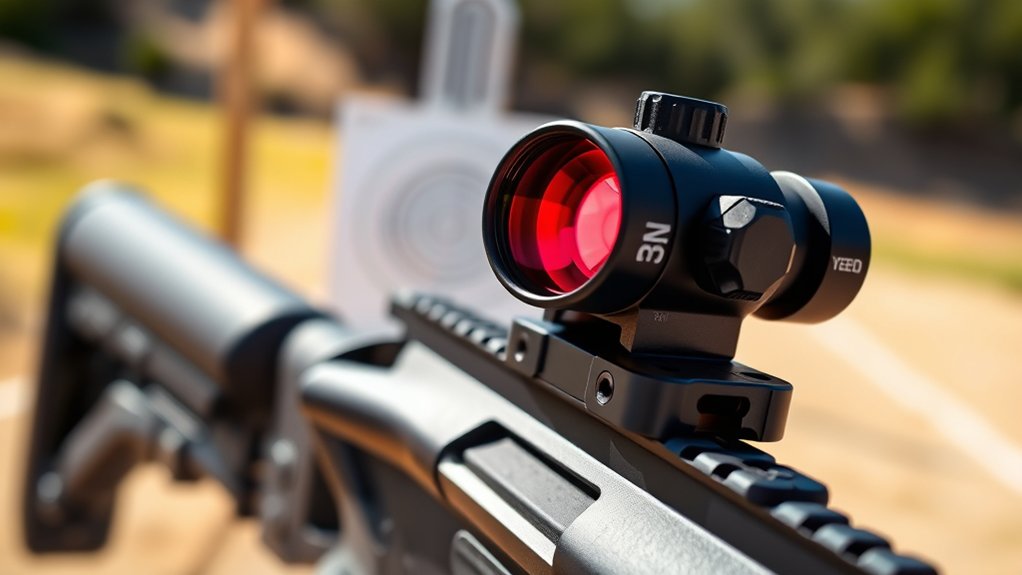
Although you might already be familiar with traditional sights, a red dot sight offers a distinct advantage by projecting an illuminated red dot onto a single focal plane lens. This lets you keep your focus on the target without shifting your eyes. Pretty neat, right?
This design lets you quickly acquire and aim with precision, as the red dot overlays your view unobstructed. However, to maximize accuracy, zeroing your red dot sight is essential.
Zeroing aligns the red dot with your firearm’s point of impact at a specific distance, ensuring your shots land exactly where you intend. Without proper zeroing, your aim may be off, reducing effectiveness.
How to Mount Your Red Dot Sight Securely
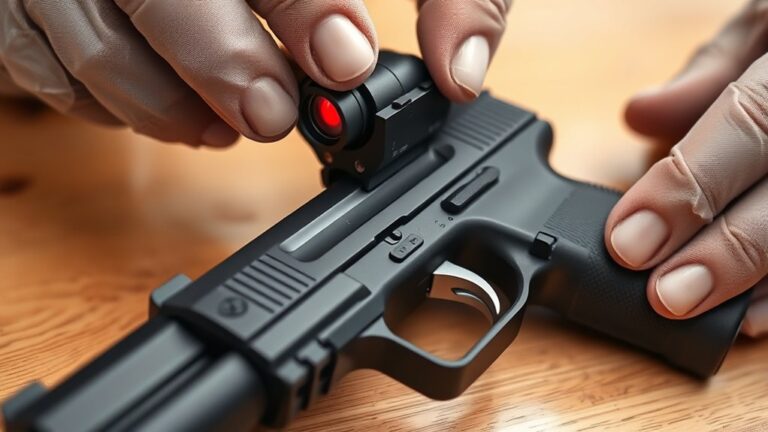
To mount your red dot sight securely, start by choosing high-quality rings or mounts that fit your weapon’s rail system perfectly. It’s important to get the right fit so everything stays stable.
Next, tighten the screws incrementally in a crisscross pattern using a torque wrench. Try to follow the manufacturer’s recommended torque to avoid damaging your gear. This way, you make sure everything is snug but not over-tightened.
Also, applying blue Loctite on the screws is a smart move. It helps keep them tight even when you’re dealing with recoil and vibrations, so your sight won’t shift unexpectedly.
Mounting Hardware Torque
When mounting your red dot sight, you need to tighten the screws with a torque wrench set to the manufacturer’s recommended range, usually between 15 and 20 inch-pounds.
Use a calibrated torque wrench to evenly tighten all mounting screws, ensuring consistent pressure that prevents loosening during recoil or handling.
Apply a small amount of blue Loctite to each screw before tightening. This secures them further and helps maintain your zero over time.
Avoid over-tightening, as it can strip threads or damage the mount, which could mess up sight alignment and zeroing accuracy.
Proper torque is critical for maintaining a stable zero, so follow the specs precisely.
Using the right technique with your torque wrench and blue Loctite guarantees your red dot sight stays firmly in place and performs reliably.
Secure Attachment Techniques
Securing your red dot sight properly starts with choosing high-quality mounts and tightening the screws to the manufacturer’s recommended torque, usually between 15 and 20 inch-pounds.
Apply blue Loctite threadlocker to the mounting screws before installation to guarantee a secure attachment and minimize loosening from recoil or vibration.
Use spacers as needed to maintain proper alignment, and mark the screws with red paint or additional threadlocker to easily monitor any movement over time.
Make sure your sight is mounted level and aligned with the bore for accurate initial zeroing.
After each shooting session or rough handling, regularly check and re-torque the mounting screws according to torque specifications to preserve a stable and secure attachment.
This helps ensure consistent accuracy every time you use your sight.
How to Choose the Right Zeroing Distance for Your Red Dot Sight
You’ll want to pick a zeroing distance that matches where you usually shoot and the type of firearm you’re using.
For pistols, zeroing at around 25 yards often works best.
On the other hand, rifles usually do better with a zero at 50 yards or even farther.
Knowing these little details helps make sure your red dot sight hits exactly where you’re aiming every time.
Selecting Optimal Distance
Although selecting the right zeroing distance might seem straightforward, it considerably impacts your red dot sight’s effectiveness. Choosing the ideal zero distance ensures your aiming point matches the bullet’s trajectory within your typical shooting range, improving target acquisition and accuracy.
Keep these factors in mind: match zero distance to your firearm and use—pistols at 25 yards, rifles at 50 yards or more.
Opt for longer distances (like 100 yards) for precision shooting and extended range. Shorter distances reduce holdover in close-quarters scenarios.
Also, factor in ballistic considerations and environmental conditions for consistent performance.
It’s a good idea to use initial close-range zeroing or laser bore sights to verify alignment before making final adjustments.
This approach guarantees your red dot sight performs accurately where it matters most.
Factors Influencing Zeroing
When choosing the right zeroing distance for your red dot sight, consider your firearm type, typical shooting range, and intended use. The zeroing distance directly impacts sight alignment and accuracy. It’s influenced by your ammunition’s ballistic trajectory.
Pistols usually zero at 25 yards, which is ideal for close-range shooting distances. Rifles often zero at 50 yards, balancing short and medium-range engagements. For precision or longer-distance shooting, zeroing at 100 yards offers a versatile point of aim.
Start by establishing a baseline zero using laser bore sights or at shorter distances (7-25 yards) before fine-tuning.
Selecting the proper zeroing distance guarantees your red dot sight compensates for bullet drop and maximizes hit probability across expected shooting distances.
Understanding these factors will optimize your sight alignment and overall accuracy.
What MOA Means and How to Adjust Your Sight
Because MOA, or Minute of Angle, measures the angular distance that translates to roughly one inch at 100 yards, comprehending it’s essential for precisely adjusting your red dot scope.
Understanding MOA is key to accurately adjusting your red dot scope for precise shooting.
MOA lets you calculate how much to move your impact point by turning the turret dials on your sight.
When you zero your red dot, each click corresponds to a fraction of an MOA, often 1/4 MOA, shifting your point of aim accordingly.
Keep in mind:
- One MOA equals about 1 inch at 100 yards
- At 200 yards, 1 MOA shifts the impact point roughly 2 inches
- Turret clicks translate to fixed MOA adjustments
Use MOA to compensate for bullet drop and windage.
Accurate MOA adjustments ensure your red dot zero is precise and reliable.
Step-by-Step Zeroing Your Red Dot Sight
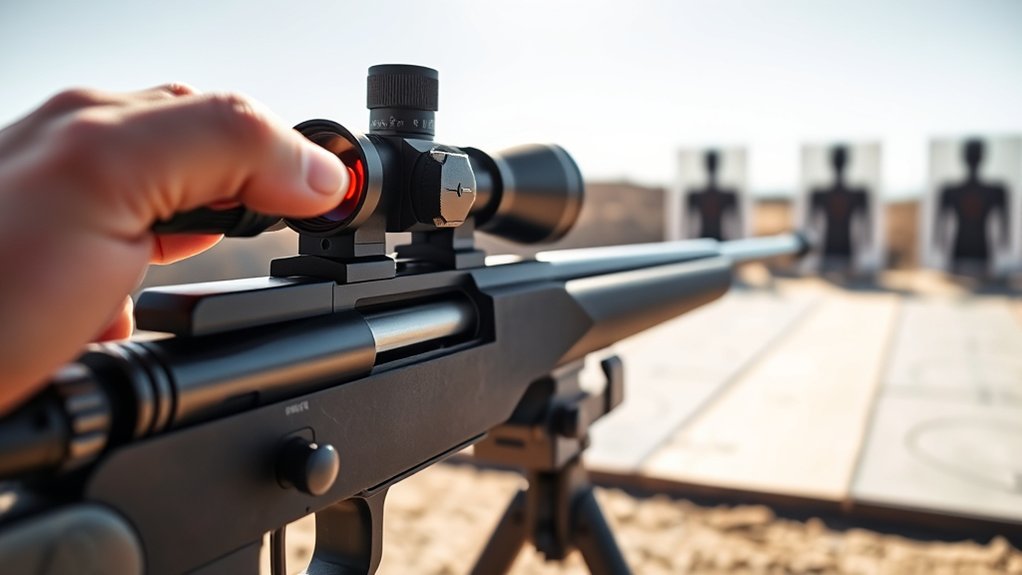
Understanding MOA helps you make accurate adjustments, but the real test is zeroing your red dot sight step-by-step. Start by securely mounting your red dot and roughly aligning it with the bore at about 7 yards to establish an initial zero.
Fire a three-round group, then measure the distance between your aim point and the actual impact. Use this to guide your adjustments. Turn the elevation and windage turrets in small increments; usually, one click equals 1/4 MOA, until the point of impact matches your aim point.
Confirm your zero by firing additional groups, making minor adjustments to improve accuracy. Once zeroed, record your settings and recheck periodically, especially after removing or remounting the red dot.
This will help you maintain consistent zeroing.
How to Fine-Tune Your Red Dot Zero at the Range
Although you’ve established an initial zero, fine-tuning your red dot at the range is essential for pinpoint accuracy.
To guarantee your point of impact aligns perfectly with your aim, follow these steps:
Ensure your point of impact matches your aim precisely by following these essential zeroing steps.
Fire a group at your zeroing distance and note vertical and horizontal deviations from the point of aim. Convert these deviations into MOA by dividing the inches offset by distance in yards/100 to determine how many clicks to adjust.
Adjust elevation and windage turrets accordingly, up/down or left/right, to bring shots closer to your point of impact. Make small, incremental adjustments (1-2 clicks), then fire another group to verify improvement.
Repeat until your shots consistently hit the point of aim, confirming your red dot zero is finely tuned for accuracy.
This method guarantees precise zero and reliable shot placement.
Keep Your Zero Tight: Tips for Consistency and Accuracy
To keep your red dot zero tight, you need to regularly verify and adjust your sight after each shooting session, especially following handling or transport. Consistency is key. Always shoot from the same position using a stable platform to maintain accuracy.
Document your zero settings along with environmental conditions for quick reference and easier re-zeroing when needed. Keep the sight lens clean and the mounting hardware securely tightened to prevent shifts that could affect your point of impact.
Periodic range checks are essential, especially if weather or firearm setup changes. These adjustments help sustain your zero’s precision over time.
Troubleshooting Common Zeroing Problems
When your red dot sight doesn’t zero as expected, pinpointing the cause quickly can save frustration and improve accuracy. Troubleshooting common zeroing problems means checking several key factors that affect scope zeroing and impact point consistency.
Quickly identifying zeroing issues boosts accuracy and prevents frustration with your red dot sight.
If shots hit low at max elevation, try using a 1-degree shim to correct mounting inaccuracies. Also, be sure to re-zero your sight after removing or reinstalling the scope to avoid mechanical zero shifts.
Make sure turret adjustments correspond correctly to impact point changes and verify there are no issues with the adjustments themselves.
If your groups are large or erratic, inspect both the mounting torque and your shooting fundamentals.
Don’t forget to account for weather conditions, as they can cause shifts in the point of impact. Always double-check your zero in the current environment to keep your accuracy consistent.
Addressing these areas will help you maintain a reliable zero and steady accuracy with your red dot scope.
Frequently Asked Questions
Can I Use a Red Dot Sight in Low-Light Conditions?
Yes, you can use a red dot sight in low-light conditions effectively. Just adjust the brightness to avoid glare while keeping the reticle visible against darker backgrounds.
Many red dots have night vision compatibility, which helps in very dark environments.
Keep both eyes open to maintain situational awareness and improve accuracy.
With proper settings and technique, a red dot sight enhances target acquisition speed and precision when lighting is poor.
It’s all about finding the right balance so you can see clearly without any distractions.
How Do Battery Types Affect Red Dot Performance?
Did you know lithium batteries like the CR2032 can last up to five years in your red dot sight? Battery types directly affect brightness and reliability.
Lithium batteries offer stable voltage and long life, which means your dot stays visible and consistent.
Alkaline batteries may dim faster, especially in cold weather. Rechargeables can have voltage fluctuations, causing the brightness to change unexpectedly.
It’s a good idea to stick with the battery recommended by the manufacturer.
That way, your red dot sight performs best when you need it most. Keeping the right battery inside ensures reliable, clear aiming every time.
What Maintenance Does a Red Dot Sight Require?
You need to regularly clean your red dot sight’s lens with a microfiber cloth to keep it clear and dust-free.
Tighten mounting screws often to maintain zero after recoil or handling.
Replace batteries every 6 to 12 months to guarantee steady reticle illumination.
Also, inspect for damage or corrosion and address any issues quickly.
Always keep your sight dry and store it in a protective case when not in use.
This helps prevent moisture damage and keeps it working well over time.
Are Red Dot Sights Compatible With Night Vision Devices?
About 80% of standard red dot sights aren’t compatible with night vision devices. You can’t just use any red dot sight with night vision because most emit bright red reticles that interfere with night vision sensors.
You’ll need a night vision-compatible sight that uses infrared illumination and adjustable brightness levels to avoid sensor overload. Always check the specs to verify your red dot sight explicitly supports night vision for reliable performance in low light.
It’s really important to pick the right one if you want everything to work smoothly in the dark. Otherwise, your night vision device mightn’t perform as expected.
Can I Use a Red Dot Sight for Long-Range Shooting?
You can use a red dot sight for long-range shooting, but it’s not ideal. Red dots work best at close to mid-range targets, usually up to about 200 yards. Beyond that, things get trickier.
For longer distances, you’ll need to adjust for bullet drop and wind. Often, this means pairing your red dot with magnifiers or using ballistic tools to help out. Without those, your accuracy will take a hit.
That’s because red dots don’t offer the precision and magnification that specialized long-range scopes provide. So, if you want the best results, it’s smart to choose your optic based on the shooting distance.
Conclusion
Zeroing your red dot sight isn’t just a setup step. It’s the backbone of every shot you take. By mounting it securely, choosing the right distance, and understanding MOA adjustments, you guarantee your aim stays true.
Think of zeroing like tuning a fine instrument. Without it, your accuracy falls flat. Follow these steps carefully, and you’ll keep your shots tight, consistent, and on target every time you pull the trigger.