How To Get Concealed Carry Permit In California – Requirements And Application Steps
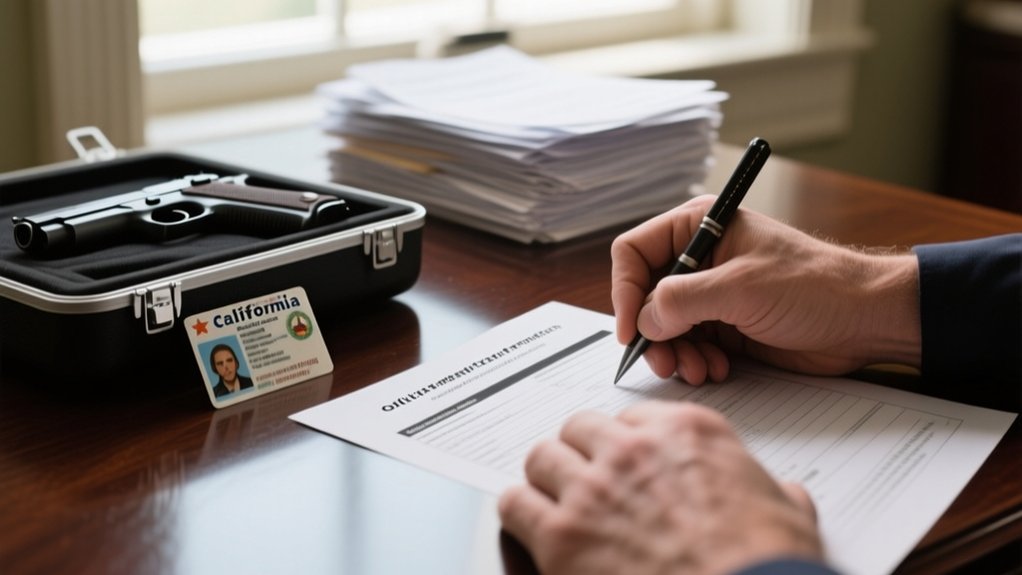
To get a concealed carry permit in California, you must be at least 21, prove residency, and show good moral character. You also need to complete a 16-hour safety training course. After that, you’ll have to pass background checks, fingerprinting, and firearm proficiency tests at multiple distances.
When you’re ready, submit your application through the official online portal with all the required documents. Don’t forget to schedule your interview and qualification appointments accordingly. Keep in mind, any firearms you list must be qualified separately.
Make sure to learn the full application process and understand the important post-approval steps to stay compliant. It’s a lot to keep track of, but following these steps carefully will help you get your permit smoothly.
California CCW Permit Overview: What You Need to Know
Although the process varies by county, you’ll need to navigate several key steps to obtain a California concealed carry permit (CCW). The application process is county-specific, so start by contacting your local sheriff’s office to understand their requirements under the California Penal Code.
You must complete a firearm safety and legal training course, typically 16 hours for first-time applicants, covering concealed carry laws and safe handling.
After submitting your application, you’ll undergo an in-person interview and fingerprinting.
Significantly, you must pass a firearm qualification test within six months of approval, proving proficiency with the specific firearm registered with the California DOJ. Remember, only firearms listed on your permit are allowed.
Your CCW is generally valid for two years, with potential extensions coming soon.
Follow these steps precisely to meet all legal mandates. It might seem like a lot, but taking it one step at a time will get you through the process smoothly.
CCW License Eligibility Requirements
To qualify for a CCW license in California, you must meet strict eligibility criteria designed to guarantee responsible firearm ownership. First, you need to be at least 21 years old and prove residency by showing full-time residence or employment in the county.
You must demonstrate good moral character. This means no felony convictions, certain misdemeanors, restraining orders, or mental health restrictions.
Completing an approved firearm safety training course is mandatory. The required hours vary for initial permits or renewals.
You’ll also need to provide valid identification, such as a California driver’s license, and any additional documents like birth certificates if applicable.
The process includes a thorough background check, fingerprinting, and proving firearm proficiency. This means shooting accurately at 7, 5, and 3 yards.
Meeting all these requirements shows you’re ready to apply for the concealed carry permit.
How to Submit Your California CCW Application Online
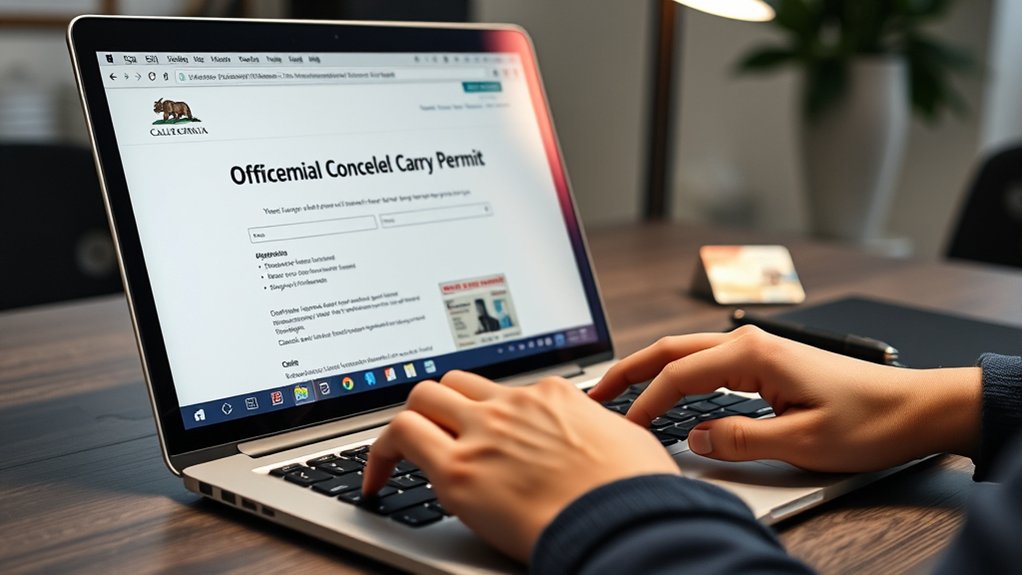
Before you can carry your concealed weapon legally in California, you need to submit your CCW application through the official online portal. Start by creating an account, then carefully enter your personal information and firearm details as required.
Make sure to upload all required documents like proof of residency, identification, and firearm safety certification as separate, clearly labeled files. Double-check each document for clarity and accuracy because you won’t be able to change them after you submit your application.
Once everything is complete, go ahead and submit your application through the online portal. After submission, you can keep an eye on your application status using the portal’s order tracker system.
Staying organized and precise during this process helps guarantee a smooth application experience and avoids delays in getting your concealed carry permit in California.
Scheduling and Rescheduling Your CCW Appointment
When you’re ready to schedule your CCW appointment, keep in mind that all appointments are processed strictly in the order they’re received. Same-day or expedited scheduling isn’t available. If you have an urgent case, you can email ccw@sdsheriff.org to request a review for an earlier slot. Just know that approval isn’t guaranteed.
Renewal appointments often allow for online scheduling, which means you mightn’t need to visit in person. It’s a good idea to regularly check the appointment system for any updates on scheduling or rescheduling.
Here are some key points to keep in mind: appointments are set for specific times and locations, and no scheduling happens on government holidays. Renewal appointments typically offer online scheduling without the need to come in person.
For urgent cases, you can request a review via email, but it has to follow strict approval rules.
Stay proactive so you can secure the appointment time that works best for you.
California CCW Firearm Safety Training Requirements
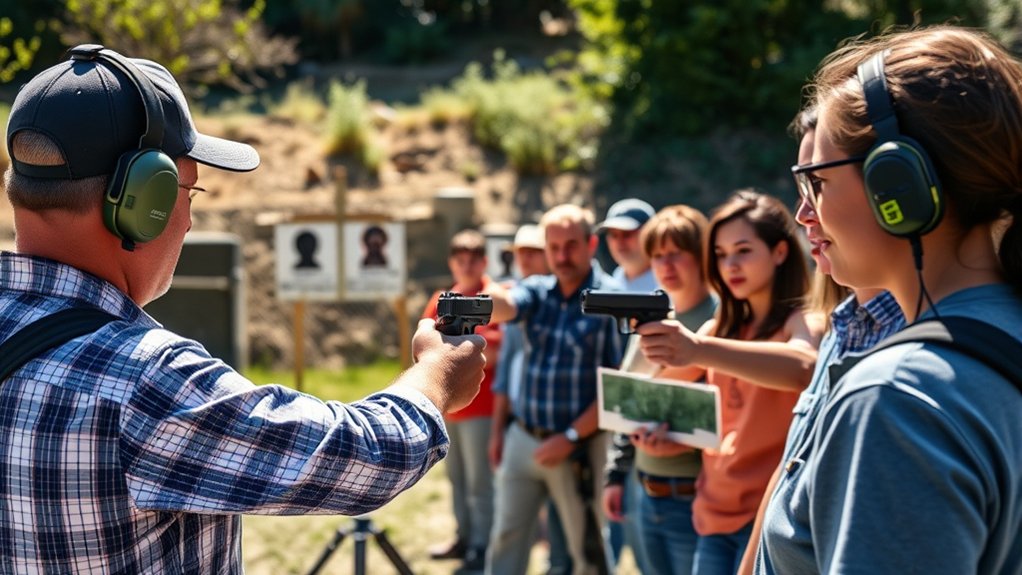
You’ll need to complete a firearm safety course that lasts 16 hours if it’s your first time applying. If you’re renewing, the course is shorter—about 8 hours.
Either way, the training has to be taught by certified DOJ instructors, and their certification numbers must be listed on your qualification form.
During the course, you’ll learn about firearm handling, safety, shooting techniques, and California firearm laws.
It all leads up to a live-fire qualification test. If you’re a new applicant, you’ll need to fire 100 rounds and hit at least 13 out of 15 shots from different distances.
For renewals, you’ll fire 50 rounds but still need to meet the same accuracy requirements.
Training Hour Requirements
Although California’s concealed carry permit process can seem complex, fulfilling the state’s firearm safety training requirements is a critical step you must complete.
Starting January 1, 2024, new applicants must complete at least 16 hours of certified firearm safety training, while renewals require 8 hours.
This training covers firearm handling, safety, shooting techniques, and relevant laws. The courses must be led by DOJ-certified instructors, whose certification details appear on your qualification form.
Here are a few key points to remember: complete the required training hours before applying or renewing your permit. You’ll also need to demonstrate proficiency through qualification within six months of application approval.
This training ensures you understand essential firearm safety, legal responsibilities, and handling skills. Meeting these requirements is mandatory to secure and maintain your concealed carry permit.
Live-Fire Qualification Standards
Since demonstrating firearm proficiency is a crucial part of California’s concealed carry permit process, you must complete a live-fire qualification that meets state standards. This involves shooting exercises at distances of 7, 5, and 3 yards, following an approved course of fire.
You’re required to hit at least 13 of 15 rounds to pass.
New applicants must fire 100 rounds, while renewals need 50 rounds for qualification.
The live-fire qualification must be conducted by DOJ Certified Instructors who verify you meet all qualification standards.
During the test, you must handle your firearm safely without using lasers or red dot sights for scoring, although their use is permitted.
Meeting these requirements confirms your firearm proficiency essential for CCW approval.
It’s a key step, so make sure you’re prepared and familiar with the process before you show up.
Certified Instructor Criteria
The live-fire qualification you complete must be overseen by a certified instructor who meets strict criteria set by the California Department of Justice (DOJ). Your instructor must hold current DOJ certification and include their certification number on your Sheriff’s Qualification Form.
All firearm safety training follows standards in California Penal Code Section 26165. This requires live-fire exercises along with thorough safety and legal instruction.
To maintain DOJ certification, instructors undergo biennial recertification. This ensures they’re up-to-date with the latest training methods.
Approved instructors can provide both initial and renewal courses. These cover handling, safety, laws, and shooting proficiency.
Key certified instructor requirements include:
- DOJ approval and current certification
- Compliance with California Penal Code live-fire and training standards
- Biennial recertification to maintain qualification
Passing Your California CCW Firearm Qualification Test
Before you can receive your California CCW permit, you’ll need to pass a firearm qualification test that proves your proficiency with each approved firearm.
This test requires you to shoot from 7, 5, and 3 yards, hitting at least 13 out of 15 rounds at each distance.
You’ll complete range exercises using a minimum of 100 rounds for new permits or 50 rounds for renewals.
Make sure you only use the firearm listed on your permit, and no laser sights are allowed.
All qualification tests must be done on a firing range under the supervision of DOJ Certified Instructors to meet state standards.
Keep in mind, you must complete this shooting proficiency test within six months of application approval to stay eligible for your CCW permit.
What Documentation and Character References You Need
Completing your firearm qualification test sets the stage for submitting your documentation and character references, which play a key role in your California CCW permit application. You’ll need to provide thorough documentation, including proof of residency like utility bills or a driver’s license, to confirm your local status.
For initial applicants, submitting three character references is mandatory, with at least one cohabitant and one spouse or former partner included. These references must be reputable, able to attest to your moral character and firearm responsibility, and you must include their contact information for the background check.
If you’ve legally changed your name, upload court documentation showing both previous and current names to verify accurate record keeping.
Key documentation and references include:
- Proof of residency documents
- Three character references with reference contact information
- Legal name change court papers (if applicable)
How to List and Qualify Firearms on Your CCW License
Although it can take several months for your firearm paperwork to finalize with the DOJ, you must guarantee all firearms you want on your CCW license are properly listed in your name beforehand.
Ensure all firearms are registered in your name before your CCW paperwork is finalized by the DOJ.
Only firearms legally registered and capable of concealment qualify for listing. Make sure each firearm remains unaltered from manufacturer specifications, as modified or unsafe firearms may be denied.
You can list up to five firearms, but you must qualify with each separately. Qualification requires demonstrating proficiency by shooting from 7, 5, and 3 yards, achieving at least 13 hits out of 15 rounds.
Rigorous training is essential to meet these standards.
Remember, your CCW license will record only the firearms you’ve listed and qualified with. So, thorough listing and training are critical steps in your application process.
Take your time and prepare well!
What to Expect at Your CCW Interview and Fingerprinting
Once you’ve listed and qualified your firearms, the next step involves your CCW interview and fingerprinting. At your appointment, bring all required documentation, including proof of residency and training certificates.
The interview will assess your firearm safety knowledge and reasons for seeking a permit. Expect questions about your character references and firearm qualification results.
Fingerprinting takes place on-site to collect biometric data essential for a thorough background check. Arrive on time and dress professionally, as the interview is a formal evaluation.
Key points to remember:
- Bring complete documentation to avoid delays.
- Prepare to discuss firearm safety and your application’s purpose.
- Fingerprinting is mandatory and done during the interview appointment.
Stay focused and organized to navigate this critical step efficiently.
How to Renew Your California CCW License
You should renew your California CCW license at least 30 to 90 days before it expires. This way, you can avoid any lapse in validity.
To do this, you’ll need to complete an 8-hour renewal firearm safety course, which includes live-fire exercises.
Along with the course, make sure to submit updated documentation with your application.
Just keep in mind, if you miss the deadline and your license expires, you’ll have to start over as a new applicant and requalify with your firearms.
Renewal Timing Guidelines
Because timely renewal guarantees uninterrupted carrying privileges, you should submit your California CCW license renewal application within 180 days before your permit expires. To guarantee smooth processing, plan to apply 30 to 90 days before the expiration date.
Renewal applicants must complete an 8-hour training course, including live-fire exercises, to qualify.
Keep these timing guidelines in mind:
- Submit your renewal application online or by mail well before expiration to avoid delays.
- Processing occurs in the order applications are received, so earlier submission helps.
- Starting January 1, 2027, renewal permits will be valid for three years instead of two.
Following these steps makes sure your renewal application and training are completed on time. That way, you won’t have any lapse in your concealed carry privileges.
Required Training Updates
How often do you need to update your training to maintain your California CCW license? You must complete an 8-hour CCW training update every renewal cycle. This training has to be conducted by a DOJ Certified Instructor whose certification is valid for two years.
The training includes firearm safety, legal updates, and live-fire firearm qualification at 7, 5, and 3 yards. You need at least 13 hits out of 15 rounds per firearm to pass. Make sure to submit your renewal application 30 to 90 days before expiration to stay compliant.
Additional psychological or medical evaluations may be required if requested.
| Requirement | Importance |
|---|---|
| 8-hour CCW training | Ensures current knowledge |
| DOJ Certified Instructor | Guarantees expert-led instruction |
| Firearm qualification | Validates practical skills |
| Timely renewal application | Prevents legal lapses |
Late Renewal Consequences
Maintaining your California CCW license requires timely renewal to avoid losing your privileges. If you miss the renewal deadline, you enter a late renewal phase that can drastically complicate the renewal process.
After your license expires, you have a 90-day grace period to renew. Beyond that, you must reapply as an initial applicant. This means starting over, including retaking firearm safety and qualification courses. That can really delay your authorization to carry.
To prevent late renewal consequences, keep these points in mind:
- Submit your renewal application 30-90 days before your license expires.
- Avoid lapses that force you to reapply as a new applicant.
- Stay current with firearm safety training to speed up renewal.
Act promptly to keep your CCW privileges going without any interruptions.
What to Do If You Move Out of San Diego County or Change Information
If you move out of San Diego County, you must return your concealed carry permit either by mail or in person before leaving the area. Once you move, update your new address with the California DMV promptly and submit proof of residency online to keep your CCW permit valid.
You can legally carry under your existing permit for up to 90 days after relocating, but only if you complete these residency updates.
Furthermore, notify the Sacramento Sheriff’s Office via email about your out-of-county move to ensure proper permit management. Failing to update your information can invalidate your CCW permit and force you to start a new application.
Staying proactive with these updates is essential to maintain your permit’s legality after moving from San Diego County.
Frequently Asked Questions
Can I Carry My Concealed Weapon in Other States With a California CCW?
You can’t automatically carry your concealed weapon in other states with a California CCW. Reciprocity laws vary, so you need to check each state’s rules before carrying.
Some states honor California permits, but many require their own licenses.
Always verify the specific concealed carry laws where you’re traveling to avoid legal trouble. Don’t assume your California permit grants you legal carry rights outside the state.
It’s important to research and comply accordingly.
What Are the Penalties for Carrying Without a Valid California CCW?
If you carry a concealed weapon without a valid California CCW, you risk misdemeanor charges, fines, and potential jail time. You could face arrest and criminal prosecution under Penal Code sections 26155 and 26200.
A first offense might lead to a mandatory minimum six-month jail sentence.
Plus, illegal carry can cause revocation of any existing permits you have. It can also hurt your chances of getting firearm permits in the future. So, it’s really important to always carry legally to avoid these serious penalties.
Are There Specific Zones Where Carrying a Concealed Weapon Is Prohibited?
You might be surprised to learn just how many places ban concealed weapons. You can’t carry concealed in government buildings, courthouses, or polling places. Schools, treatment centers, and mental health facilities strictly forbid it too.
Even some parks, transit systems, and private properties post clear no-carry signs. Ignoring these rules puts you at serious legal risk.
Always check local laws carefully before carrying concealed anywhere.
How Long Does the CCW Application Approval Process Usually Take?
The CCW application approval process usually takes up to 90 days after you submit all required documents and complete fingerprinting. Processing happens in the order applications are received, so you’ll need to wait patiently. There’s no way to speed it up.
Timelines can vary based on your county’s workload and if additional info is needed.
You can check your application status online through the sheriff’s office or their tracking system anytime.
Can I Appeal if My CCW Application Is Denied?
You can’t formally appeal a CCW denial in California since no official appeal process exists. However, you should contact the sheriff’s office or licensing agency to request a review or reconsideration. When doing so, provide additional evidence or clarify your eligibility.
If you’re still denied, you can reapply after addressing the reasons for denial. It’s a good idea to consult a firearms attorney. They can help you understand your options and strengthen your case for reconsideration or reapplication.
Conclusion
Getting your California CCW permit isn’t a walk in the park, but like mastering the art of a finely tuned instrument, each step from eligibility checks to your interview builds your confidence and control. Stay sharp, follow every guideline, and treat the process with the respect it demands.
Remember, this isn’t just paperwork; it’s your key to responsible, lawful carry. Stay prepared, stay informed, and carry with confidence.