What Does A Concealed Carry Permit Allow – Rights And Restrictions Explained
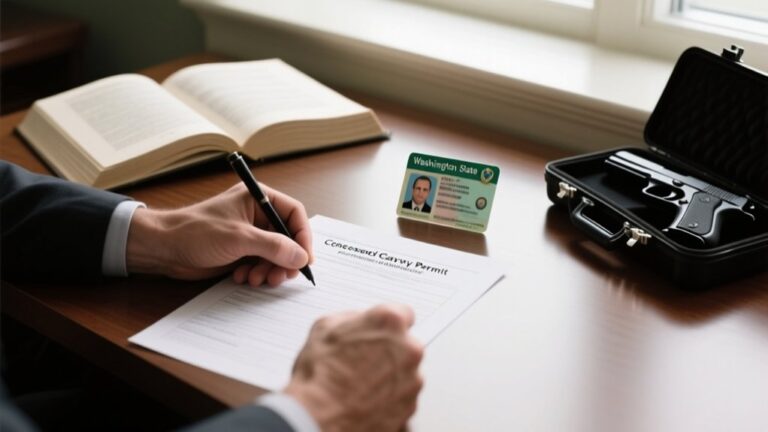
A concealed carry permit lets you legally carry a hidden handgun in public, but there are strict rules about who can get one. You’ll need to meet eligibility requirements, complete training, and pass background checks.
The permit mainly covers handguns, though sometimes it might allow semi-automatic rifles if you have explicit authorization. You also have to follow specific rules for how you store and transport your weapon.
Certain places are off-limits, like schools and airports, and you have to respect private property owners who don’t allow guns. If you break these rules, you could face fines or even lose your license.
It’s important to understand both your rights and the restrictions so you can carry responsibly and within the law. Taking the time to learn the details will help you know exactly what your permit allows.
What Is a Concealed Carry Permit and Who Can Get One?
What exactly is a concealed carry permit, and who can obtain one? A concealed carry permit legally authorizes you to carry a hidden firearm in public.
Eligibility requirements differ by state but typically involve meeting a minimum age, passing a thorough background check, and completing mandated safety training.
Eligibility varies by state but generally includes age minimums, background checks, and required safety training.
Some states limit permits to residents, while others extend eligibility to nonresidents under specific conditions. Moreover, certain professionals like retired law enforcement officers may qualify for specialized permits.
It’s important to note that in many jurisdictions, you need a permit even to carry firearms on private property or in designated public areas.
Understanding these eligibility criteria ensures you comply with legal obligations and exercise your rights responsibly.
Which Firearms Are Covered by a Concealed Carry Permit?
Your concealed carry permit mainly covers handguns, like pistols and revolvers. However, it can also include certain semi-automatic rifles—if you’ve added them to your license and gotten approval first.
You need to make sure the firearms meet specific license requirements to stay compliant. Knowing these details is really important for carrying both legally and responsibly.
Covered Firearm Types
Although concealed carry permits primarily authorize you to carry handguns such as pistols and revolvers, the specific types of firearms covered can vary considerably by jurisdiction. Most permits focus on firearm types like semi-automatic pistols and revolvers designed for concealed carry.
Some states may extend coverage to certain rifles or shotguns, but these are exceptions. Restricted firearms, including large-capacity magazines or specific models, often remain prohibited despite your permit.
| Firearm Type | Commonly Covered | Typically Restricted |
|---|---|---|
| Semi-Automatic Pistols | Yes | High-capacity magazines |
| Revolvers | Yes | Certain models |
| Rifles & Shotguns | Rarely | Most types |
Knowing these distinctions helps make certain you carry legally and responsibly. It’s always a good idea to check your local laws before carrying.
License Requirements Specifics
Understanding which firearms your concealed carry permit covers requires careful attention to specific licensing requirements. Typically, your license permits you to carry handguns, like pistols and revolvers, concealed in public.
The permitting process rarely includes semi-automatic rifles or shotguns unless state firearm laws explicitly authorize them.
Also, some jurisdictions have restrictions within the license on firearm types, such as banning large-capacity magazines or certain models.
Your concealed carry permit usually applies only to firearms you’ve legally purchased and, where required, registered.
Some states even limit concealed carry to firearms that meet specific caliber or size criteria defined by law or regulation.
To stay fully compliant, you need to understand both federal and local firearm laws that are part of the permitting process.
This way, you’ll know your license covers only the firearms authorized under your jurisdiction’s requirements.
Semi-Automatic Rifle Inclusion
While most concealed carry permits cover handguns and revolvers, they usually don’t extend to semi-automatic rifles unless state law explicitly allows it. Semi-automatic rifles fall under a different firearm classification and often require separate licensing due to stricter restrictions.
Depending on your jurisdiction’s firearm laws, you might need to apply for an extra permit to legally carry these rifles concealed.
Some states permit adding semi-automatic rifles to your existing concealed carry permit after specific approval, while others prohibit their inclusion entirely.
Furthermore, firearm licenses issued before recent legislative changes may exempt you from new restrictions on semi-automatic rifles, but this varies widely.
To comply, carefully review your state’s laws to understand if and how semi-automatic rifles are covered under your concealed carry permit. It’s always better to be informed so you don’t run into trouble later on.
How Do Household Members Affect Your License Application?
When you apply for your concealed carry permit, you need to include everyone living in your household—this means spouses and any other adults, too.
The licensing authorities look at this information to figure out if you’re a good fit and to spot any possible risks.
If you leave out or get any household details wrong, it could result in your application being denied or even revoked later on.
Household Disclosure Requirements
Because licensing authorities assess household dynamics carefully, you must disclose all adults living in your home, including spouses, domestic partners, and others, when applying for a concealed carry permit.
The disclosure requirements demand full transparency about household members, including any relevant criminal history or firearms restrictions.
Authorities use this information to verify that no prohibited individuals reside with you. This directly affects your license application’s integrity.
Omitting or falsifying household member details can lead to denial or revocation of your permit.
Providing accurate information ensures compliance with firearms restrictions and helps maintain the permit’s validity.
Understanding and meeting these household disclosure requirements is essential to managing the concealed carry permit process responsibly and lawfully.
Impact On Application Evaluation
Although household members might seem unrelated to your personal eligibility, they actually play a big role in how licensing authorities evaluate your concealed carry permit application.
When you apply, you need to fully disclose everyone living in your household, including spouses and other adults.
This matters because licensing officers look at who you live with to assess firearm safety risks. If there are minors or restricted individuals in your home, you might need to provide extra documentation.
Authorities also consider household dynamics to judge your responsibility in storing and controlling access to firearms.
Not being upfront about who lives with you can lead to your permit being denied or revoked. So, it’s really important to be honest and thorough during the application process.
What Training and Background Checks Are Required?
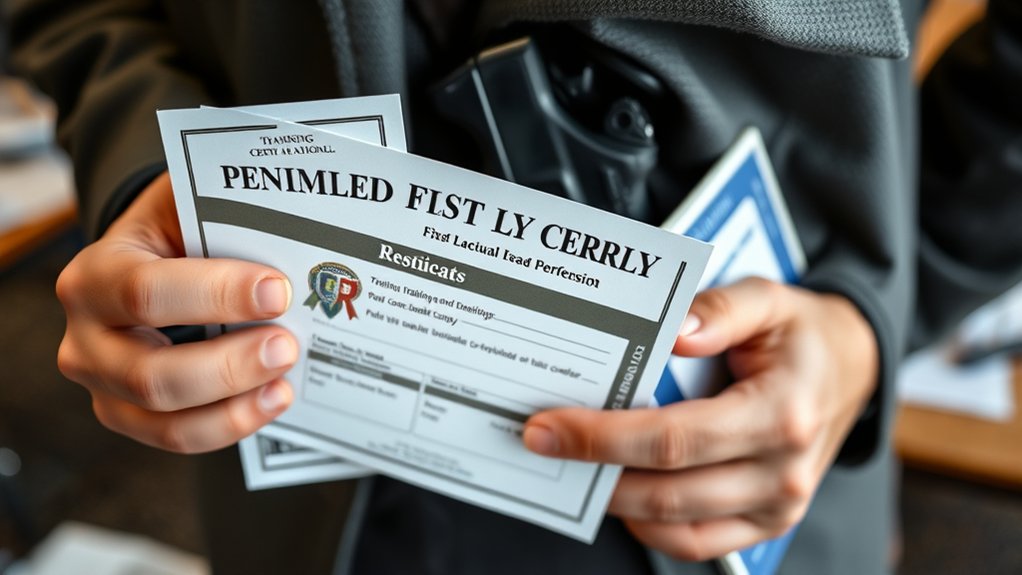
Before issuing a concealed carry permit, applicants must complete an all-inclusive training program that includes 16 hours of classroom safety instruction and a 2-hour live-fire firearms session conducted by authorized instructors.
Applicants must complete 16 hours of safety instruction plus a 2-hour live-fire session before receiving a concealed carry permit.
These training requirements apply to licenses issued on or after September 1, 2022, in specific counties, ensuring you receive thorough firearm safety education.
Background checks are also mandatory, thoroughly screening your criminal history and mental health status to uphold public safety.
Law enforcement and military personnel must meet the same standards, though prior training may be considered.
While some existing licenses outside NYC, Westchester, Nassau, and Suffolk are exempt, you still need to understand these regulations.
Remember, license renewal every three years involves recertification to verify ongoing compliance with training and background check mandates.
How Do You Renew and Recertify Your Concealed Carry Permit?
How often you need to renew your concealed carry permit depends on your jurisdiction, but it’s typically every three to five years. To successfully renew and recertify your permit, you’ll want to follow these essential steps.
First, submit a renewal application and pay any required fees, which can vary depending on where you live.
Next, complete any mandatory training or firearm safety courses to recertify your proficiency.
You’ll also need to undergo a background check to confirm your eligibility and make sure there haven’t been any disqualifying changes.
In some places, you might have to attend an in-person interview as part of the renewal process. If that’s the case where you are, be sure to schedule and attend it.
Keep in mind, if you don’t renew or recertify on time, your permit will usually expire. That means you’d have to reapply and go through a new background check.
Staying on top of your renewal helps you keep your legal concealed carry rights without interruption.
Where Can You Carry With a Concealed Carry Permit?
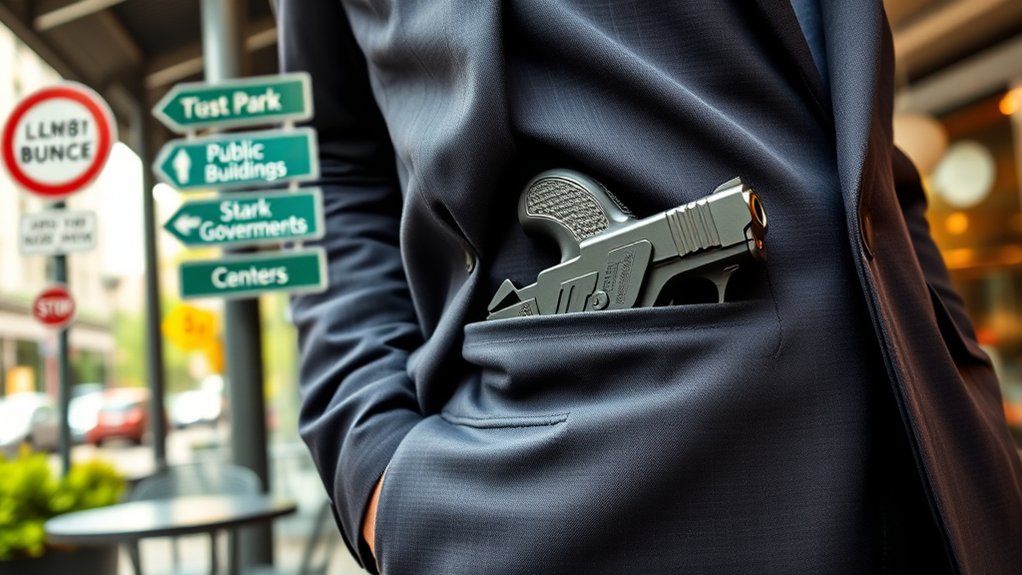
Once you’ve renewed and recertified your concealed carry permit, knowing where you can legally carry your firearm is the next step. Generally, your permit allows you to carry in most public places, but specific restrictions depend on state and local firearm laws.
Many states prohibit concealed firearms in sensitive locations like schools, courthouses, airports, and government buildings.
Moreover, carrying on private property often requires the owner’s permission or adherence to designated areas.
Some jurisdictions, including places like Times Square or national parks, enforce unique restrictions that may limit or forbid carrying despite your permit.
Always verify local laws before entering new areas, as restrictions vary widely and can include special events, private property rules, and specific zones.
Understanding these nuances ensures you stay compliant and safe. It’s a good idea to double-check rules whenever you’re in a new place, so you avoid any surprises.
Staying informed helps you carry responsibly and confidently.
Where Are Firearms Off-Limits Even With a Permit?
Even if you have a concealed carry permit, there are still places where bringing firearms is off-limits. For example, you can’t take guns into restricted public areas like courthouses, airports, or school zones.
On top of that, private property owners have the right to ban firearms on their premises. So, it’s important to pay attention to posted signs or check if you need explicit permission before carrying a weapon there.
Knowing these rules—and any exceptions that might apply—is key. It helps you stay on the right side of the law and protects your rights at the same time.
Restricted Public Locations
Although you hold a valid concealed carry permit, certain public locations strictly prohibit firearms to guarantee public safety and legal compliance. Understanding these restricted locations is vital to avoid firearm restrictions violations and legal penalties.
Even with a concealed carry permit, firearms are off-limits in these public places: Times Square and similar designated areas under Penal Law §265.01-e; schools, courthouses, and hospitals; specific zones within Adirondack and Catskill Parks; and other sensitive public locations clearly posted as restricted.
Carrying a firearm in these areas without exemption exposes you to serious legal consequences. So, always verify local laws before entering public places to confirm your concealed carry remains lawful.
Staying informed helps you avoid trouble and keeps everyone safe.
Private Property Regulations
While holding a concealed carry permit grants you certain rights, private property owners maintain full authority to control firearm possession on their premises. Firearms are generally prohibited on private property unless the owner explicitly consents or posts signage permitting their presence.
Even with a concealed carry permit, carrying a firearm onto private property without permission violates restrictions and can lead to legal consequences. Owners can enforce firearm bans by clear signage or verbal notification, and failure to comply constitutes trespassing.
In New York, while the state doesn’t enforce firearm restrictions on open-to-public private property, owners still retain the right to impose them. You must always respect these private property regulations to avoid criminal charges and stay within the law.
Exemptions And Exceptions
Because certain locations require heightened security and safety measures, firearms remain prohibited there despite your concealed carry permit. Understanding exemptions and exceptions is crucial to avoid violating firearm restrictions in restricted locations.
Here are key points to remember:
Firearms are banned in sensitive areas like Times Square, government buildings, courts, schools, and bars serving alcohol under Penal Law §265.01-e.
Private property owners may restrict firearms; you must have explicit consent or posted permission to carry there.
Law enforcement, military personnel, licensed hunters, and authorized individuals engaged in lawful activities qualify for specific exemptions.
Carrying a firearm without proper exemption in these locations can result in fines or criminal charges.
What Happens If You Break the Rules?
If you break the rules tied to your concealed carry permit, you face serious consequences that can include fines, license revocation, or even criminal charges. Violating location restrictions, like carrying in government buildings or sensitive areas such as Times Square, can lead to felony or misdemeanor charges.
Providing false information or failing to disclose household members during your application may prompt permit suspension or legal penalties. Carrying a firearm under the influence of alcohol or drugs risks arrest and license suspension.
Also, neglecting firearm safety, like leaving your weapon unattended or improper storage, can result in fines or losing your permit. Understanding and sticking to these regulations is essential to keep your rights and avoid severe repercussions connected to your concealed carry permit.
What Are the Rules for Non-Residents and Military Personnel?
Understanding how the rules apply to non-residents and military personnel is key to legally carrying concealed across different states. You have to navigate varied state laws and limited reciprocity when carrying concealed as a non-resident or military member.
Non-residents can apply for concealed carry permits in some states, but not all recognize out-of-state permits.
Military personnel stationed in a state may qualify for local concealed carry permits if they meet that state’s requirements.
States like California don’t honor out-of-state permits. So, military personnel need to obtain local licenses to carry concealed legally.
Military members often rely on federal or state-specific exemptions. Still, they must comply strictly with the current state’s laws and reciprocity agreements before carrying.
Always verify state laws and reciprocity to avoid legal issues. It’s better to double-check than assume you’re covered.
When and How Can You Add Semi-Automatic Rifles to Your Permit?
Since September 4, 2022, you can apply to add semi-automatic rifles to your firearm permit by submitting a formal application to your local licensing officer and meeting all background check requirements.
If you already held a firearm license with semi-automatic rifles before this date, you can add them to your permit without reapplying.
Licensing authorities strictly enforce these firearm laws to guarantee compliance. To add semi-automatic rifles to your concealed carry permit, you must follow local procedures and satisfy all legal criteria.
Note that while lawful possession of these rifles was allowed before the cutoff without a license, adding them now requires explicit authorization.
Exemptions apply only to law enforcement, military personnel, licensed hunters, and certain lawful activities, not to general permit holders.
How to Store and Transport Your Firearm Safely
Although carrying a firearm grants you certain rights, you must always store and transport it safely to comply with the law and protect yourself and others. Proper firearm safety guarantees legal compliance and prevents unauthorized access.
First, always unload your firearm before transport. Then, store it in a lock and safe or a tamper-resistant case. This helps keep it secure and out of the wrong hands.
When you’re transporting a concealed carry firearm, keep it out of sight and not readily accessible, especially in vehicles. It’s all about being responsible and cautious.
At home, make sure to secure your firearm with a gun locking device or in a fire- and impact-resistant safe. This adds an extra layer of protection for you and your family.
Also, don’t forget to follow local regulations. For example, New York City requires firearms to be unloaded, in a case, and concealed at all times.
How Does a Concealed Carry Permit Protect You?
How exactly does a concealed carry permit protect you? A concealed carry permit legally authorizes you to carry a hidden firearm in public, ensuring lawful carry within designated areas.
As a license holder, you receive legal protection from certain penalties when you follow firearm laws and stick to your permit’s conditions.
This protection is really important if you’re involved in a self-defense incident because it shows you were following state regulations.
Plus, having a permit often lets you carry in places where unlicensed carry isn’t allowed, giving you more options to stay safe.
Getting and keeping your permit properly reduces the risk of criminal charges related to unlawful carrying.
It helps protect your rights while highlighting the importance of responsibility and following the law.
Frequently Asked Questions
Can I Carry a Concealed Firearm While Intoxicated?
No, you can’t carry a concealed firearm while intoxicated. Most states explicitly forbid carrying firearms under the influence of alcohol or drugs. If you do, you risk severe legal consequences like criminal charges or arrest for unlawful possession.
Besides legal trouble, carrying impaired greatly increases the chance of accidents or mishandling your weapon. This puts you and others in danger.
Always stay sober when carrying to guarantee safety and compliance with the law.
Are Private Employers Allowed to Ban Concealed Carry on Their Property?
Yes, private employers can ban concealed carry on their property. They’ve the legal right to prohibit firearms unless state law or contracts say otherwise.
You should watch for clear signage or direct communication about these restrictions.
If you carry against the employer’s policy, you risk disciplinary action or even termination.
Exceptions usually only apply to authorized personnel like law enforcement or security staff approved by the employer.
How Does a Concealed Carry Permit Affect Traveling Across State Lines?
Imagine cruising down the highway, your concealed carry permit tucked safely in your wallet. When you cross state lines, your ability to carry depends on each state’s laws. Some states recognize your permit, while others don’t.
Before you hit the road, check reciprocity agreements and local restrictions carefully. Always carry your permit and ID with you.
Be prepared to adjust where and how you carry to stay fully compliant with every jurisdiction’s rules.
Can I Carry a Concealed Weapon in a Vehicle Without a Permit?
You generally can’t carry a concealed weapon in a vehicle without a permit, as most states require one for legal transport. Some states allow permitless carry, but these are exceptions, not the rule.
Without a permit, you risk fines, arrest, or criminal charges. Always check your state’s specific laws before carrying concealed in a vehicle.
Ignorance won’t protect you, so stay informed and compliant to avoid serious legal trouble.
What Are the Penalties for Losing or Having My Permit Stolen?
Losing your concealed carry permit is like misplacing the key to a locked vault. It can open the door to serious trouble. You must report the loss or theft immediately to avoid fines, license suspension, or criminal charges.
If you don’t notify authorities promptly, you could face unlawful possession accusations and escalating penalties. This might even lead to your permit being revoked.
Conclusion
With a concealed carry permit, you gain guarded rights but face firm restrictions. Understanding the specific statutes, securing solid training, and staying sharp on safety safeguards your standing.
Whether renewing, relocating, or responsibly storing, your permit provides powerful protection while prioritizing public peace. Stay savvy, stay secure, and strictly stick to the rules. Careful compliance creates confident, conscientious carriers committed to community care and lawful carrying.