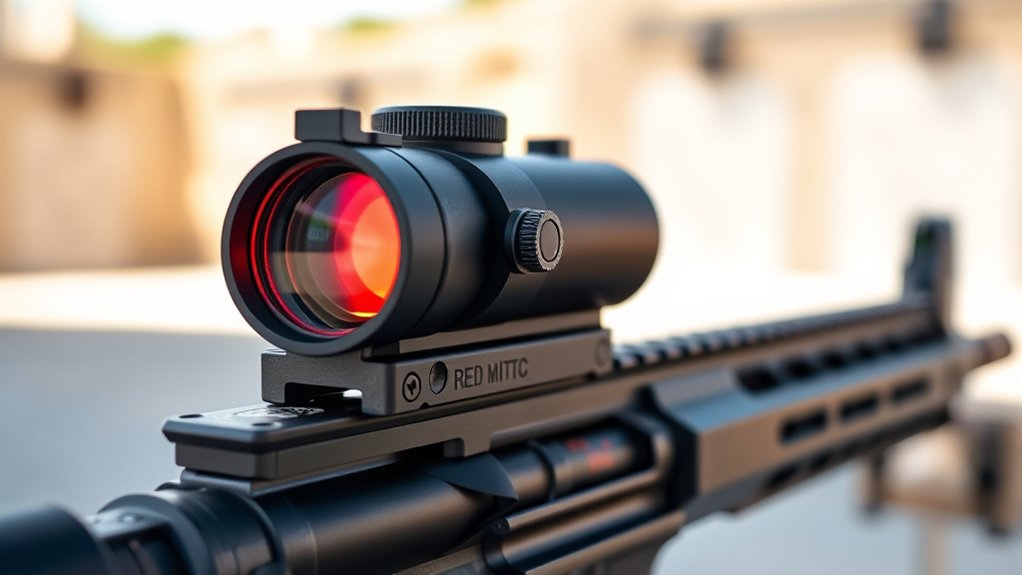
How Do Red Dot Sights Work – Technology Explained
Red dot sights work by projecting a focused LED beam, either red or green, onto a specially coated, semi-transparent glass. This glass reflects the light back, creating a virtual reticle that’s perfectly aligned with your aim. Because of this, you get a clear sight picture that’s easy to use.
This design eliminates parallax error at infinity, so the dot stays true no matter where your eye is positioned. You can also adjust the reticle’s size and brightness to match different conditions. That makes it easier to shoot quickly and accurately.
If you’re curious, there’s a lot more to learn about how design choices and new technology affect how well these sights perform. It’s pretty cool stuff once you dive into it!
Key Takeaways
- A small LED projects a red or green reticle onto a coated glass that reflects the light while remaining transparent to the target view.
- The reticle appears superimposed and remains aligned with the sight line, providing parallax-free aiming at infinity.
- Adjustable brightness and size controls optimize reticle visibility for various lighting conditions and shooting scenarios.
- Open and tube designs offer different durability and field-of-view options while maintaining consistent reticle alignment.
- Secure mounting systems ensure stable alignment and recoil resistance, preserving accuracy during repeated shots.
Understanding Red Dot Sights and How They Work
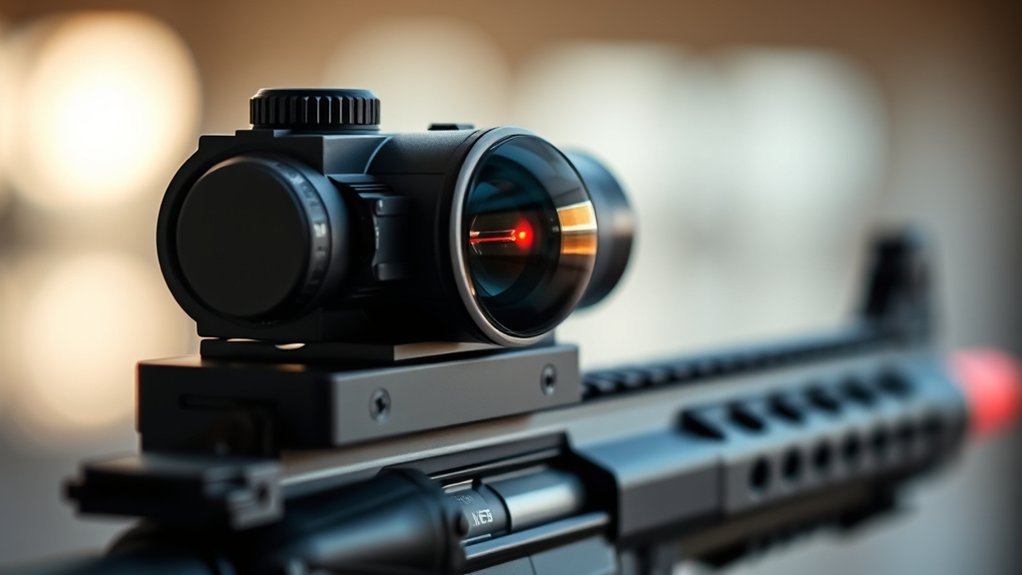
Although red dot sights may seem simple at first glance, they rely on sophisticated optical principles to provide precise aiming. You’ll find that a small LED projects light onto a semi-transparent, curved mirror, creating a virtual reticle that appears superimposed on your target. This reflection guarantees the reticle remains aligned with your sight line, allowing for quick target acquisition.
Red dot sights achieve parallax-free operation at infinity, so the reticle stays accurately positioned even if your eye shifts off-center.
The illumination of the reticle, usually red or green, can be adjusted in size and brightness to match various lighting conditions.
How LEDs and Coated Glass Create the Reticle
You’ll notice that a tiny LED shines a focused red beam. This beam hits a piece of specially coated glass that’s made to reflect that exact wavelength of light, but still lets you see through it clearly.
The coating basically bounces the LED’s light back through the lens, creating the bright reticle you’re looking at.
Getting how this reflection and coating team up is really important to understanding how the reticle shows up so precisely.
LED Light Reflection
When LEDs emit a focused beam of light, they direct it onto specially coated glass that selectively reflects specific wavelengths, such as red or green, to create a clear, visible reticle.
The light-emitting diode’s beam is precisely focused through an aperture, which controls the reticle’s size and brightness. This aperture guarantees the reticle remains sharp and consistent under varying conditions.
The coated glass then reflects this targeted light, producing a virtual, collimated reticle image that appears superimposed on your target.
This reflection process lets you see the reticle clearly without blocking your view, so you can keep your situational awareness.
Basically, the way the LED emits light, reflects it, and how the aperture controls it all work together. This combo is what makes the red dot sight so effective and precise.
Coated Glass Mechanics
Since the reticle’s clarity depends on precise light manipulation, the coated glass plays a critical role by selectively reflecting the LED’s wavelength while allowing other light to pass through. This semi-transparent coated glass features a dichroic coating that acts as a reflective surface, targeting specific red or green wavelengths emitted by the LED.
Positioned along the optical axis, the coated glass functions as a beam splitter, directing the reflected LED light toward your eye while maintaining transparency to the target view. The LED’s light focuses onto this coated glass, which reflects the reticle image back precisely.
An aperture controls the LED’s light intensity, defining the reticle’s apparent size. This interplay between the LED and coated glass ensures a sharp, bright reticle without obstructing your field of view. It’s a neat balance that lets you see clearly without any interference.
Open vs. Tube Red Dot Designs: What’s the Difference?
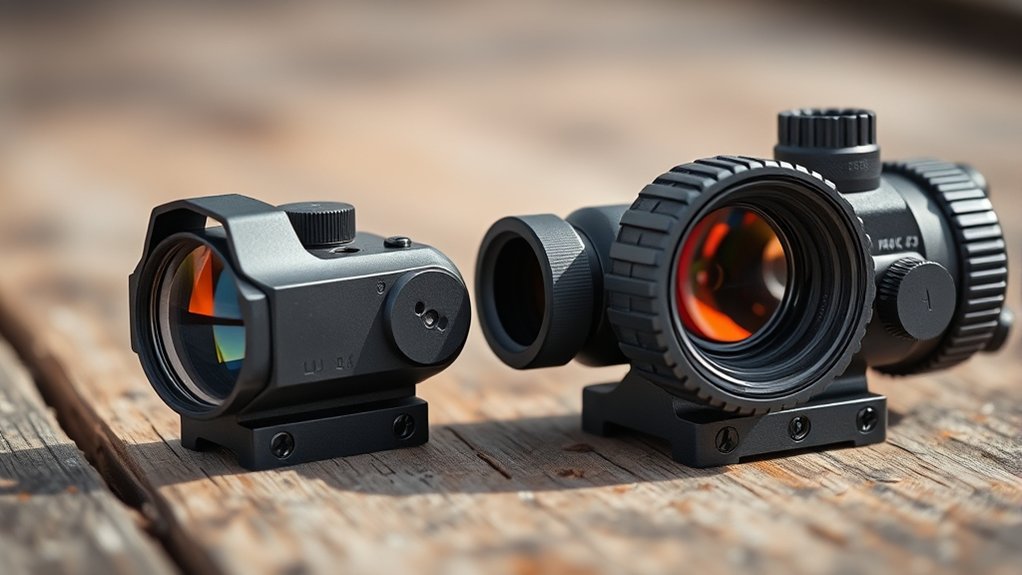
When you’re looking at open versus tube red dot designs, you’ll see some clear differences in how they’re built and how well they hold up in different environments.
Open sights have a lens that’s partly exposed, which makes them lighter, but it also means they’re more likely to get dirty or wet.
On the other hand, tube sights completely enclose the optics, giving them extra durability when conditions get tough.
Knowing these design features can really help you pick the right sight for where you’ll be using it.
Design Characteristics
Although both open and tube red dot sights serve the same fundamental purpose, their design differences considerably affect performance and suitability.
Open design sights feature a partially exposed aperture and lens, granting you a wider field of view and a lightweight setup ideal for rapid target acquisition.
Tube designs enclose the red dot within a protective housing, enhancing durability. Key distinctions include lens size: open designs typically use 24×32 mm lenses, while tube sights range from 20 to 30 mm in diameter.
Then there’s exposure—open sights risk contamination by dirt or moisture, whereas tube sights shield the lens.
Both designs maintain parallax free functionality, but the open design’s minimal obstruction improves situational awareness.
Environmental Durability
Because environmental conditions directly impact sight performance, understanding the durability differences between open and tube red dot designs is essential.
Open red dot sights expose the light source and optics partially, making them vulnerable to environmental elements such as dirt, rain, and snow. This exposure can degrade visibility and reduce reliability under adverse weather conditions.
In contrast, tube-style red dot sights create a sealed environment that fully encloses the optics and light source, offering superior protection against dust and moisture. This design guarantees consistent durability and operational integrity in harsh environments.
While open designs provide a wider field of view with larger lenses, their reduced protection compromises performance in challenging conditions.
Red Dot Reticle Size: Importance and Measurement
Since the reticle size directly affects both your aiming precision and speed, understanding its measurement is essential when selecting a red dot sight. Reticle size is measured in MOA (minutes of angle), where 1 MOA equals roughly 1 inch at 100 yards. This measurement impacts your aiming accuracy and target coverage markedly.
Reticle size, measured in MOA, crucially influences your aiming precision and speed with red dot sights.
Think of it this way: smaller reticles, around 0.6 MOA, offer superior precision for long-range shots. But they might need brighter illumination to see clearly.
On the other hand, larger reticles, up to 7.5 MOA, make it easier to acquire targets quickly. However, they can obscure small targets, which means less precision.
Reticle measurement in MOA helps balance speed and accuracy. Picking the right size really optimizes your shooting performance.
Mastering reticle size ensures you get precise, effective aiming that fits your shooting needs perfectly.
How Red Dot Sights Reduce Parallax Error
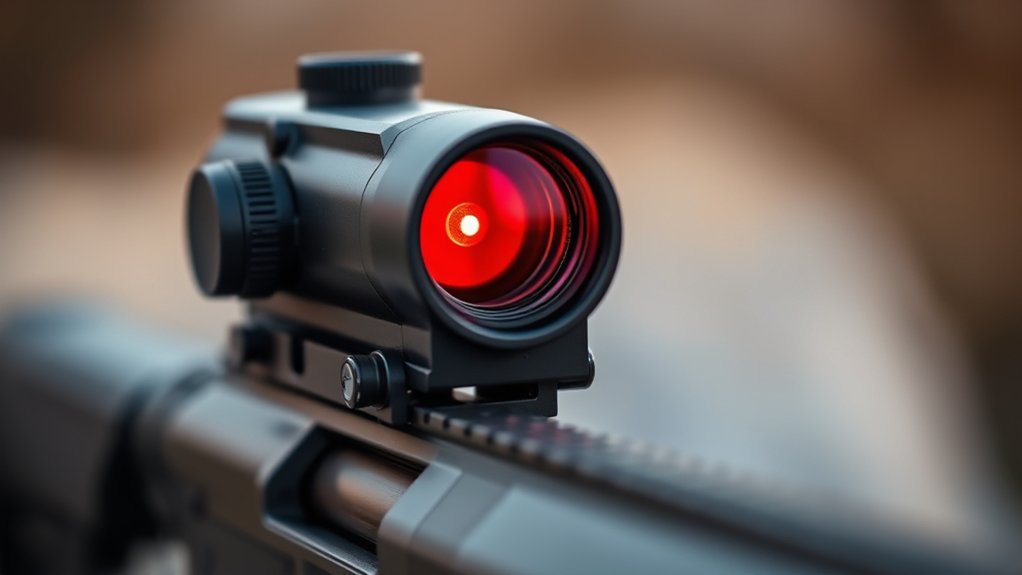
How do red dot sights maintain accuracy despite shifts in your eye position? They achieve this by minimizing parallax error through precise optical engineering.
The spherical mirror and beam splitter reflect the LED-generated reticle onto the same optical path as the target. This design makes certain the reticle remains superimposed and aligned with the point of impact, regardless of your viewing angle.
Red dot sights are typically focus-adjusted for infinity, which keeps parallax error negligible at longer distances. However, at close range, slight reticle shifts may occur due to parallax error, as the optical focus is optimized for distant targets.
Mounting Types for Red Dot Sights and Their Impact
When selecting a red dot sight, you’ll need to take into account the mounting type carefully, as it directly affects your firearm’s performance and handling. Different mounting types like dovetail, wedge, cross-slot, and proprietary footprints are tailored for specific firearm platforms. This impacts compatibility and zero retention.
A secure mounting system is essential to manage recoil and prevent sight shift during firing. So, it’s worth paying close attention to how your sight attaches to your firearm.
Consider these key factors:
- Compatibility: Confirm the mount matches standardized footprints such as Aimpoint Micro or RMR for interchangeability.
- Zero retention: Proper mounting keeps your sight aligned after repeated shots.
- Recoil management: Some systems need extra securing features to handle recoil forces.
Choosing the right mounting type also helps optimize eye relief, weight distribution, and concealability on your firearm. It’s all about finding what works best for your setup and shooting style.
How Red Dot Sights Improve Shooting Accuracy
Although traditional iron sights require aligning multiple reference points, red dot sights streamline aiming by projecting a single illuminated reticle directly onto the target plane. This parallax-free design guarantees consistent aiming accuracy regardless of eye position.
By using a red dot sight, you gain rapid target acquisition, especially with both eyes open. This preserves peripheral awareness and reduces errors.
Adjusting reticle size optimizes precision for various distances. You can use smaller dots for long-range accuracy and larger dots for quick close-range engagement.
| Feature | Benefit | Impact on Shooting |
|---|---|---|
| Parallax-Free | Consistent point of aim | Improved accuracy |
| Variable Reticle Size | Tailored precision | Optimized target acquisition |
| Both Eyes Open | Maintains peripheral vision | Reduced aiming errors |
| Adjustable Brightness | Visibility in all lighting | Enhanced aiming accuracy |
Upcoming Innovations in Red Dot Sight Technology
Building on the advantages of current red dot sights, upcoming innovations will push the boundaries of performance and usability. You’ll see advancements that enhance both functionality and durability, including:
Upcoming red dot sight innovations will elevate performance and durability to new levels.
- Integration of holographic displays combined with adaptive brightness systems. This allows automatic reticle adjustments for ideal visibility across varying light conditions.
- Extended battery life achieved through advanced power management and solar charging. This minimizes downtime and increases operational readiness.
- Improved optical clarity paired with new coatings and materials that boost environmental resistance against extreme temperatures, moisture, and abrasion.
These developments reduce size and weight without sacrificing robustness. This means your red dot sight remains reliable in diverse scenarios.
Frequently Asked Questions
How Long Do Red Dot Sight Batteries Typically Last?
Red dot sight batteries typically last between 1,500 to over 50,000 hours, depending on the model and brightness settings you use. You’ll find higher brightness drains power faster, while lower settings extend battery life.
Features like shake-awake or solar assistance help conserve energy when the sight isn’t in use.
Choosing the right battery type, such as CR2032 or AA, and adjusting brightness to the minimum effective level will maximize your sight’s operational time.
It’s all about finding that balance between visibility and battery life. So, play around with your settings and see what works best for your needs.
Can Red Dot Sights Be Used on Airsoft or Paintball Guns?
Yes, you can use red dot sights on airsoft or paintball guns, and about 70% of competitive players prefer them for faster target acquisition. These sights are built with durable, lightweight materials that can withstand impacts while offering non-magnifying reticles perfect for close to medium ranges.
You’ll want to select models with adjustable brightness and compatible mounts like Picatinny rails. This helps guarantee peak performance in various lighting conditions and game scenarios.
Using the right red dot sight can really up your game and make hitting targets quicker and easier.
Are Red Dot Sights Waterproof or Weather-Resistant?
Yes, most modern red dot sights are waterproof and weather-resistant. They’re designed to handle rain, snow, and humidity without any issues. You might see ratings like IPX7 or IPX8, which means they can handle being submerged in water for a bit.
These sights use sealed O-rings and gaskets to keep moisture, dust, and debris out. That helps ensure they keep working consistently no matter the conditions.
To keep their waterproof protection in good shape, it’s a good idea to regularly clean the lenses and check the seals for any damage or wear. This way, you can trust your sight to perform well every time you use it.
How Do Red Dot Sights Compare in Price to Traditional Scopes?
Imagine comparing a knight’s sword to a laser pistol: red dot sights cost less than traditional scopes, often starting under $50 versus scopes beginning around $100. You’ll find red dots cheaper because they use simpler LED tech and fewer glass elements.
While high-end scopes can reach thousands, red dots offer cost-effective, reliable aiming for short to medium ranges. They deliver excellent value without compromising performance.
What Maintenance Is Required to Keep a Red Dot Sight Functional?
You need to clean the lenses regularly using a soft, lint-free cloth and lens cleaner to maintain clarity.
Check and replace batteries before essential uses to avoid power loss.
Periodically inspect mounting hardware for tightness to prevent misalignment.
Avoid exposing the sight to extreme temperatures or moisture beyond specified limits.
Finally, verify seals and waterproof features remain intact to guarantee water resistance and fog-proof performance.
Keeping up with these simple steps will help your red dot sight work reliably when you need it most.
Conclusion
Think of a red dot sight as your personal lighthouse in the fog of aiming. Its LED and coated glass beam your target with precision, cutting through distractions. Whether you choose an open or tube design, understanding reticle size and parallax reduction hones your focus like a compass needle pointing true north.
Mastering mounting options guarantees your sight stays steady, guiding every shot with unwavering accuracy. Embrace these innovations, and your aim will never lose its way.