What Is Considered Long Range Shooting – Distance Explained
You call shots beyond 600 meters (around 660 yards) long range shooting, though it varies by caliber. .22 LR defines it just past 100 meters, while centerfire rounds start around 300-400 meters.
As distance grows, gravity, wind, and environmental factors like altitude affect bullet trajectory, demanding precise adjustments. You’ll need the right gear and skills to manage these challenges. Keep exploring to understand how bullet behavior, equipment, and technique shape true long-range accuracy.
What Distances Define Long Range Shooting?
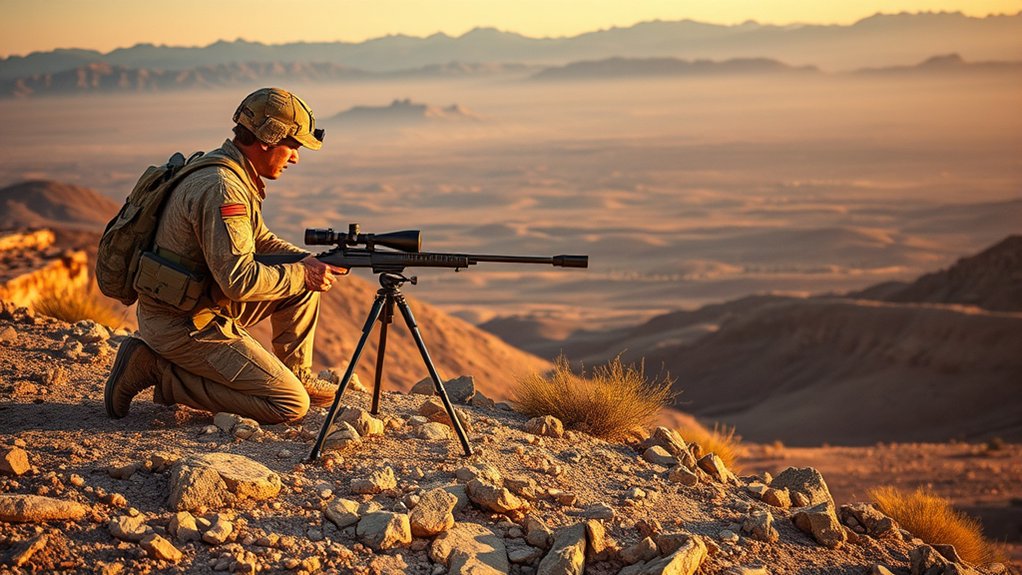
Long range shooting generally begins at distances beyond 600 meters (660 yards), but the exact definition depends on the caliber and context.
For example, if you’re using a .22 LR cartridge, long range shooting kicks in at just over 100 meters (110 yards), while centerfire intermediate calibers start around 300 to 400 meters (330-440 yards).
As a long-range shooter, you’ll notice that distances for competitions like F-Class vary between 300 and 1200 yards, reflecting different challenges.
Extreme long range (ELR) shooting, on the other hand, covers distances exceeding 1,000 meters (1,100 yards) and can go beyond one mile.
When shooting at distances this far, you must consider environmental conditions, as they heavily influence your accuracy and shot placement in long range shooting.
How Bullet Trajectory Changes in Long Range Shooting
When you’re shooting at long distances, gravity pulls your bullet down, making it drop more the farther it travels.
So, the longer the range, the more you have to compensate for that drop.
On top of that, there’s wind drift to think about.
Wind can push your bullet off course, and the longer it’s in the air, the more effect the wind has.
It also helps to understand your bullet’s ballistic coefficient.
This tells you how well your bullet cuts through the air, which is key for making the right adjustments and hitting your target accurately.
Gravity’s Effect On Trajectory
Although a bullet leaves the barrel traveling fast and straight, gravity immediately begins pulling it downward. This causes significant drop as distance increases. In long-range shooting, you must carefully adjust your elevation to compensate for gravity’s effect on bullet drop.
The bullet’s ballistic coefficient and initial velocity influence how much it drops. Environmental factors like altitude and temperature also play roles. Understanding minute of angle (MOA) helps you make precise adjustments; 1 MOA equals about 1.047 inches at 100 yards.
Here’s how gravity impacts trajectory:
| Distance (yards) | Approximate Bullet Drop (inches) |
|---|---|
| 100 | ~1.0 (1 MOA) |
| 500 | ~25 |
| 1000 | ~100 |
Accounting for these factors guarantees your shots stay accurate over long distances.
Wind Drift Impact
Gravity pulls your bullet downward, but the horizontal forces acting on it can be just as impactful. Wind drift plays a major role in long range shooting, as even a gentle breeze can push your bullet off target.
For example, a 10 mph crosswind at 1,000 yards can shift your bullet by 10-12 inches, making precision adjustments essential. The farther your bullet travels, the more pronounced the drift becomes.
At 600 yards, a 5 mph wind might cause a 4-5 inch drift, but this doubles near 1,200 yards. You must carefully assess wind speed and direction before each shot, since changes affect your bullet’s path.
Mastering wind reading and compensation sets apart skilled shooters, ensuring consistent accuracy despite environmental challenges.
Ballistic Coefficient Role
Since air resistance greatly affects your bullet’s flight, understanding the Ballistic Coefficient (BC) is essential for long-range shooting. The BC measures how well a bullet overcomes drag, with higher values, typically over 0.450, indicating better performance at extended distances.
A bullet with a high BC maintains velocity and energy, resulting in a flatter trajectory and less drop over distance. This means you can make more precise elevation adjustments when targeting beyond 600 meters.
Bullet design plays a key role in achieving a high BC, influencing accuracy and consistency.
Why Accurate Wind Estimation Is Crucial for Long Range Shooting?
When you shoot at long distances, even a slight breeze can push your bullet off course, making accurate wind estimation essential.
In long range shooting, wind affects your bullet trajectory considerably, especially beyond 600 meters.
You need to interpret environmental cues like mirage and terrain features to gauge wind speed and direction accurately. This skill lets you adjust your aim precisely, boosting accuracy and overall shooting skill.
Without proper wind estimation, even a perfectly aimed shot can miss the target. At extreme ranges over 1,000 yards, wind can vary along the bullet’s flight path, so you must account for those changes.
Mastering wind reading is challenging but crucial for consistent success in long range shooting.
How Caliber Choice Influences Long Range Shooting Distances
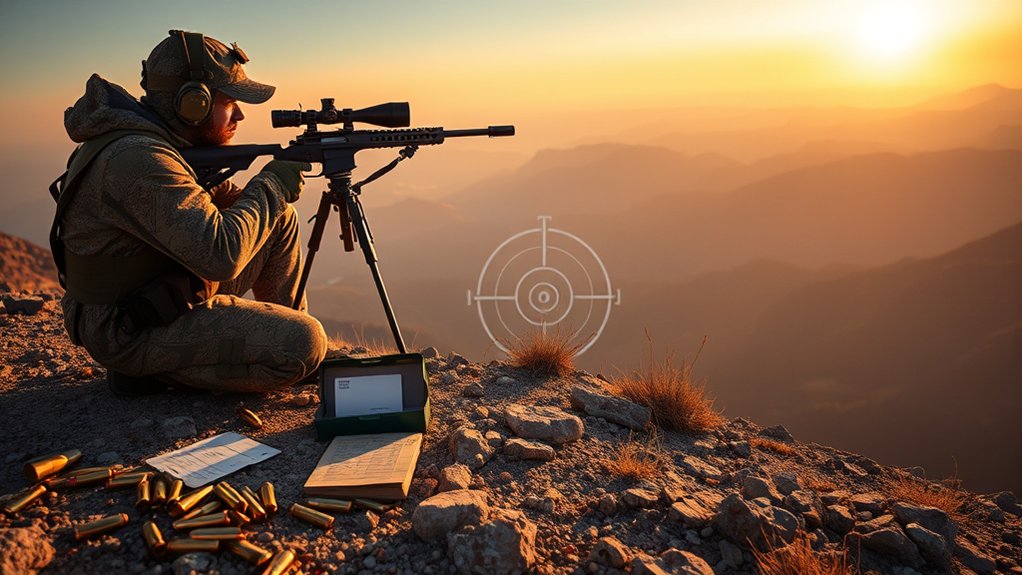
You’ll notice that choosing the right caliber directly impacts how far you can shoot accurately. It’s not just about the size of the bullet; factors like the bullet’s ballistic coefficient and velocity play key roles in extending your effective range.
When you understand these performance elements, it becomes a lot easier to pick the best caliber for your long-range needs.
Caliber Impact On Range
Although many factors affect long-range shooting, your choice of caliber plays a crucial role in determining effective distance and accuracy.
The caliber impact on ballistic performance is clear: calibers with higher muzzle velocity and ballistic coefficients, like the 6.5 Creedmoor, reduce bullet drop and maintain energy retention better over long ranges.
Larger calibers, such as the .300 PRC, offer enhanced downrange energy and resist wind drift, making them ideal beyond 1,000 yards.
Conversely, smaller calibers like the .223 Remington struggle with energy retention and are more affected by wind, limiting their effective range.
Understanding how caliber influences bullet drop, energy, and velocity helps you pick the right round for your shooting goals, ensuring improved precision and power at extended distances.
Ballistic Performance Factors
Ballistic performance hinges on your caliber choice, especially when shooting at long distances. Your caliber selection impacts trajectory, recoil, and energy delivery, all essential for accurate shots beyond 1,000 yards.
To maximize performance, focus on these factors:
Choose bullets with a high ballistic coefficient to reduce wind drift and bullet drop. Consider muzzle velocity consistency, which affects predictable bullet flight.
Also, account for weather conditions like temperature and humidity, as they influence caliber effectiveness.
Use match-grade ammunition for superior precision and reliable performance. Larger calibers like .300 Win Mag offer flatter trajectories, while manageable options like .308 Win help control recoil.
Environmental Factors Affecting Long Range Shooting Accuracy
When you shoot at long range, environmental factors like wind, temperature, humidity, and altitude play a fundamental role in your accuracy. Wind estimation is essential since wind speed and direction can push your bullet off course.
Atmospheric conditions affect air density, impacting bullet drop and velocity. Bullets fly faster at higher altitudes where air is thinner. Don’t forget gravity causes significant bullet drop over distance.
Ammunition quality also matters. Inconsistent muzzle velocity due to temperature or humidity changes can ruin your shot.
| Factor | Effect on Bullet | What You Should Do |
|---|---|---|
| Wind | Alters trajectory | Estimate speed/direction |
| Temperature | Changes air density | Adjust calculations |
| Humidity | Affects air resistance | Monitor local conditions |
| Altitude | Impacts velocity & drop | Account for thinner air |
Long Range Shooting Disciplines and Competitions
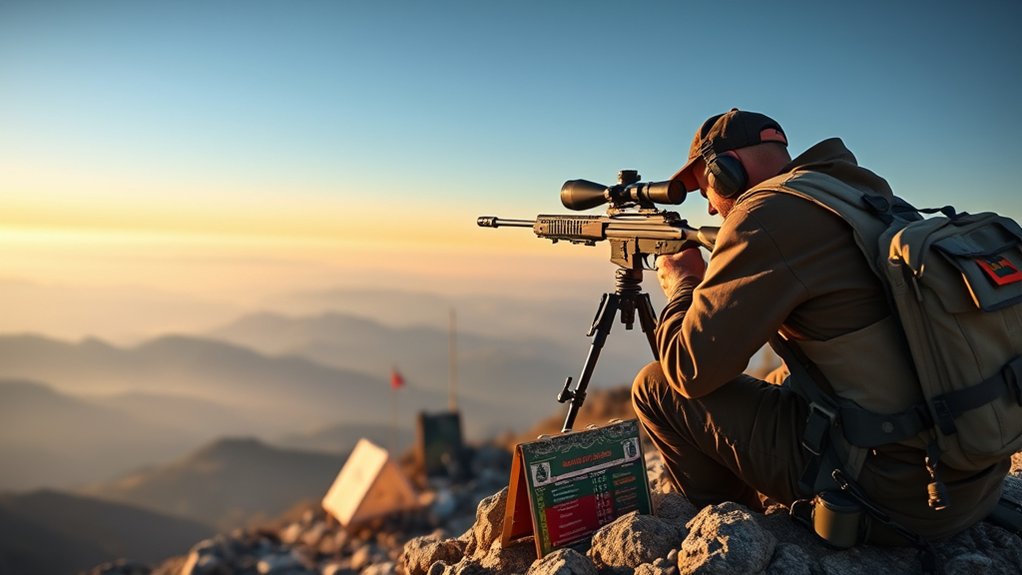
Since long range shooting covers a wide range of distances, you’ll find various disciplines tailored to different skill sets and challenges.
Whether you’re into Long Range Precision or tactical scenarios, competitions test your skills with rifle and scope setups suited for specific demands.
Competitions challenge your rifle and scope skills across diverse long range precision and tactical scenarios.
Here are some key disciplines to explore:
- F-Class shooting: Ranges from 300 to 1,200 yards, with categories like F-Open and F-TR, focusing on precision and equipment limits.
- Precision Rifle Competitions: Combine speed and accuracy at varying distances up to 1,000 yards, often requiring shooting from multiple positions.
- Benchrest competitions: Aim for the tightest shot groups at 600 and 1,000 yards, emphasizing supreme consistency.
- T-Class: Features six disciplines, scoring in milliradians with added complexity from penalty targets.
Each discipline sharpens different aspects of your long range shooting skills.
Essential Equipment for Long Range Shooting Beyond 600 Yards
To succeed at long range shooting beyond 600 yards, you’ll need a precise combination of specialized equipment tailored for accuracy and stability.
Start with a precision rifle built for long range, ensuring it’s chambered with match-grade or hand-loaded ammunition for consistent performance.
Your scope must offer clear optics with BDC reticles and turrets that allow precise elevation and windage adjustments to compensate for bullet drop and wind drift.
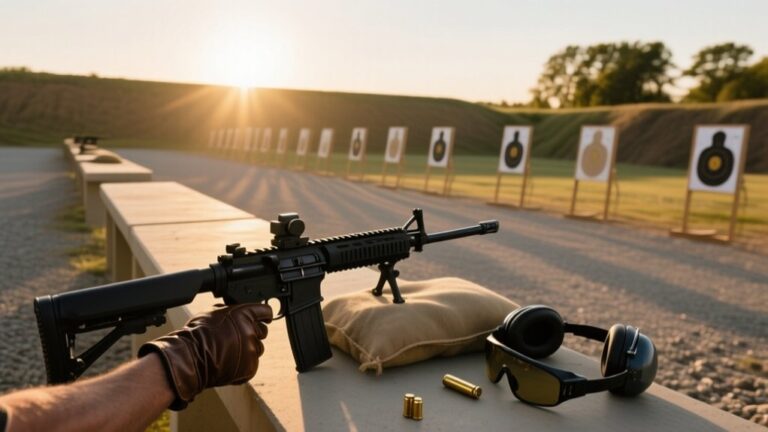
Stability is critical, so use a reliable bipod or shooting rest to minimize movement.
Don’t forget essential tools like a ballistic calculator, wind meter, and rangefinder to gather environmental data and calculate accurate firing solutions.
Combining this equipment sharpens your ability to place each shot exactly on target, even at extended distances.
Comparing Target Shooting and Hunting Distances
Although both target shooting and hunting involve long distances, the ranges you’ll encounter and the precision required can differ markedly.
In long range target shooting, you often face distances beyond 1,000 yards, demanding exact adjustments for wind and bullet drop.
Long range target shooting challenges you with distances over 1,000 yards, requiring precise wind and bullet drop adjustments.
Hunting distances usually max out around 300 to 500 yards, where ethical considerations become critical to guarantee a humane shot when shooting game.
Here’s how they compare:
- Long range in target shooting often exceeds 1,000 yards, while hunting distances are shorter.
- Precision shooting in competitions requires consistent accuracy at extreme ranges.
- Hunting demands accounting for animal movement and quick decision-making.
- Ethical considerations in hunting prioritize a clean, humane kill.
Understanding these differences helps you adjust your approach for each discipline.
Tips to Improve Accuracy at True Long Range
Mastering accuracy at true long range takes more than just understanding distances; it demands refined techniques and consistent practice. Start by securing a stable shooting position using a bipod or backpack to minimize movement.
Next, focus on wind estimation. Observe mirage and terrain features carefully to adjust your sights precisely. Use a ballistic calculator to input bullet specifics and environmental data, helping you determine the correct elevation and windage adjustments.
Don’t forget to document your data of previous engagements (DOPE) to track what works best under varying conditions.
Finally, practice breathing control by timing your shots during natural respiratory pauses to reduce body movement.
Combining these elements sharpens your long range accuracy and builds confidence with every shot.
Frequently Asked Questions
What Is the Best Type of Rifle Scope for Long-Range Shooting?
The best rifle scope for long-range shooting has high magnification levels, usually 10x to 25x, and a first focal plane reticle type for accurate holdovers.
Look for fully multi-coated lens coatings to improve clarity and light transmission.
Good scope mounts guarantee stability, while adequate eye relief protects your vision.
If you’re on a budget, you can still find quality options with adjustable turrets and parallax correction for precise shots.
How Do Temperature Changes Affect Long-Range Bullet Performance?
Temperature changes affect your bullet performance like a dance partner shifting steps. Higher heat reduces air density, lessening bullet drop and wind drift, while cold thickens air, increasing drag.
You’ll notice altitude effects and humidity impact combine with barrel temperature to alter velocity.
Ammunition choice plays a role too, as warmer temps boost cartridge pressure. To stay precise, you’ve got to adjust your scope for these factors constantly.
What Physical Skills Are Essential for Successful Long-Range Shooting?
You need solid stance stability to minimize movement and hold your aim steady.
Breath control helps you shoot during natural pauses, preventing shake.
Trigger discipline guarantees a smooth, jerk-free shot, improving accuracy.
Mental focus keeps you sharp and ready, while wind reading lets you adjust for environmental shifts affecting your bullet’s path.
Finally, target acquisition helps you quickly find and track your target, all essential for successful long-range shooting.
How Often Should Long-Range Shooters Practice to Maintain Proficiency?
Think of your skills as a finely tuned engine. You need regular fuel to run smoothly. You should practice at least once a week, combining shooting drills with mental focus to sharpen your edge.
Don’t forget equipment maintenance and adapting to range conditions. Use skill assessment tools to track progress, ensuring every session refines your aim and judgment.
Consistent practice keeps you ready for any challenge long-range shooting throws at you.
Are There Legal Restrictions on Long-Range Shooting in Certain Areas?
Yes, you’ll find legal regulations on long-range shooting vary widely depending on state laws and local rules.
Shooting ranges often have distance limits to guarantee safety, while public land may require hunting permits or restrict shooting zones.
You must follow safety guidelines and check specific restrictions before shooting, especially in populated or protected areas.
Staying informed helps you shoot legally and responsibly wherever you are.
Conclusion
When you step into the world of long range shooting, you’re not just firing a bullet, you’re mastering science and art together. Distances beyond 600 yards demand precision, patience, and understanding of wind, trajectory, and caliber.
Like a knight aiming an arrow in a medieval tournament, you’ll need the right gear and skills to hit your mark. Keep practicing, respect environmental factors, and soon you’ll see your shots consistently fly true at those impressive ranges.