Is Kentucky A Concealed Carry State – Laws And Permit Rules
Yes, Kentucky lets you carry a concealed firearm without a permit if you’re 21 or older and legally allowed to possess a gun. Residents can also get an optional concealed carry license by completing training and meeting specific criteria.
There are certain places where carrying concealed is restricted, and weapons like stun guns and pepper spray are allowed. Understanding Kentucky’s laws and reciprocity rules helps you carry responsibly and legally.
Keep exploring to grasp all key details and requirements.
Key Takeaways
- Kentucky allows permitless concealed carry for residents aged 21+ who legally possess firearms since June 28, 2019.
- A concealed carry license requires applicants to be 21+, complete state-approved training, and pay a $60 fee.
- Open carry is legal without a permit for residents aged 18 and older.
- Concealed carry is prohibited in federal buildings, schools, police stations, and private properties with posted restrictions.
- Kentucky recognizes valid concealed carry permits from other states through reciprocity agreements.
Permitless Concealed Carry in Kentucky

How does permitless concealed carry work in Kentucky? If you’re 21 or older and legally allowed to possess a firearm, you can carry a concealed weapon without needing concealed carry permits.
Kentucky’s law lets you carry concealed without a license, but this only applies to residents who meet the age and legal possession criteria.
Firearm safety is still super important, even if you don’t need a permit. So, you have to be aware of where you can legally carry your weapon.
The law doesn’t cover out-of-state visitors, and there are restrictions on carrying concealed in federal buildings, schools, and other specific places.
Open carry is also allowed without a license for people 18 and older, which goes hand in hand with permitless concealed carry.
Knowing these rules helps you carry responsibly and stay within Kentucky’s legal framework.
Eligibility for a Kentucky Concealed Carry License
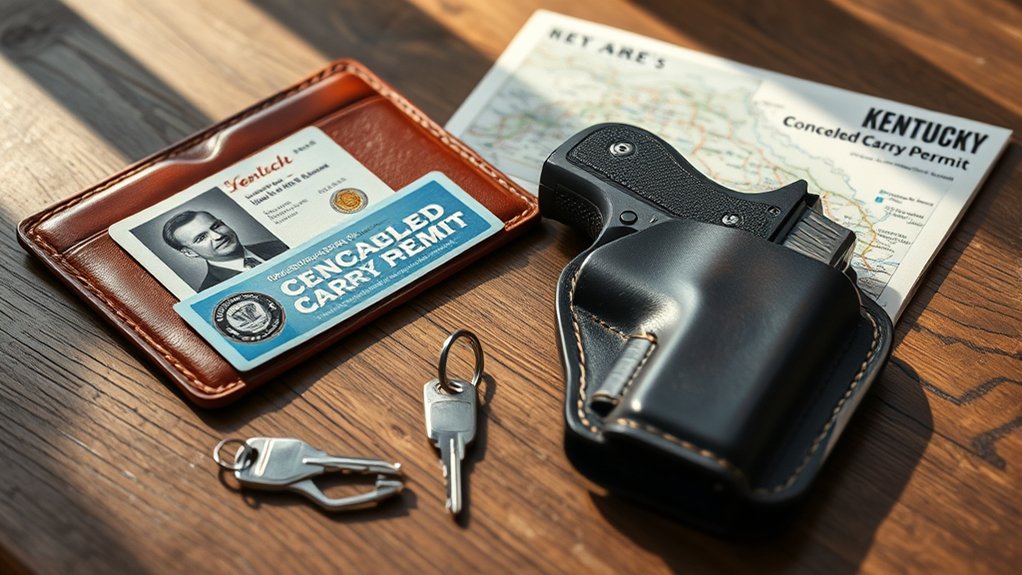
To be eligible for a Kentucky concealed carry license, you need to be at least 21 years old. You also have to be either a resident of Kentucky or an active-duty military member stationed in the state.
On top of that, you’ll have to complete a state-approved firearm training course to show that you’re competent with a gun.
Keep in mind, though, that certain criminal convictions and mental health issues can prevent you from getting a license.
License Eligibility Criteria
Although Kentucky allows concealed carry licenses to many residents, you must meet specific eligibility criteria to qualify. You need to be at least 21 years old and a U.S. citizen or legal resident.
To demonstrate firearm competence, you must complete a state-approved training course covering safety, laws, and marksmanship.
Firearm licensing also requires lawful possession of a firearm under federal and state law. Legal restrictions disqualify you if you have felony convictions, recent assault or drug-related misdemeanors, mental health adjudications, or active protective orders.
Active-duty military personnel assigned to Kentucky may also qualify.
Non-residents, however, are generally ineligible. Meeting these criteria guarantees you comply with Kentucky’s firearm licensing laws and helps maintain public safety.
Residency And Age Requirements
Meeting eligibility criteria extends beyond training and legal qualifications to include specific residency and age requirements. To qualify for a Kentucky concealed carry license, you must meet certain residency requirements and age restrictions.
Kentucky residents and active-duty military personnel aged 21 or older can apply, while non-residents cannot.
Individuals aged 18 to 20 may possess firearms but aren’t allowed to carry concealed weapons legally. If you move out of state, your license is automatically revoked.
Keep in mind these significant points:
- You must prove lawful Kentucky residency
- Full licenses are available only at age 21+
- Provisional licenses exist for 18-20-year-olds
- Non-residents are ineligible to apply
- Moving out of state cancels your license
Understanding these requirements is essential before applying. So, make sure you’re clear on these rules before you start the process.
How to Apply for and Renew a Kentucky Concealed Carry License

Applying for a Kentucky concealed carry license requires completing a state-approved firearms training course, submitting an application form along with a recent photo, and paying a $60 fee. The permit application process emphasizes firearms safety and accuracy. Processing takes about 90 days.
To renew, submit a renewal application and pay $60 before expiration. If you renew late, it costs an additional $55. You must report address or personal information changes in person at the sheriff’s office within 30 days.
If your license is lost or damaged, just request a duplicate with a $15 fee.
| Action | Fee |
|---|---|
| New Application | $60 |
| Renewal | $60 |
| Late Renewal | $115 |
| Duplicate License | $15 |
Where You Can and Cannot Carry Concealed Weapons in Kentucky
While Kentucky generally permits concealed carry for those 21 and older with a valid license or under permitless carry laws, certain locations restrict where you can carry a concealed weapon. Gun safety remains a priority, so understanding these restrictions helps you stay compliant with concealed carry permits and avoid legal trouble.
You can carry concealed in many public areas, but some places are off-limits.
You can’t carry concealed weapons in:
- Federal properties, courthouses, and police stations
- Detention facilities
- Schools and childcare facilities
- Private property with posted restrictions
- Liquor-licensed establishments that prohibit concealed carry
Always respect posted signs and private property rules to maintain gun safety and uphold legal responsibilities tied to your concealed carry permit.
Weapons and Ammunition Allowed for Concealed Carry in Kentucky
In Kentucky, you can carry pretty much any weapon that could cause serious injury or even death. This includes firearms, certain types of knives, and non-lethal options like tasers and pepper spray.
One thing to keep in mind is that there are no restrictions on the capacity of handgun magazines. So, you don’t have to worry about limits there.
However, armor-piercing ammunition isn’t allowed.
Knowing these rules is important because it helps you stay on the right side of the law when carrying concealed.
Permitted Firearms and Weapons
Although Kentucky permits concealed carry of various weapons, it places specific restrictions on certain ammunition types. You can carry firearms, knives, clubs, and brass knuckles, but you must follow laws regarding weapon storage and concealed carry training for responsible handling.
Kentucky allows high-capacity magazines and legal non-lethal options like pepper spray and stun guns without a license. However, armor-piercing ammunition remains prohibited. Remember, lawful possession depends heavily on intent and proper use.
Here are key permitted weapons for concealed carry in Kentucky:
- Firearms capable of causing serious injury or death
- High-capacity magazines allowed
- Non-lethal weapons such as tasers and pepper spray
- Certain knives, clubs, and brass knuckles
Legal possession requires adherence to weapon storage and concealed carry training.
This framework helps guarantee your safety and compliance.
Ammunition Restrictions and Types
How does Kentucky regulate the types of ammunition you can carry concealed? The state prohibits armor-piercing ammunition, so you can’t legally possess or use it while carrying concealed. Beyond that, Kentucky imposes no specific ammunition restrictions on standard handgun rounds or magazine capacity. You’re free to carry most common ammunition types without limitation.
Additionally, firearm accessories like stun guns, Tasers, pepper spray, and tear gas are legal for self-defense, with no size or concentration restrictions. Kentucky also recognizes valid out-of-state concealed carry permits, which might allow different weapon and ammunition types.
While Byrna, chemical, or kinetic guns are legal, they aren’t classified as firearms under Kentucky law.
Understanding these ammunition restrictions and firearm accessories rules helps you stay compliant when carrying concealed in Kentucky. It’s good to know exactly what’s allowed so you can carry with confidence.
Kentucky’s Stand Your Ground and Castle Doctrine
When faced with a threat in Kentucky, you don’t have to retreat if you’re lawfully present. The state’s stand your ground law lets you use deadly force without the duty to back down.
Kentucky’s Castle Doctrine further strengthens your legal defenses by presuming reasonable fear of death or serious injury when defending your home or vehicle. The use of force is justified to prevent death, serious injury, kidnapping, or violent felonies.
Unlawful entry into your dwelling or vehicle automatically creates a presumption of threat, allowing you to act decisively.
- Protect your family without hesitation
- Defend your home as a sanctuary
- Exercise your right to stand firm
- Rely on strong legal protections
- Respond swiftly to violent threats
Kentucky’s laws provide clear legal defenses for justified self-defense. You can feel confident knowing the law is on your side.
Kentucky’s Reciprocity and Out-of-State Carry Rules
Because Kentucky recognizes valid concealed carry permits from other states, you can legally carry a concealed weapon here if your permit is honored under reciprocity agreements.
Kentucky has established state reciprocity with other states, allowing holders of out-of-state permits to carry concealed weapons within its borders. However, out-of-state licenses don’t automatically transfer; reciprocity agreements must be in place for legal carry.
Since June 28, 2019, anyone 21 or older who can lawfully possess a firearm may carry concealed without a Kentucky license. This means out-of-state visitors and residents who meet eligibility can carry without obtaining a Kentucky permit.
So, if you qualify, you don’t have to worry about getting a Kentucky permit to carry concealed.
Understanding Kentucky’s reciprocity and out-of-state carry rules guarantees you stay compliant while carrying concealed in the state. It’s always a good idea to double-check the current agreements before you travel or carry. That way, you’ll avoid any surprises and carry with confidence.
Frequently Asked Questions
Can Employers Prohibit Concealed Carry on Private Property in Kentucky?
You can’t let employer restrictions ban concealed carry in employee parking lots on private property in Kentucky.
However, employers can prohibit firearms inside private buildings by posting clear signs or policies.
Are There Any Restrictions on Carrying Concealed Weapons in Vehicles?
You won’t face concealed carry restrictions in vehicles if your firearm is stored securely, like in a locked container or glove box. Vehicle security matters, but Kentucky lets you carry without a permit if you’re legally allowed.
That means as long as you’re following the law, you can keep your weapon with you in the car without any extra hassle. Just make sure it’s stored safely to avoid any issues. It’s pretty straightforward!
How Does Kentucky Handle Lost or Stolen Concealed Carry Permits?
Back in the days of telegrams, you’d still handle permit replacement by visiting your sheriff’s office in person. Kentucky’s lost permit procedures require a written request and a $15 fee.
There’s no extra training or paperwork needed. It’s pretty straightforward and doesn’t take much time. Just make sure you follow the steps carefully.
What Are the Penalties for Violating Kentucky’s Concealed Carry Laws?
If you violate Kentucky’s concealed carry laws, you risk misdemeanor or felony charges, fines, and jail time.
Permit renewal requires a background check, so any violations can prevent you from renewing or obtaining a permit.
It’s important to follow the rules to avoid these serious consequences.
Can Minors Possess Firearms for Educational Purposes Under Kentucky Law?
You might think minors can’t touch a firearm for anything, but Kentucky lets minor possession for educational use like safety courses or supervised shooting.
Just make sure you follow all laws and stay under adult supervision.
Conclusion
Exploring Kentucky’s concealed carry laws is like reading a detailed map. You need to know the routes and rules to travel safely. While permitless carry lets you carry without a license, it’s important to understand eligibility, application, and restricted locations.
Stay informed about what weapons are allowed. And remember Kentucky’s self-defense laws and reciprocity agreements. Being well-prepared helps you protect yourself responsibly and legally across the state.