Do You Need A Concealed Carry Permit In Kansas – Current Carry Laws
If you’re 21 or older, you don’t need a concealed carry permit to carry a handgun in most public places in Kansas. Those aged 18 to 20 must complete approved training and get a provisional license. Active duty military and their dependents can carry without a permit.
While a license isn’t required statewide, it’s necessary for reciprocity in other states and some specific locations. Keep in mind, certain areas still prohibit concealed carry.
Want to learn more about the application process, training requirements, and legal details? You can find all that information here.
Key Takeaways
- Adults 21+ can carry concealed in Kansas without a permit, except in restricted locations like federal buildings and schools.
- Individuals aged 18-20 must complete approved training and obtain a provisional license to carry concealed.
- Active duty military and their dependents stationed in Kansas can carry concealed without a permit.
- A Kansas Concealed Carry License is needed for reciprocity and broader legal protections outside Kansas.
- Concealed carry is prohibited in federally regulated areas and private properties that post explicit bans.
Who Can Carry Concealed Without a Kansas Permit?

While Kansas law permits individuals aged 21 and older to carry concealed handguns without a state-issued permit, those between 18 and 20 must complete approved training and obtain a provisional license to do so lawfully.
You should also know that active duty military personnel stationed in Kansas and their dependents can carry concealed firearms without a Kansas permit.
Kansas recognizes out-of-state permits for those 21 and older, allowing legal concealed carry. However, persons under 18 can’t carry concealed handguns regardless of any permit.
It’s important to dispel concealed carry myths, especially about firearm storage; safe storage laws still apply regardless of permit status.
Understanding who can carry without a permit helps you comply with state regulations and ensures responsible, lawful firearm handling.
When and Why Do You Need a Kansas Concealed Carry License?
If you’re 21 or older and want to carry a concealed handgun in most public places, you’ll need a Kansas Concealed Carry License. It’s pretty straightforward for adults.
Now, if you’re under 21, things are a bit different—you’ll need a provisional license and have to meet certain training requirements before you can carry concealed.
Also, if you’re an active-duty military member stationed in Kansas or a dependent family member, you might be able to carry without a license, but only under specific conditions.
Permitless Carry Age
Since July 1, 2015, Kansas allows individuals aged 21 and older to carry concealed handguns without a permit, simplifying the process for adults. Understanding the permitless carry age is *fundamental* within Kansas concealed carry regulations, especially considering license reciprocity with other states. Here’s what you need to know:
- If you’re 21 or older and a Kansas resident or active-duty military stationed in Kansas, you can carry concealed without a license.
- Ages 18 to 20 must obtain a provisional license and complete approved training to carry concealed legally.
- Anyone under 21 can’t carry concealed without a license, except as specifically allowed by law.
- A Kansas concealed carry license remains *vital* to comply with reciprocity rules when carrying in other states.
Knowing these distinctions helps you stay compliant and informed.
License Requirements Explained
Understanding the age requirements for permitless carry sets the stage for knowing when you actually need a Kansas Concealed Carry License (CCHL). If you’re 21 or older, you can carry concealed without a license.
But if you’re between 18 and 20, you must get a provisional CCHL after completing an approved firearm safety course.
You’ll also need a CCHL if you want to carry concealed in states recognizing Kansas reciprocity or in areas where permitless carry isn’t allowed.
Don’t fall for common licensing myths. The license isn’t just bureaucratic; it offers legal protections and broader recognition.
Ultimately, the CCHL ensures you comply with Kansas law and supports responsible firearm safety, especially when traveling or entering regulated private properties.
Military Exemptions Allowed
Active duty military personnel stationed in Kansas and their dependents living with them don’t need a Kansas Concealed Carry License (CCHL) to carry concealed firearms. Kansas law provides specific military exemptions allowing you to carry concealed without a license if you meet certain conditions.
Here’s what you should know: Active duty members can carry concealed on or off base without a Kansas CCHL. Dependents residing with active duty personnel also qualify for this exemption.
Military members with valid out-of-state permits are recognized and don’t need a Kansas license.
Non-resident military personnel stationed in Kansas may apply for a Kansas CCHL but can carry concealed without one under active duty status.
These military exemptions guarantee active duty personnel and their families have flexibility in concealed carry laws while stationed in Kansas.
How to Apply for a Kansas Concealed Carry License
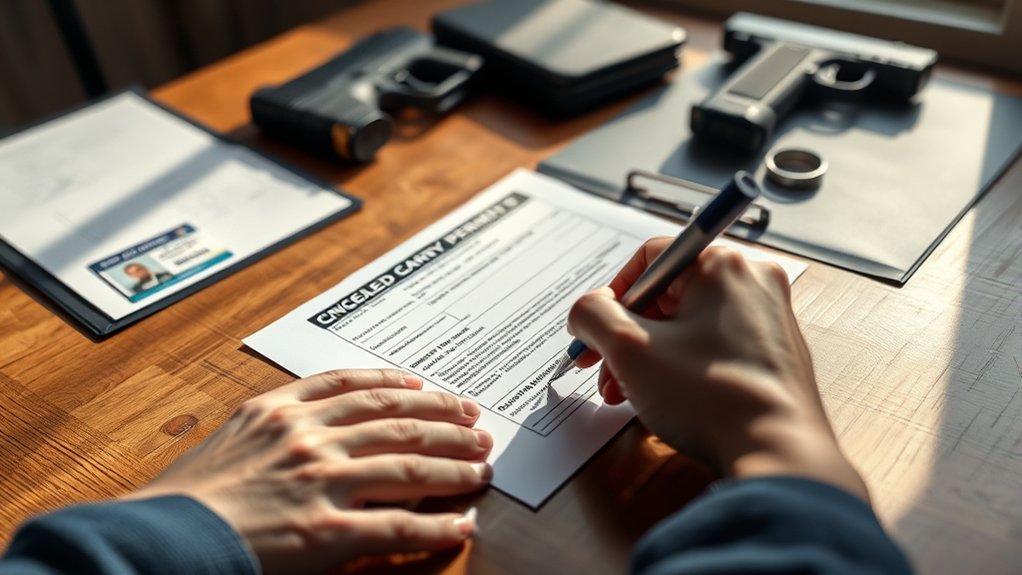
Before you can legally carry a concealed firearm in Kansas, you’ll need to complete a specific application process. First, finish an approved 8-hour firearms training course. Then, download and fill out the application from the Kansas Attorney General’s website.
Next, schedule an in-person appointment at your county sheriff’s office for fingerprinting. Submit your application along with the required documents and payment.
| Step | Requirement | Fee |
|---|---|---|
| Training | 8-hour certified course | Varies |
| Application | Completed form + photo + ID | $0 (since July 1, 2023) |
| Submission | Fingerprinting + documents | Included |
Keep in mind, the license renewal process is straightforward. This helps ensure your concealed carry rights remain uninterrupted.
What Training Is Required for a Kansas CCHL?
To get your Kansas CCHL, you’ll need to complete at least eight hours of approved handgun safety and training. This training covers important topics like Kansas self-defense laws and safe firearm handling.
Keep in mind, Kansas will accept out-of-state courses only if they meet the state’s standards. However, online training won’t count, so you’ll need in-person instruction.
When you’re ready to apply, make sure you have official proof of your completed training from a certified instructor. This is a key part of the application process.
Mandatory Course Components
Although Kansas law requires all concealed carry permit applicants to complete specific training, the state sets clear standards on what that training must include. To meet firearm safety and training standards, your course must total at least 8 hours of approved instruction. It needs to cover safe handling, storage, and firing practice.
The training also has to include Kansas laws related to concealed carry and use of force. Plus, it must be taught by a Kansas-approved instructor in person since online courses aren’t accepted.
You’ll need to submit proof of completion with your application, either through a signed form or an affidavit from your instructor. This compulsory course ensures you understand both practical firearm safety and the legal responsibilities of carrying concealed in Kansas.
Meeting these requirements is essential before you can get your concealed carry handgun license.
Recognized Prior Training
Since Kansas requires an approved 8-hour firearms training course for all concealed carry license applicants, certain prior training can qualify if it meets state standards. If you’ve completed military service, are a retired law enforcement officer, or a corrections officer with qualifying training, your prior instruction may satisfy the firearm safety and legal components.
This training must align with Kansas requirements, including safe handling, storage, firing of handguns, and state laws on concealed carry and use of force.
Only courses taught by certified Kansas instructors are accepted; online courses won’t qualify. To use recognized prior training for your Kansas CCHL, you must provide valid training certification confirming completion within designated timeframes.
Meeting these criteria ensures your prior experience counts toward the mandatory firearm safety training.
Training Documentation Required
Before applying for a Kansas Concealed Carry Handgun License (CCHL), you must complete an approved 8-hour handgun safety and training course. This course covers Kansas self-defense laws, safe handling, storage, and firing of handguns. The training is mandatory and must be conducted by a Kansas-approved instructor. Online courses don’t qualify.
To fulfill the training documentation requirements, you need certification verification that shows you completed the course. Here’s what you must provide:
- A signed instructor’s form confirming course completion
- Or an affidavit verifying your training
- Acceptable prior military or law enforcement training if it meets Kansas standards
- Guarantee all documentation is accurate and submitted with your application
Following these steps makes sure your application meets Kansas concealed carry laws. It’s important to have everything in order before you apply.
Which Criminal Records Disqualify You From Getting a Kansas CCHL?
If you have certain felony convictions or juvenile adjudications, you won’t qualify for a Kansas Concealed Carry Handgun License (CCHL). Background checks thoroughly review your criminal history, focusing on disqualifications such as felony offenses with incarceration over 12 months, violent misdemeanors, domestic violence, or drug-related convictions.
Additionally, dishonorable military discharges, misconduct dismissals, or renunciation of U.S. citizenship also bar eligibility. Mental health adjudications or involuntary commitments can disqualify you as well.
While expunged records don’t have to be disclosed, prior convictions may still prevent you from obtaining a CCHL depending on their severity. It’s important to understand these criminal disqualifications because federal and state laws work together to make sure only qualified individuals get the permit after passing thorough background checks.
Does Kansas Recognize Out-of-State Concealed Carry Licenses?
Understanding which criminal records disqualify you from obtaining a Kansas Concealed Carry Handgun License (CCHL) is essential, but you might also wonder how Kansas treats concealed carry licenses issued by other states.
Kansas supports license portability through reciprocity agreements, recognizing valid out-of-state concealed carry licenses since July 1, 2021. Here’s what you need to know:
- Kansas accepts out-of-state licenses for non-residents and active-duty military stationed in Kansas.
- Residents aren’t required to use out-of-state licenses while carrying concealed within Kansas.
- Non-residents with valid, recognized licenses can carry concealed in Kansas regardless of age.
- Reciprocity agreements apply universally, ensuring seamless license portability across state lines.
This approach guarantees you can carry concealed responsibly when visiting or stationed in Kansas without needing a separate state-issued permit.
Where Can You Carry Concealed in Kansas?
While Kansas generally allows you to carry concealed in most public places, certain locations have specific restrictions you should know about. Travel restrictions mainly apply to federal buildings, schools, and courthouses where concealed carry is not allowed.
On private property, you can carry unless the owner posts signs that forbid it. Renewing your license doesn’t change where you can carry, but it’s important to keep it current to stay legal.
| Location | Concealed Carry Allowed? |
|---|---|
| Public places | Yes, unless posted otherwise |
| Private property | Yes, unless owner prohibits |
| State parks & forests | Yes, generally unrestricted |
| Federal buildings | No |
| Schools & courthouses | No |
Make sure to stay aware of posted signs and laws to avoid any violations.
How to Update Your Kansas CCHL After Moving or Name Changes
Because keeping your Kansas Concealed Carry Handgun License (CCHL) information accurate is essential, you must notify the Kansas Concealed Carry Licensing Unit of any address or name changes within 30 days. Remember, updating your driver’s license doesn’t update your CCHL.
Notify the Kansas Concealed Carry Licensing Unit of address or name changes within 30 days to keep your CCHL accurate.
To complete an address update or name change, follow these steps: submit a written notification via an online form or mail. Be sure to include any applicable fees required for processing.
If you move out of Kansas, provide prior notice to request a 90-day extension to maintain your license validity.
Avoid failure to report changes, as it can lead to fines up to $100 or a six-month license suspension.
Staying compliant guarantees your concealed carry privileges remain intact and legally recognized. So, keeping your information current is definitely worth the effort.
Frequently Asked Questions
Can I Carry a Concealed Firearm in Kansas State Parks?
Yes, you can carry a concealed firearm in Kansas state parks without a permit. However, you need to follow firearm registration rules and concealed carry restrictions.
This includes making sure your firearm is stored securely. Also, be sure to avoid buildings that have posted prohibitions. That way, you’ll stay compliant with the law.
Are There Restrictions on Carrying Concealed Firearms in Kansas Schools?
Yes, you’ll face firearm restrictions in Kansas schools to guarantee school safety. You can’t carry concealed inside buildings unless security measures and signage allow it. Also, unlicensed carry within 1,000 feet of schools is illegal.
What Should I Do if My Concealed Carry License Is Lost or Stolen?
If your concealed carry license is lost or stolen, you need to report it within 30 days. Make sure to submit a notarized form along with a $15 fee.
After that, you’ll have to apply for re-issuance. This means completing a new background check and taking a new photo for your license renewal.
It’s a bit of a process, but following these steps will get you back on track with your concealed carry license.
Can Non-Residents Apply for a Kansas Concealed Carry Permit?
You’d think non-resident eligibility is open, but it’s not. Only active duty military stationed in Kansas or their dependents can apply.
The application process requires strict proof. Others simply can’t get a Kansas concealed carry permit.
Are There Specific Firearm Storage Laws for Concealed Carry in Kansas?
Yes, Kansas requires you to follow strict storage safety rules for concealed carry firearms. Although firearm registration isn’t mandatory, you must securely store your handgun when not in use to prevent unauthorized access and comply with state law.
It’s important to keep your firearm in a safe place where others, especially children, can’t get to it. This helps ensure everyone’s safety and keeps you on the right side of the law. So, even if you’re carrying concealed, your responsibility to store your gun safely doesn’t go away.
Conclusion
Mastering Kansas concealed carry laws might feel like threading a needle, but with the right knowledge, you hold the key. Whether you qualify to carry without a permit or need to apply for a CCHL, understanding the rules keeps you on the safe side of the law.
Stay sharp on training, disqualifications, and license recognition to carry confidently. Being informed is your best defense. Keep your carry rights clear and your steps steady.