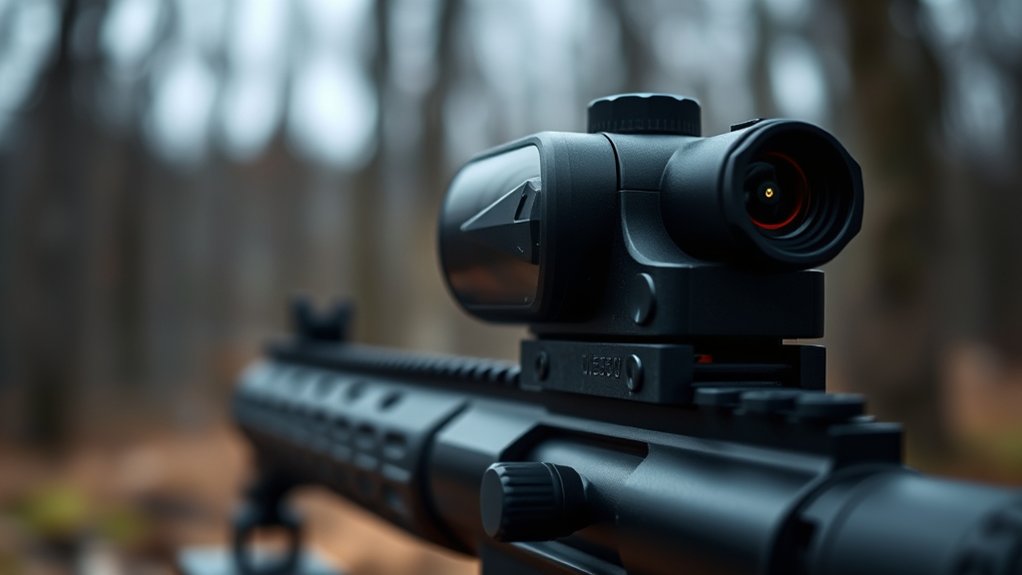
What Is Parallax On A Red Dot – Meaning And Performance Explained
Parallax on a red dot sight is the apparent shift of the reticle relative to your target when your eye moves off-center, causing aiming errors. Even premium sights show small shifts within ±1-2 MOA, which can affect shot precision, especially at longer ranges.
Proper zeroing, consistent cheek weld, and using parallax-corrected optics help minimize these errors. Understanding how lens design and adjustments control parallax will improve your shooting accuracy and reliability.
Key Takeaways
- Parallax causes the reticle to appear to shift relative to the target when the shooter’s eye moves off-center.
- Even high-quality red dot sights exhibit minor reticle shifts within ±1-2 MOA due to parallax.
- Proper zeroing and consistent eye position minimize parallax errors and maintain shot accuracy.
- Parallax-free sights are designed to keep reticle alignment stable at a set distance, often 50 or 100 yards.
- Testing parallax involves moving the head while aiming to observe any reticle movement against the target.
What Is Parallax and How It Affects Red Dot Sights
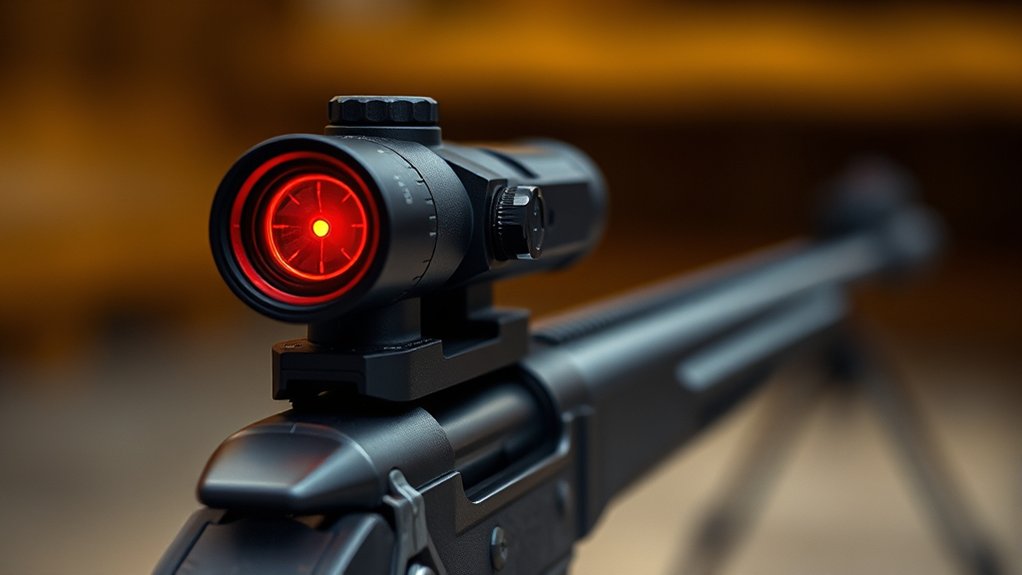
How does parallax impact your accuracy when using red dot sights? Parallax refers to the perceived shift of the reticle relative to the target when your eye moves behind the optic.
In many red dot sights, parallax is minimized or eliminated at a specific distance, ensuring the reticle stays aligned with the target even if your eye position shifts slightly.
However, if parallax error occurs, moving your head can cause the reticle to appear off-target, which can degrade shot precision. High-quality red dot sights reduce parallax effects to within ±1-2 MOA, allowing for consistent aiming.
You can test this yourself by aiming at a distant target and moving your head. If the reticle shifts relative to the target, then parallax is affecting your sight’s performance. It’s a simple way to see how much parallax might be impacting your accuracy.
How Parallax Can Change Your Shots
A slight shift in your eye position behind a red dot sight can cause the reticle to move relative to the target, directly affecting your shot placement. This parallax effect becomes more pronounced if your sight isn’t properly zeroed at the target distance, leading to misalignment between the dot and the bullet’s impact point.
Even so-called parallax-free sights show minor reticle shifts with small eye movements, which can influence your precision.
At longer ranges, parallax can shift your point of aim by several inches if your eye moves considerably off-center.
To minimize parallax-induced errors, keep a consistent cheek weld and make sure your optic is precisely zeroed.
Understanding how parallax changes reticle position helps you compensate for potential deviations and ultimately improves your shot accuracy.
Testing Your Red Dot for Parallax Issues
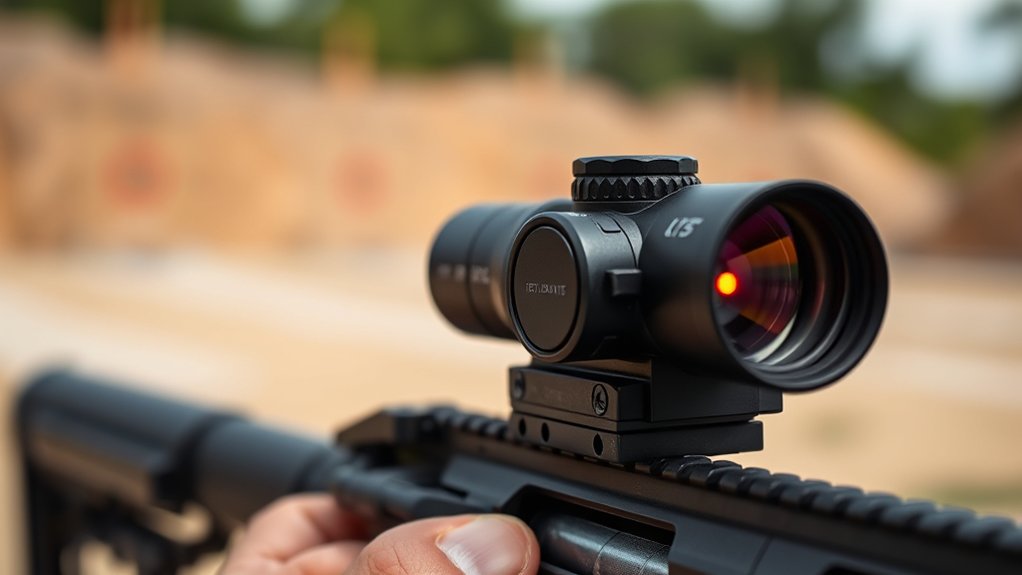
When you test your red dot for parallax, you’ll aim at a distant target and systematically move your head to check if the dot shifts relative to the target. This process helps determine if your sight is truly parallax free at that range.
Next, fire multiple shots while varying your eye position across the lens to analyze group consistency. Testing at different distances, like 15 and 50 yards, reveals if parallax effects grow with range.
Focus on these key steps:
- Observe if the red dot moves against the target when shifting your head.
- Assess bullet group shifts when aiming through top, bottom, and side lens positions.
- Compare impact points across distances to confirm parallax free performance.
This guarantees your red dot maintains accuracy despite eye position changes.
Why Some Red Dot Lenses Are Slanted
Understanding parallax behavior involves more than just testing your red dot. It also requires recognizing design factors that affect reticle visibility. Some red dot lenses are intentionally slanted to reflect reticle light at ideal angles, which enhances brightness and clarity.
This slant isn’t a defect. It’s vital for the proper function of certain optics, especially larger models like the Primary Arms SLx® MD-25 Gen 2 and holographic sights. These use internal reflective technology to improve performance.
| Lens Type | Slant Purpose | Effect on Performance |
|---|---|---|
| Standard Red Dot | Minimal or no slant | Basic reticle visibility |
| Large Optics | Pronounced slant | Enhanced brightness & clarity |
| Holographic Sights | Slight slant | Optimal internal reflection |
| Primary Arms SLx® | Noticeable slant | Improved image quality |
| Reflective Optics | Designed slant | Maximized reticle contrast |
How Red Dot Sights Handle Parallax
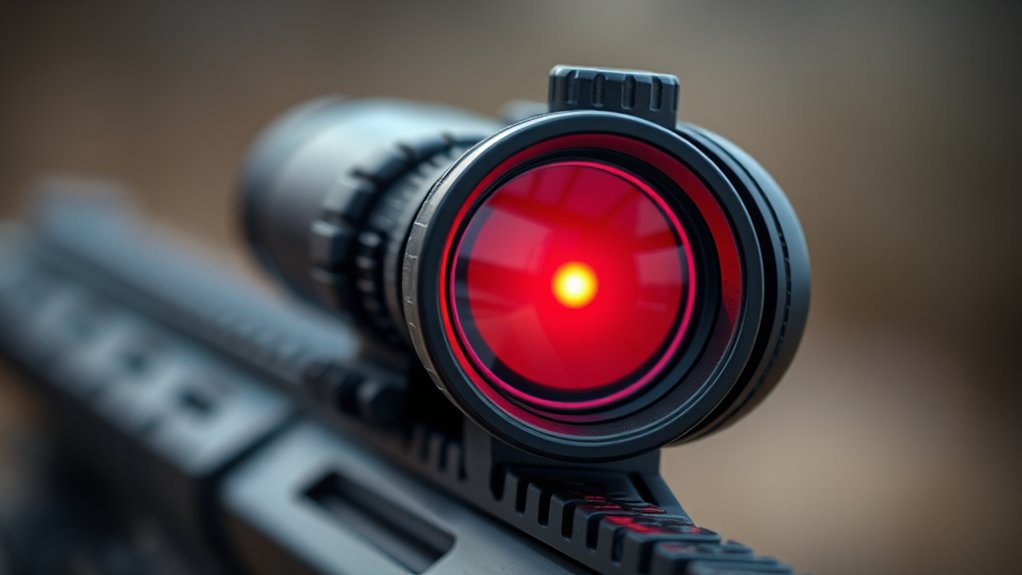
Modern red dot sights incorporate advanced optical engineering to handle parallax by maintaining the reticle’s alignment with the target across various eye positions within a specified range. These sights are designed to be parallax-free at a set distance, typically 50 or 100 yards, which minimizes reticle shift as you move your eye.
The lens system often features slanted or specialized internal reflectors that ensure the reticle light reflects correctly to reduce parallax effects. High-quality models consistently keep the point of aim stable even with head movement, so you can trust that parallax is well managed.
Key features include:
- Parallax-free design within a defined distance range
- Lens architecture optimized for precise reticle projection
- Reticle stability despite eye position shifts
This precision means you can rely on consistent accuracy without worrying about parallax-induced errors.
Tips to Reduce Parallax Problems in the Field
To reduce parallax problems effectively in the field, you’ll need to zero your red dot sight precisely at your intended shooting distance. This ensures the reticle aligns accurately with the point of impact.
Zero your red dot sight at your shooting distance to ensure reticle and impact alignment.
Maintaining a consistent cheek weld and stable head position helps minimize eye movement, which in turn prevents unintended parallax shifts.
It’s a good idea to regularly test your sight by slightly moving your head while aiming at a fixed target. This helps reveal any residual parallax errors that might need correction.
You can also adjust your optic’s focus and eye relief settings to sharpen image clarity and reduce parallax-related aiming discrepancies.
Using a high-quality, parallax-free red dot sight is especially important for longer-range or dynamic shooting. It really reinforces accuracy by minimizing parallax effects during practical use.
Staying consistent and checking your setup often will make a big difference out in the field.
How to Choose a Red Dot Sight That Minimizes Parallax
When you’re picking out a red dot sight, it’s a good idea to look for models that are specifically labeled as parallax-free or designed to minimize parallax at the range where you usually shoot. That way, you know the sight is built to keep your aim true.
Also, don’t overlook the quality and design of the lens. Opt for optics that have precise craftsmanship and features like adjustable focus, which can really help reduce any image shift.
Another thing to keep in mind is the size of the lens and sight window. Generally, sights with smaller lens diameters and shorter sight windows do a better job at minimizing parallax because they limit how much the reticle moves when your eye position changes.
Parallax-Free Optic Features
Although no red dot sight can be entirely free of parallax at every distance, choosing one designed to be parallax-free at a specific range, often 50 or 100 yards, ensures the reticle stays aligned with your target despite slight shifts in eye position.
Parallax-free optics achieve this by focusing the reticle on a precise plane beyond the lens. This minimizes aiming errors caused by eye movement.
To select an effective parallax-free sight, consider features that directly impact performance:
- Adjustable side focus or objectives for fine-tuning reticle clarity at various distances
- Manufacturer specifications confirming parallax elimination at targeted ranges
- Proven reputation for maintaining reticle alignment despite inconsistent head or eye placement
These factors help you maintain accurate shot placement under varied shooting conditions. It’s really about picking a sight that stays true no matter how you move your head.
Lens Quality And Design
Selecting a red dot sight that effectively minimizes parallax involves scrutinizing the quality and design of its lenses. High lens quality is vital. Precise manufacturing and advanced coatings reduce light distortion and parallax errors.
Optics with larger, well-engineered lenses maintain reticle alignment across varying eye positions, which enhances accuracy. You should prioritize sights featuring adjustable focus or side focus parallax correction to fine-tune reticle positioning at different distances.
Furthermore, lens coatings that boost clarity and light transmission prevent image distortion. This directly impacts parallax performance.
Choosing reputable brands known for rigorous quality control and innovative lens technology ensures you invest in a red dot sight engineered to minimize parallax issues effectively.
Focusing on these design elements guarantees ideal sight performance under diverse shooting conditions. It’s worth taking the time to find a sight that gets this right.
Summary: Managing Parallax for Better Accuracy
You need to understand how parallax can subtly shift your point of aim and affect accuracy, especially at different distances. It’s something that can catch you off guard if you’re not paying attention.
To keep these errors in check, make sure you regularly zero your sight at the range you plan to shoot. And if your scope has adjustable focus features, definitely use them—they can make a big difference.
Also, try to keep the reticle steady on your target as you move your eye. Doing this helps confirm that you’re managing parallax effectively, which leads to more consistent shot placement.
Parallax Impact On Accuracy
When your eye shifts position, even slightly, relative to the red dot sight, parallax can introduce aiming errors that affect shot placement. This happens because the reticle’s apparent position changes with your head’s lateral or vertical movement. That causes misalignment between the sight and the target.
Even with high-quality, parallax-minimized red dot sights zeroed at a specific distance, small deviations of ±1-2 MOA can occur.
To understand parallax’s impact on accuracy, consider how lateral or vertical head movement shifts the reticle’s perceived position. Also, think about the importance of a properly zeroed sight reducing parallax-induced errors. And don’t forget the necessity of consistent eye positioning for reliable shot placement.
Recognizing parallax’s influence helps you maintain precision and consistency in your shooting performance. It’s a key factor that can make a real difference when you’re aiming.
Techniques To Minimize Parallax
Although parallax can compromise your shot accuracy, several techniques effectively minimize its impact. Start by adjusting the scope’s parallax correction knob or focus to align the reticle precisely with your target at the intended shooting distance.
Make sure to maintain a consistent cheek weld and eye position to keep the reticle aligned with your line of sight. This helps reduce parallax shifts and keeps your aim steady.
You can also use high-quality, parallax-free red dot sights designed to keep the reticle stable even if your eye moves slightly. Zero your red dot at your typical shooting distance to make sure the reticle stays accurately aligned during use.
Want to test your parallax correction? Just move your head a little while aiming. If the reticle stays fixed on the target, you’re good to go. This means better shot precision and consistency.
Frequently Asked Questions
Does Parallax Affect Night Vision Red Dot Sights?
Parallax minimally affects night vision red dot sights because they’re designed to be parallax-free at their intended viewing distances. You’ll find that the internal optics and lens configurations focus on a specific plane, reducing parallax errors even if your eye moves slightly.
Still, you need to properly zero and focus your sight to maintain precision. This guarantees consistent accuracy during low-light use, where parallax impact is naturally less pronounced compared to daylight optics.
Can Parallax Cause Eye Strain During Extended Use?
Parallax itself doesn’t directly cause eye strain. But if you keep adjusting your eye position to compensate for it, you’ll end up with muscle fatigue around your eyes and neck.
When you use non-parallax-free sights at long distances, your eyes have to work harder to keep the reticle aligned. That can increase discomfort over time.
To minimize strain, it’s best to rely on high-quality, parallax-free optics. These allow you to keep the reticle in place without constantly moving your head or eyes, especially during extended use.
Are Parallax Issues More Common in Budget Red Dot Sights?
Yes, parallax issues are more common in budget red dot sights because they use lower-quality lenses and less precise manufacturing.
When you rely on cheaper models, you’ll notice more reticle movement if your eye shifts, which can increase aiming errors.
These sights often lack advanced parallax compensation and have simpler reticle designs, making image shift even worse.
Investing in higher-quality sights can help reduce parallax thanks to better lens coatings and internal adjustments.
How Does Parallax Differ Between Red Dots and Holographic Sights?
You’ll notice parallax differences mainly in how the reticle behaves with eye movement. Red dots use reflective lenses designed to be nearly parallax-free at their set distance.
So, your reticle stays aligned even if your eye shifts.
Holographic sights project a laser reticle onto a glass window, which can cause slight reticle shifts at extreme angles or edges of the sight.
Does Temperature or Weather Impact Parallax Performance?
Temperature and weather do impact parallax performance, acting like unseen hands shifting your sight’s alignment. Lens expansion or contraction from heat or cold changes optical paths.
At the same time, thickened lubricants in low temperatures can hinder lens movement.
High humidity or condensation fog lenses, obscuring your view and complicating precise adjustments. Rain and fog reduce visibility, making it harder to detect parallax errors.
You really have to keep these factors in mind for reliable accuracy in different conditions.
Conclusion
Now that you understand how parallax can subtly shift your point of aim, imagine using that knowledge to tighten every shot. You’re not just shooting. You’re mastering precision by minimizing parallax errors with the right red dot sight and proper technique.
The key lies in your ability to detect and correct these shifts before they impact your performance. Stay sharp, test thoroughly, and you’ll reveal accuracy that others only dream of achieving.