How To Get Concealed Carry Permit In Ny – Licensing Requirements Explained
To get a concealed carry permit in New York, you must be at least 21, complete approved firearms safety training, and pass thorough background checks including fingerprinting. You’ll need notarized character references, valid ID, and proof of residency or employment ties to NY.
Apply in person at your local sheriff’s office or courthouse, and attend an interview verifying your information and firearm knowledge. Understanding restrictions and renewal requirements will help you maintain compliance and legal privileges.
More details will clarify each step and responsibility. Just take it step-by-step, and you’ll be on your way to getting that permit.
Key Takeaways
- Applicants must be at least 21 years old and demonstrate good moral character with notarized references and background checks.
- Complete 16 hours of firearm safety training, including classroom and live-fire practice, and pass a written test with at least 80%.
- Submit an application in person with valid ID, fingerprinting receipts, training certificates, character references, and pay required fees.
- Undergo fingerprinting and thorough background checks through NY and FBI databases before an in-person interview verifying eligibility.
- Renew permits every three years, with possible recertification requirements like updated training or fingerprinting to maintain legal carry privileges.
Eligibility Requirements for a New York Concealed Carry Permit
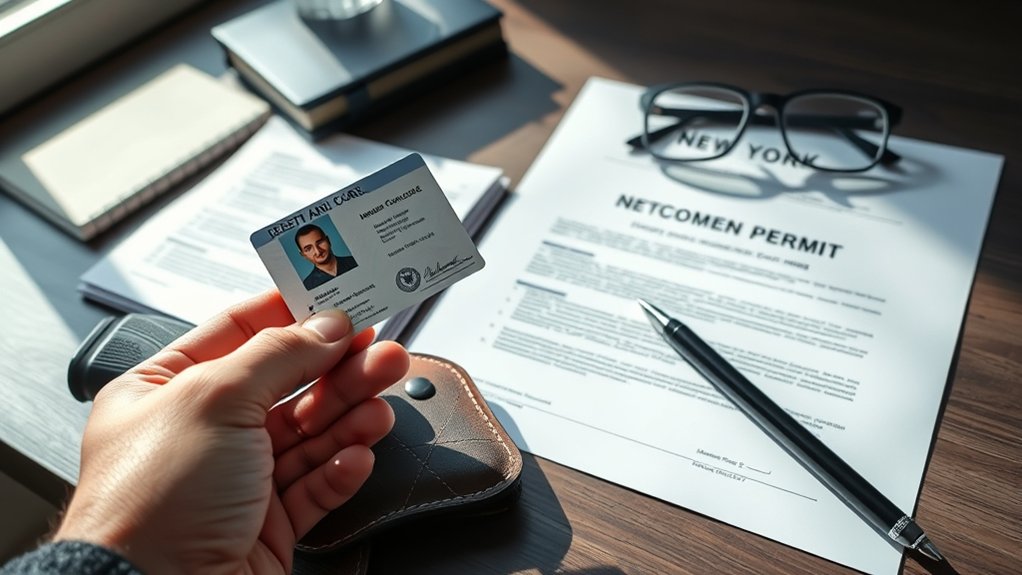
While applying for a New York concealed carry permit, you must meet several eligibility requirements. You need to be at least 21 years old, though honorably discharged military members may qualify earlier. Demonstrating good moral character is essential; this involves background checks and character references.
You also must complete a state-approved firearms safety training course, which includes 16 hours of classroom instruction and 2 hours of live-fire training. Handling firearm storage responsibly is a critical part of the training, emphasizing safety and legal compliance.
Additionally, you should understand concealed carry etiquette, which includes respecting others’ comfort and following all laws regarding when and where to carry. These requirements guarantee you’re prepared to carry safely and responsibly in New York.
Residency Rules and Non-Resident Applications for NY Permits
If you don’t live in New York but work or have your main business there, you can apply for a concealed carry permit under certain conditions. Non-resident eligibility requires you to show a significant connection to the state, like having a job or owning property.
Meeting the employment connection requirements is key. Your permit stays valid only as long as you keep that connection.
New York law lets non-residents apply, but approval is up to the authorities and depends on meeting specific criteria.
You’ll need to complete the same training, background checks, and paperwork as residents. Just remember, non-resident permits depend on your ongoing ties to New York.
Firearms Safety Training for Concealed Carry in New York
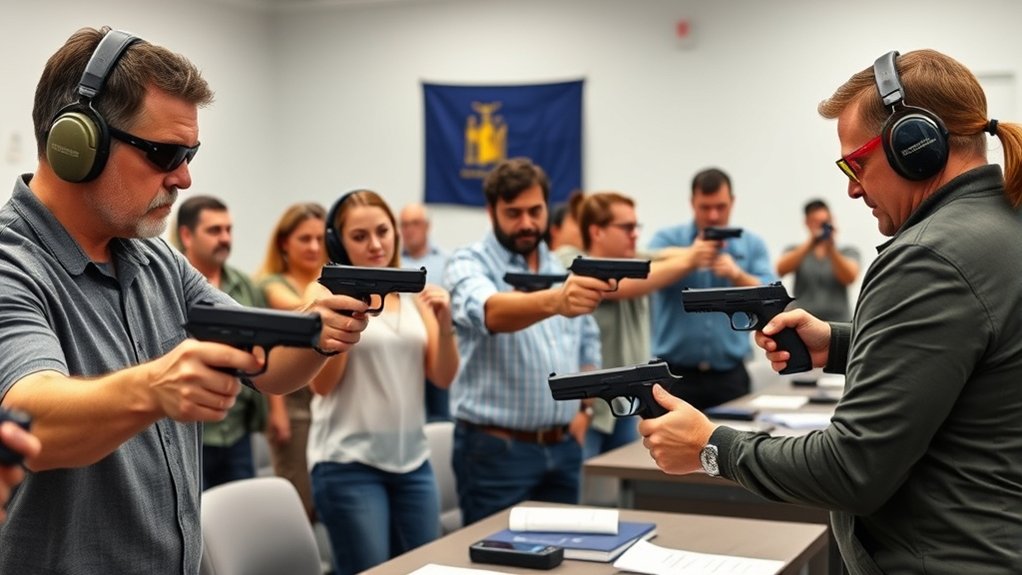
Because safety is paramount, New York requires applicants for concealed carry licenses to complete 16 hours of classroom training covering firearm handling, storage, relevant laws, and use of force. This training emphasizes gun safety and proper firearm storage to prevent accidents and guarantee responsible ownership.
You’ll also need to complete at least 2 hours of live-fire practice, where certified instructors evaluate your proficiency. To demonstrate your understanding, you must pass a written test with a minimum score of 80%.
Approved courses are offered by certified instructors and organizations like the International Security Services (ISS), which provides DCJS-approved programs.
Successfully completing this firearms safety training is mandatory before you can apply for a concealed carry license in New York. So, make sure you get everything done before submitting your application. It’s all about keeping you and others safe.
Documents and References Needed for Your Application
You’ll need to submit proper identification documents and proof that you’ve completed firearms safety training along with your application.
Also, make sure your character references meet the residency and acquaintance requirements.
Don’t forget to have their signatures notarized.
If you’ve lived outside Monroe County or New York State for a significant amount of time, you might need to provide additional references as well.
Required Identification Documents
What documents do you need to submit when applying for a concealed carry license in New York? You must provide valid identification, such as a driver’s license or state ID, proving your identity, residency, and lawful presence.
Include notarized character references, usually three, who’ve known you for at least one year. If you’ve recently moved or lived outside the jurisdiction, you might need additional references.
Don’t forget to submit fingerprint cards and background check consent forms. All documents must be current and accurately completed for timely processing.
While applying, consider your firearm’s ammunition compatibility and concealed carry accessories to verify compliance with regulations. Meeting these documentation requirements sets a solid foundation before moving on to proof of firearm training in your application process.
Proof of Firearm Training
Although submitting identification documents is essential, providing proof of firearm training is just as important when applying for a concealed carry license in New York. You must complete 16 hours of classroom safety training and 2 hours of live-fire practice with certified instructors.
The course covers gun safety, firearm maintenance, handling, storage, laws, and use of force. To demonstrate your knowledge, you need to pass a written test with at least 80% accuracy.
After you finish the course successfully, you’ll receive certificates from approved training providers. These certificates serve as proof of firearm safety training.
Make sure to submit these certificates along with your application to show you meet New York’s licensing requirements. Without this documentation, your application won’t meet the state’s standards for concealed carry permits.
Character References Submission
After submitting your firearm training certificates, the next step is to gather character references to support your application. You need to provide three notarized signatures from character references who’ve known you during your residence in Monroe County. These references should attest to your good moral character and complete the Proof of Character Form.
Keep these points in mind. References must be Monroe County residents or from your previous residence if you’ve recently moved. Each reference must sign and notarize the Proof of Character Form as part of the notarization process.
You might need additional references if you’ve lived outside Monroe County or another state recently. Making sure your character references meet these criteria will really help strengthen your concealed carry permit application.
Fingerprinting and Background Check Process Explained
You’ll need to get your fingerprints done at specific locations. Just be sure to bring your appointment receipt and follow the schedule based on where you live.
This part is really important because it’s how they check your background, looking into your criminal history and law enforcement records through both NY State and FBI databases.
After that, you’ll have an interview and a verification process to make sure all your information matches up.
This helps them decide if you qualify for your concealed carry permit.
Fingerprinting Procedure Details
Since fingerprinting is a mandatory step in the concealed carry permit process, you must schedule an appointment in advance through the designated local office. You can do this online if you live in the city or by phone for suburban areas.
Fingerprinting is done only at authorized locations like the Rochester Police Department or Sheriff’s Office, not through private companies.
You’ll need to bring your appointment receipt as proof because walk-ins aren’t accepted.
This step guarantees legal compliance and supports gun safety by verifying your identity and background.
Here’s what you need to remember:
- Schedule your fingerprinting appointment through the proper local office.
- Attend the session at an authorized government facility.
- Bring your appointment receipt to avoid delays.
Completing this process is essential before proceeding with your background check.
Background Check Components
Although fingerprinting is just one part of the process, it plays a crucial role in the background check for your New York concealed carry permit. You must complete fingerprinting at authorized locations like the RPD or Sheriff’s Office, where digital prints are captured and securely sent for screening.
The background check reviews your criminal history, mental health records, and any disqualifying offenses using FBI and state databases. You’ll need to provide proof of fingerprinting when submitting your application.
This thorough process ensures adherence to gun safety standards and can take several months to complete.
Keep in mind that licensing fees cover fingerprinting and background screening costs, so budgeting for these expenses is necessary during your application process. It’s important to plan ahead so there are no surprises along the way.
Interview And Verification
Before your background check can proceed, you must complete fingerprinting at authorized locations such as the Monroe County Sheriff’s Office or Rochester Police Department. Third-party vendors like Indentogo aren’t permitted. You’ll need to schedule your appointment in advance and bring the receipt as proof.
After fingerprinting, the NY State Police and FBI conduct a thorough background check, reviewing criminal history and domestic violence records.
During the in-person interview, officials verify your identity, review documents, and assess your eligibility under New York’s concealed carry laws. This guarantees you understand important details, including appropriate holster types for safe firearm carrying.
Key steps include:
- Scheduling fingerprinting during designated hours
- Completing background checks by state and federal agencies
- Participating in an interview to confirm compliance with legal requirements
What to Expect at Your In-Person Interview
When you attend your in-person interview for a concealed carry permit in New York, expect licensing officers to verify your identity, review your application, and assess your character references.
Be sure to dress appropriately. Your interview attire should be neat and professional to make a positive impression.
Practicing good interview etiquette, such as punctuality and respectful communication, is essential.
During the interview, you’ll answer questions about your background, residence, employment, and firearm experience.
Officers will also assess your knowledge of firearm safety, laws, and responsible ownership.
This interview helps determine your suitability for a concealed carry license, so prepare to discuss your reasons for applying and demonstrate your understanding of safe handling practices.
Approaching the interview with professionalism will improve your chances of approval.
Submitting Your Concealed Carry Application
Since submitting your concealed carry application requires an in-person visit, you’ll need to go to the local sheriff’s office or courthouse in your county. Make certain you bring completed application forms and proof of gun safety training if your application is after September 2022. You’ll also need to provide documentation like character references and proof of residency.
Here’s what to keep in mind:
- Schedule and complete fingerprinting at authorized locations; bring receipts as proof.
- Pay the required license fees during submission.
- Prepare for an in-person interview as part of the application process.
Following these steps guarantees your application is complete and meets New York’s licensing requirements. It might seem like a lot, but being prepared will make the process smoother. Just take it one step at a time!
Firearms Restrictions and Legal Duties for Permit Holders
After submitting your application and completing the necessary steps, it’s important to understand the restrictions and legal responsibilities that come with holding a concealed carry permit in New York.
Understanding your legal responsibilities is crucial after obtaining a concealed carry permit in New York.
You can’t carry concealed firearms in restricted locations such as Times Square, government buildings, courthouses, and designated parks.
Carrying on private property requires explicit owner permission, though the NYSP doesn’t enforce restrictions on public-access private spaces.
Law enforcement and certain officials are exempt from some location restrictions.
You must follow strict firearm storage rules, ensuring your firearm is unloaded and securely stored when transported or left unattended.
Carrying a firearm outside the home without a valid permit is illegal.
Always comply with local, state, and federal laws to avoid legal issues and maintain your permit privileges.
Renewing and Recertifying Your New York Concealed Carry Permit
How often do you need to renew your New York concealed carry permit? You must renew it every three years through your local licensing authority, like the NYPD if you’re in NYC.
Recertification means updating your personal information and compliance status online, usually by January 31 each year. During renewal, you’ll also need to complete any required safety or training updates related to gun storage and self-defense tactics.
Here are the key steps for renewal and recertification:
- Submit your renewal application and pay any applicable fees.
- Complete the required safety or self-defense tactics training updates.
- Attend an in-person interview or fingerprinting if your jurisdiction requires it.
If you don’t recertify on time, your permit could be suspended or even lost until you finish the process. So, it’s important to stay on top of these deadlines!
Frequently Asked Questions
Can I Carry Concealed While Traveling Through New York With an Out-Of-State Permit?
You can’t carry concealed while traveling through New York with an out-of-state permit because there’s no permit reciprocity.
New York enforces strict travel restrictions. They require you to have a valid New York concealed carry license.
What Are the Penalties for Carrying Without a Permit in New York?
If you carry without a permit in New York, you risk arrest, fines, and imprisonment. Firearm registration violations and failure to comply with license renewal worsen penalties.
These issues can possibly lead to permanent criminal records and loss of gun rights. So, it’s really important to stay on top of all the legal requirements if you want to avoid serious trouble.
How Long Does the Concealed Carry Permit Application Process Typically Take?
The application timeline for a concealed carry permit in NY typically takes several months, often up to six. Processing duration depends on background checks, application completeness, and local licensing workload.
Are There Specific Restrictions on the Type of Firearm I Can Carry Concealed?
Yes, you’ll face firearm restrictions and permit limitations in New York. Only handguns or revolvers qualify, while rifles or shotguns don’t. Some semi-automatic pistols have magazine capacity limits, and all firearms must comply with safety regulations.
Can Employers Prohibit Concealed Carry on Their Private Property in New York?
Yes, employers can prohibit concealed carry on their private property by enforcing workplace policies. You must follow their rules, as private property owners have the right to restrict firearms, even if you hold a valid permit.
Conclusion
So, ready to plunge into the thrilling world of paperwork, background checks, and interviews? Getting your New York concealed carry permit might not be a walk in Central Park, but hey, who doesn’t enjoy a little bureaucratic adventure?
Just remember the rules, stay sharp with your training, and keep all those documents handy. Follow the steps carefully, and you’ll be legally packing in no time without turning the process into a full-time job.