How Does Concealed Carry Work – Laws Permits And Responsibilities
Concealed carry means carrying a hidden firearm, typically requiring a permit issued after completing safety training and background checks. You must adhere to state laws on where you can legally carry, like avoiding schools and government buildings. Transport firearms unloaded and in locked containers, and store them securely to prevent unauthorized access.
Keep your permit current and respect location restrictions. Understanding these rules guarantees you carry responsibly and legally. Explore more to grasp the full scope of your duties and legal limits.
What Is Concealed Carry? Who Needs a Permit?

Although laws vary by state, concealed carry generally means carrying a firearm in a way that’s hidden from view, like under your clothing or inside a bag. To legally carry a firearm concealed, most states require you to obtain a permit or license. This permit guarantees you meet all legal requirements.
Concealed carry means keeping your firearm hidden, usually requiring a permit to meet legal standards.
Some states have permitless or “constitutional carry” laws, which allow you to carry a firearm without a permit. But these are exceptions rather than the rule.
You should always understand and comply with firearms laws specific to your area.
Focusing on safety and responsible use is super important. Knowing who needs a permit and how concealed carry is defined helps you avoid legal issues.
Plus, it ensures you practice responsible firearm ownership within the bounds of the law.
Where You Can and Cannot Carry a Concealed Firearm
Where can you legally carry a concealed firearm? You can typically carry on private property if you have the owner’s explicit consent or if clear signage permits it. Always respect private property rules. Signage indicating firearm restrictions must be followed to guarantee public safety.
However, sensitive locations such as government buildings, airports, courthouses, public schools, military installations, and transportation hubs prohibit concealed carry, regardless of permits. Even areas like Times Square and certain parks enforce strict firearm restrictions.
Private property owners can forbid concealed firearms through posted signs or explicit policies. Entering without permission violates these rules.
Special exemptions apply only to law enforcement, security personnel, and licensed hunters.
Understanding where you can and can’t carry is essential to comply with laws and protect public safety.
How to Apply for a Concealed Carry License

To apply for a concealed carry license, you’ll first need to complete a state-approved safety course.
After that, you’ll submit your application along with the required documents, such as proof of training and identification.
Most states require you to be at least 21 years old and to pass a criminal background check before your application can be approved.
Keep in mind that licenses come with expiration dates.
When that time comes, you may need to renew your license, which could involve additional training or recertification.
Application Requirements
When you decide to apply for a concealed carry license, you must first meet specific eligibility criteria such as age, residency, and passing thorough background checks.
The application requirements include completing approved firearm safety courses or training courses, often involving both classroom instruction and live-fire practice.
You’ll need to submit personal identification, undergo fingerprinting, and pay applicable fees as part of the licensing process.
Some jurisdictions also require you to demonstrate firearm proficiency through certified courses or prior military experience.
Meeting these standards guarantees responsible firearm handling.
While license renewal involves updated training and documentation, your initial application focuses on verifying your eligibility, safety knowledge, and adherence to local laws.
Understanding these steps helps you navigate concealed carry authorization confidently and legally.
Renewal Process
How often do you need to renew your concealed carry license? It depends on your county’s rules. Some licenses expire every three years, requiring you to reapply, submit updated documentation, and pay a renewal fee.
Others don’t expire but still require recertification. That means you must provide updated information and may need to complete refresher training or requalification.
The renewal process typically includes verifying eligibility, updating personal data, and meeting any training requirements. Counties with expiring licenses now mandate requalification or recertification. Meanwhile, others exempt existing licenses from new training requirements.
| Renewal Type | Requirements |
|---|---|
| Expiring Licenses | Reapply, updated documents, fee |
| Non-expiring Licenses | Submit info, possible refresher |
| Training Needed | Safety/proficiency course if mandated |
What Training and Safety Courses You Need
You’ll need to complete some mandatory training that covers firearm laws, safety, and handling. This often includes a live-fire demonstration to give you hands-on experience.
The courses are led by certified instructors, usually approved by the NRA or state agencies, to make sure the instruction is standardized and reliable.
Depending on your background—like if you have military or law enforcement experience—you might even qualify for training waivers.
Mandatory Training Requirements
Although requirements vary by state, most concealed carry applicants must complete a certified firearm safety or training course that covers legal regulations, proper firearm handling, and shooting proficiency.
You’ll often find that state laws specify the minimum hours and curriculum, such as Florida’s 16 hours of classroom instruction plus live-fire practice.
This firearms safety training guarantees you understand licensing requirements and responsible carry.
Many states accept certifications from recognized organizations like the NRA or military safety training as equivalent.
Be aware that active or retired law enforcement and military personnel may qualify for exemptions or alternative certification routes.
To obtain your concealed carry permit, you must successfully complete an authorized training course and receive certification proving your competency and knowledge of relevant state laws.
Authorized Instructor Roles
Because authorized instructors play a critical role in your concealed carry training, they must hold certifications from recognized organizations such as the NRA or law enforcement agencies. These certified instructors deliver essential firearms training and safety courses that cover firearm mechanics, safe handling, relevant laws, and firearm proficiency demonstrations.
Meeting training requirements usually involves completing both classroom and live-fire components. This ensures you gain practical experience under expert supervision.
| Training Component | Instructor Qualification |
|---|---|
| Classroom Instruction | NRA or law enforcement certified |
| Live-Fire Course | Certified for firearm proficiency |
| Equivalency | Law enforcement/military records |
Rely on authorized instructors to guide you through approved courses that are crucial for your concealed carry readiness. They’re there to help you build confidence and competence every step of the way.
Training Waiver Conditions
Authorized instructors guarantee you complete the required training to carry concealed safely and legally. If you’re a new applicant, you must finish a 16-hour classroom safety course plus a 2-hour live-fire safety course, effective September 1, 2022.
However, training waiver conditions exist. Active or retired law enforcement and military personnel often qualify for exemptions from training requirements due to their prior experience. Some counties may waive or satisfy these requirements based on verified prior training courses or military service.
For renewal or recertification, existing license holders might also be exempt if their licenses expired outside counties enforcing new mandates. Local licensing officers hold the authorization to verify your prior experience and grant waivers, ensuring compliance without redundant training.
Always confirm specific conditions in your jurisdiction to meet legal obligations efficiently.
Renewing and Recertifying Concealed Carry Licenses
When your concealed carry license is up for renewal or recertification, you’ll need to submit updated personal information and documentation to the NY State Police or your local licensing authority. Renewal happens every 3 years in NYC and nearby counties, and it requires 16 hours of safety training plus a live-fire course.
Outside these areas, recertification takes place every 5 years and doesn’t require any additional training. If you already have a license outside NYC and those counties, you’re exempt from the new training requirements. The NY State Police handle recertifications without asking for extra courses.
| Location | Renewal Period | Training Required | Authority |
|---|---|---|---|
| NYC, Westchester, Nassau, Suffolk | Every 3 years | 16-hour safety + live-fire | Local Licensing Authority |
| Other NY Counties | Every 5 years | No training required | NY State Police |
Transporting and Storing Firearms for Concealed Carriers
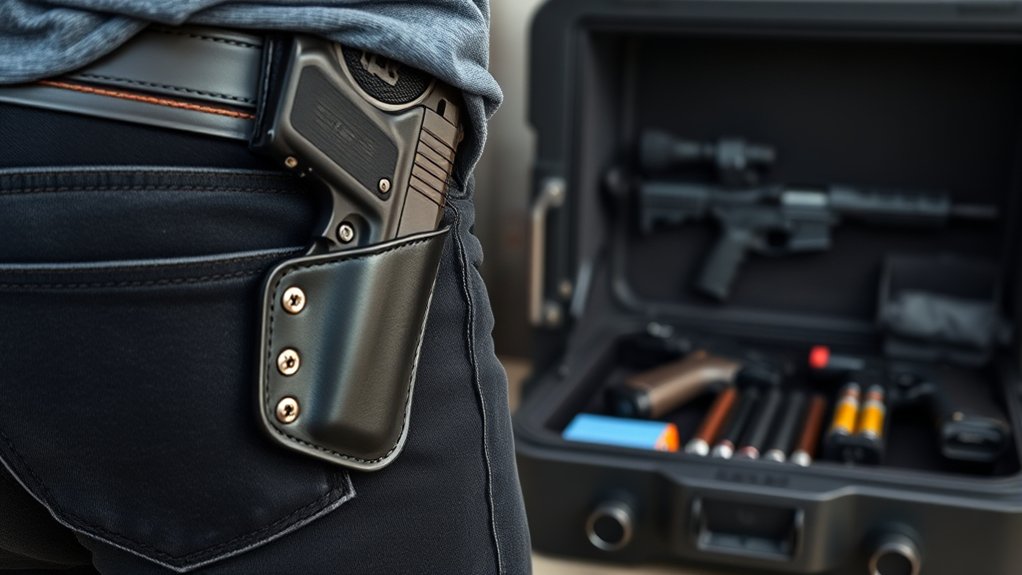
How should you transport and store your firearm to comply with concealed carry laws? Proper firearm transportation and safe storage are critical to ensure firearm security and legal compliance. You must follow local regulations closely. They often require unloaded firearms kept in lockable containers during transport.
Transport firearms unloaded and concealed, preferably in a hard-sided, lockable case. Keep firearms out of sight in your vehicle. Make sure you’re also following any additional local restrictions.
Use tamper-resistant, lockable containers for safe storage at home. This helps prevent unauthorized access. Secure firearms especially if minors or prohibited individuals live in your household to avoid accidental use.
What You’re Responsible for as a Concealed Carrier
Although carrying a concealed firearm grants you certain rights, it also comes with significant responsibilities that you must uphold at all times. You must carry a valid license or permit along with proper identification whenever you carry concealed.
Familiarize yourself with all local, state, and federal firearm laws to ensure your carry remains legal.
Stay informed about all applicable firearm laws to keep your concealed carry lawful and responsible.
You’re responsible for ongoing training and staying current with permit renewals and evolving regulations. Prioritize firearm safety by practicing secure storage and safe handling to prevent accidents or unauthorized access.
Furthermore, respect restricted locations where concealed carry is prohibited, such as government buildings and private properties with posted bans.
By diligently managing these responsibilities, you maintain your rights and contribute to responsible concealed carry practices. It really comes down to being aware, prepared, and respectful every time you carry.
That way, you’re not only protecting yourself but also those around you.
Clearing Up Concealed Carry Myths
Because misconceptions about concealed carry abound, it’s essential to address and clarify common myths that can lead to legal misunderstandings or unsafe practices. Understanding your legal responsibilities helps guarantee safe and lawful carry.
Permitless carry doesn’t mean unrestricted access. Laws impose restrictions on locations like schools and government buildings.
Even in states with permitless carry, concealed carry permits are still necessary for reciprocity and compliance with various laws.
Carrying in public isn’t unrestricted either. You must avoid sensitive areas such as transportation hubs and prominent public spaces.
Many jurisdictions require a safety course or proof of proficiency before issuing permits. This really shows how important training is.
Stay informed about concealed carry laws, permits, and restrictions. Doing so helps protect yourself and others while you exercise your rights responsibly.
Frequently Asked Questions
Can I Carry a Concealed Firearm While Traveling Between States?
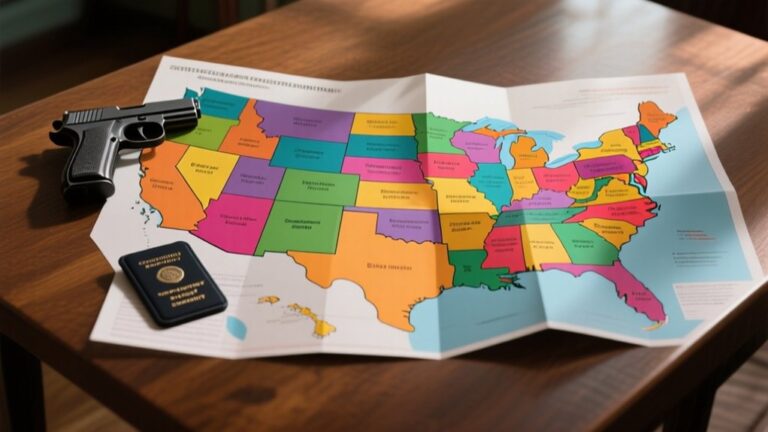
You can carry a concealed firearm while traveling between states only if your permit is recognized by the state you’re entering. Reciprocity agreements vary, so you must check each state’s rules before you go.
Some states allow permitless carry, but many require a valid permit.
Always verify local laws to avoid legal trouble. Never assume your home state permit automatically grants you permission across state lines.
It’s better to be safe and informed than to face unexpected issues on the road.
How Does Concealed Carry Insurance Work and Is It Necessary?
Think of concealed carry insurance as your safety net in a high-stakes performance. It covers legal fees, bail bonds, and sometimes restitution if you’re involved in a firearm incident.
While not mandatory, it’s a smart move to protect yourself from costly lawsuits or criminal charges.
Providers often require proof of training or licensing. For $10 to $30 monthly, you get peace of mind that your rights and finances won’t be left hanging.
It’s definitely worth considering if you want that extra layer of protection.
What Should I Do if My Concealed Carry Permit Is Lost or Stolen?
If your concealed carry permit is lost or stolen, report it immediately to the issuing agency, like your local sheriff’s office.
Request a replacement by submitting the necessary application and paying any fees.
You’ll need to provide proof of identity and possibly a police report.
Check your state’s specific rules for extra steps.
Keep records of all communications and documents during this process to protect yourself and guarantee a smooth replacement.
It’s always better to stay on top of things so you don’t run into any issues later.
Are There Restrictions on the Types of Firearms I Can Carry Concealed?
Think of concealed carry like fitting puzzle pieces. You can’t just use any piece. Yes, there are restrictions on the types of firearms you can carry concealed.
Most states limit you to handguns and ban fully automatic weapons and large-capacity magazines. Semi-automatic rifles or firearms with special features often require extra permits or are prohibited.
Always check your local laws carefully to avoid carrying a firearm that’s not allowed concealed. It’s better to be safe and informed than to risk penalties.
How Do Concealed Carry Laws Affect Private Property Owners?
Concealed carry laws give you, as a private property owner, the right to prohibit firearms on your premises by posting clear signs or explicitly stating your rules.
If someone carries a concealed weapon without your consent, they may be trespassing or breaking the law.
You just have to make sure that proper notice is visible to everyone who enters.
Keep in mind, some exemptions might apply for law enforcement or licensed individuals.
Enforcing these rules helps protect your property and your legal rights.
It’s all about keeping your space safe and respecting the law at the same time.
Conclusion
Now that you understand the ins and outs of concealed carry, from permits to responsibilities, you’re better equipped to handle the weight of this serious privilege.
Remember, carrying concealed isn’t just about having a firearm. It’s about knowing the law, respecting safety, and acting responsibly.
Don’t drop the ball when it comes to training and legal requirements. Being prepared means protecting yourself and others while staying within the boundaries of the law.