How To Improve Long Range Shooting Accuracy – Tips And Techniques
To improve your long-range shooting accuracy, start by choosing a stable rifle and a caliber like 6.5 Creedmoor for better control and trajectory. Set up quality optics with the right reticle and clear glass.
Build steady shooting positions using bone support. Master smooth trigger control and practice controlled breathing to reduce movement.
Learn to read wind and environmental factors carefully. Keep refining these skills, and you’ll reveal advanced techniques that boost your precision even more.
Choose the Right Rifle and Caliber
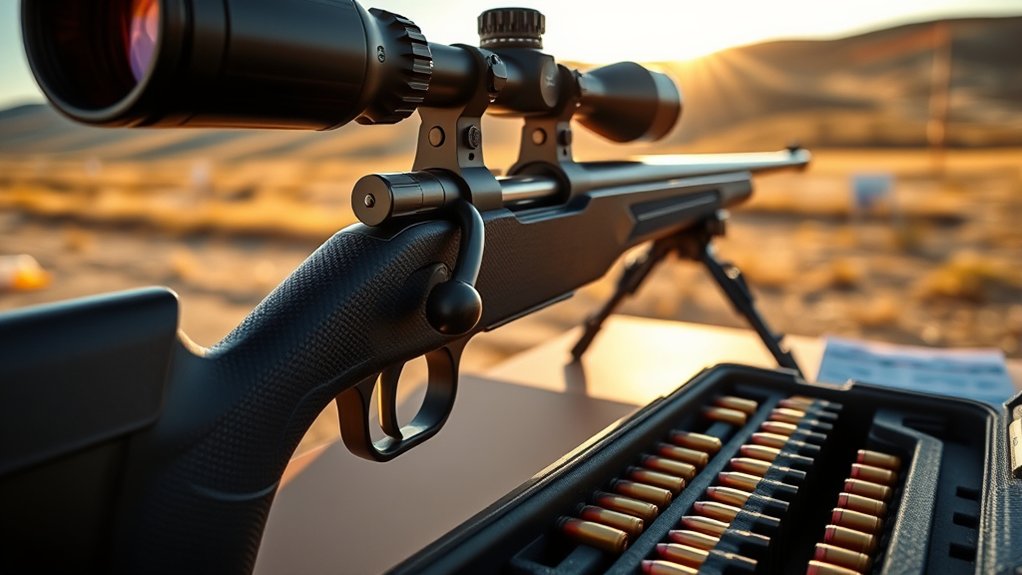
When you choose the right rifle and caliber, you’ll set a strong foundation for long-range shooting accuracy. Opting for a caliber like the 6.5 Creedmoor benefits you with its flat trajectory and manageable recoil, making it perfect for precise shooting at distance.
Pick a heavier rifle to enhance stability, especially when resting it during your shooting sessions. Brands like Bergara’s HMR Pro stand out, offering near-custom performance that suits your precision needs.
Make sure your rifle fits your body well, so you maintain control and comfort while shooting.
Also, consider the rifle’s weight relative to your shooting conditions. If you need portability for field use, balance weight with handling.
Your rifle and caliber choice directly impact your long-range shooting success.
Choose and Set Up Quality Long-Range Optics
When you’re picking out long-range optics, it’s best to go for scopes that are built for precision and clarity, like the TORIC 4.5-30×56 ELR.
You’ll want to choose a reticle type—either MOA or MRAD—that fits your shooting style so making adjustments on the fly becomes much easier.
And don’t forget about eye relief; making sure it’s just right will keep you comfortable and safe with every shot.
Optic Selection Criteria
Because your optic plays an essential role in long-range accuracy, choosing one with clear glass, strong construction, and excellent light-gathering ability is important.
When considering optic selection, rifle shooters should prioritize scopes that withstand harsh field conditions and provide bright, sharp images even in low light.
Make certain your scope offers sufficient eye relief for comfort and safety, especially with powerful calibers.
Proper mounting using quality rings and bases is critical. Keep your optic level and aligned with the rifle to guarantee precise shot placement.
Spend time learning your scope’s features, including parallax adjustment and magnification, to improve your shooting efficiency.
Selecting an optic that matches your shooting style and needs will greatly enhance your long-range accuracy and overall experience.
Reticle Types Explained
Anyone choosing long-range optics should understand the different reticle types available, as they directly affect how you estimate distance and make aiming adjustments. Common reticle types include MOA (Minute of Angle) and MRAD (Milliradian).
MOA feels more intuitive for some shooters, while MRAD simplifies long-range shooting calculations. Pick a reticle that matches your style. A duplex reticle offers simplicity, whereas a Christmas tree reticle provides precise holdover points for wind and elevation.
Always opt for high-quality glass to guarantee clarity in various lighting conditions, helping you acquire targets faster and shoot more accurately.
Master your reticle’s adjustments, including windage and elevation turrets, so you can compensate for bullet drop and drift effectively during long-range shooting.
Eye Relief Importance
Proper eye relief plays an essential role in achieving a clear sight picture and preventing injuries from recoil. Most scopes require 3 to 4 inches of eye relief to keep you safe and comfortable.
When choosing long-range optics, prioritize models offering generous eye relief to suit different shooting positions and reduce strain during long sessions.
Adjust your scope’s placement on the rifle to maintain consistent, natural eye relief, which helps you align your sight picture quickly and maintain a perfect trigger pull.
Quality optics like the TORIC 4.5-30×56 ELR provide excellent eye relief and enhanced light-gathering, crucial for low-light conditions common in long-range shooting.
Regularly check and tweak your eye relief during practice to guarantee consistent sight alignment and improve your overall accuracy.
Build Stable Shooting Positions Using Bone Support
To improve your long-range accuracy, try focusing on your bone structure instead of relying on muscle to stabilize the rifle. It’s all about letting your skeleton do the work, so you stay steady without getting tired.
Make sure you position your body so the buttstock lines up with your center, and your shoulders are facing the target straight on. This way, everything feels balanced and controlled.
You can also add shooting aids like bipods or bags. These help create a steady platform but won’t get in the way of the barrel’s natural movement.
It’s a simple way to stay stable and accurate.
Using Bone Over Muscle
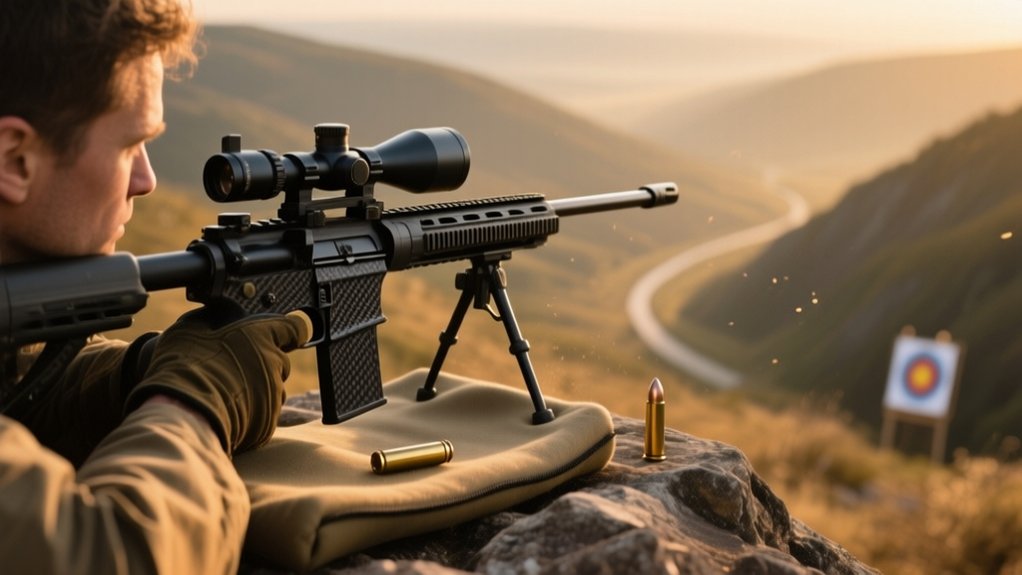
When you rest your rifle on stable points like your elbows and knees, you reduce muscle fatigue and boost your shooting accuracy.
Using bone support instead of relying on muscle strength helps you maintain steadiness longer, especially in the prone position.
By creating a natural triangle with your arms and legs, you form a solid foundation that minimizes unnecessary muscle tension.
Focus on applying just enough pressure to control your rifle without gripping it too tightly, which can cause movement.
Incorporate aids like bipods or shooting bags to further enhance stability, letting your bones carry the load.
Staying low to the ground naturally emphasizes bone support over muscle, helping you maintain a stable, consistent shooting platform that improves long-range accuracy.
Optimal Body Positioning
Building on the idea of using bone support to steady your rifle, the way you position your body plays a big role in maintaining that stability. Achieving ideal body positioning means aligning your shoulders perpendicular to the target line, which prevents misalignment and improves rifle control.
Favor prone or seated shooting positions over standing, as these provide a solid base and reduce unnecessary movement. Use natural supports like rocks or logs to further steady your shooting position without relying on muscle strength, cutting down fatigue.
Practicing dry firing from various shooting positions helps you refine your alignment and feel for stability.
Stabilizing With Shooting Aids
A stable shooting position depends heavily on using the right aids to support your rifle with your bones instead of your muscles. Start by utilizing a shooting bag, bipod, or tripod to create a stable platform that lets your skeletal structure bear the weight. This approach minimizes muscle fatigue and enhances precision.
Keep your shoulders perpendicular to the line of fire to reduce rifle misalignment and improve stabilizing. Practice shooting prone or kneeling to lower your center of gravity and increase steadiness.
Adjust your rifle’s placement on the shooting bag carefully to maintain consistent pressure without excessive contact.
When outdoors, use natural supports like logs or rocks to boost stability. These techniques help you build a reliable, bone-supported shooting position for better long-range accuracy.
Master Trigger Control for Long-Range Accuracy
Since trigger control directly influences your shot’s precision, mastering it’s essential for long-range accuracy.
When you focus on trigger control, you reduce the rifle’s movement during long-range shots, helping maintain alignment and improving shot placement.
Proper finger placement, between the fingertip and second joint, gives you the sensitivity needed for a controlled pull.
Practicing dry firing at home builds muscle memory, making your pulls smoother and more consistent.
Aim for a two-stage trigger pull: a gentle squeeze followed by a smooth break to minimize disturbance.
- Position your finger correctly for ideal sensitivity
- Practice dry firing regularly to enhance muscle memory
- Use a two-stage trigger pull for controlled, steady shots
Mastering these elements will greatly boost your long-range shooting accuracy.
Use Breathing Techniques to Reduce Movement
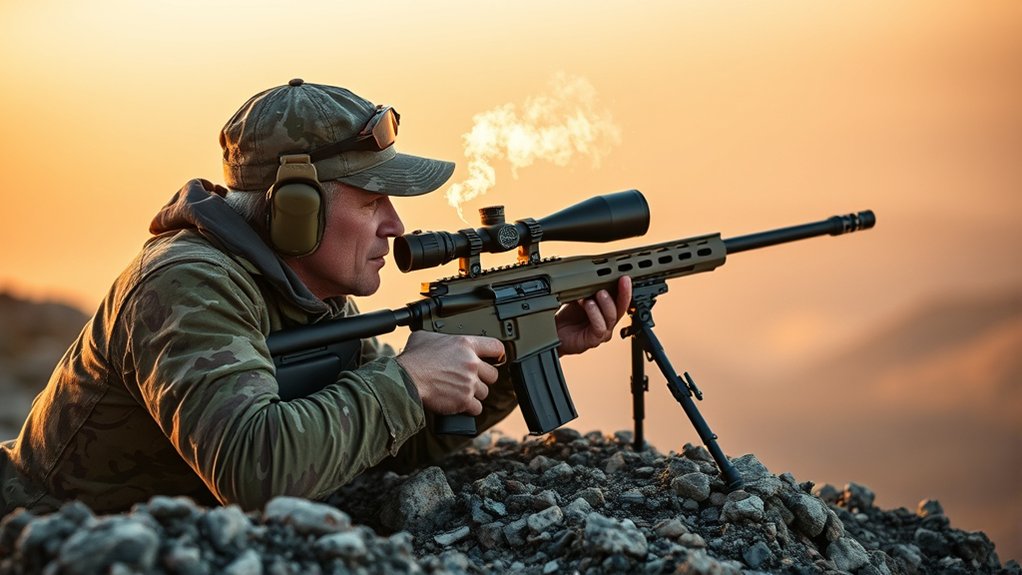
Controlled breathing plays an essential role in reducing movement and improving your long-range shooting accuracy. By using breathing techniques like the respiratory pause, you can time your shots during the natural 2-3 second pause after exhaling. This brief moment helps enhance shot stability by minimizing body movement.
When you practice controlling your breath, you relax your body, which reduces involuntary motions that could throw off your aim. Before each shot, settle your breathing and heartbeat to create a calm, steady foundation for better accuracy.
Incorporate breathing exercises into your dry firing routine to reinforce this connection. Recognizing how your breath affects shot stability will help you shoot more consistently and improve your long-range results over time.
Read Wind and Environmental Factors for Long Range
Mastering your breathing helps steady your shot, but reading wind and environmental factors can make or break your long-range accuracy. Understanding wind speed and direction is crucial since even a 5 mph crosswind can deflect a bullet by several inches.
Master your breathing and read wind carefully—small changes can drastically impact long-range shot accuracy.
Use a wind meter to measure wind speed and develop an instinct for how it alters your bullet’s trajectory. Remember, terrain can create wind eddies that mislead you, so practice in varied conditions.
Always observe natural indicators like grass or smoke to gauge wind in real time. Keep in mind that wind conditions may differ between you and your target, requiring adjustments based on distance and environment.
- Use wind meters and natural signs to assess wind speed
- Factor terrain-induced wind eddies into your aim
- Adjust for differing wind conditions along the bullet’s trajectory
Frequently Asked Questions
How Do I Clean and Maintain My Long-Range Rifle?
You clean and maintain your long-range rifle by following a consistent maintenance schedule.
After each use, apply proper cleaning techniques: disassemble the rifle, clean the barrel with a bore brush and solvent, wipe down metal parts, and lubricate moving components.
Regularly inspect for wear or damage.
Sticking to this routine guarantees reliability and accuracy, helping your rifle perform at its best every time you hit the range or field.
What Type of Ammunition Is Best for Long-Range Shooting?
You want ammo so precise it might as well have a GPS! For long-range shooting, your caliber selection is essential. Choose something like .308 Winchester or 6.5 Creedmoor for deadly accuracy.
Bullet types matter too. Match your target and conditions with heavy, boat-tail hollow points or match-grade bullets. They fly straighter and resist wind better, helping you hit bullseyes consistently.
Don’t settle. Your ammo can make or break your shot!
How Can I Prevent Eye Strain During Extended Shooting Sessions?
To prevent eye strain during extended shooting sessions, you should regularly perform eye exercises to relax your eye muscles and improve focus.
Take short breaks to look at distant objects, which helps reduce fatigue.
Make sure to wear proper lens protection to shield your eyes from glare and harsh sunlight.
Staying hydrated and adjusting your shooting environment’s lighting will also help maintain your visual comfort and accuracy throughout your session.
What Are the Best Safety Practices at a Long-Range Shooting Range?
You should always wear proper safety equipment, like eye and ear protection, to guard against hazards.
Follow range etiquette by keeping your firearm pointed downrange and only loading when it’s your turn.
Communicate clearly with others, obey all range commands, and never handle firearms when someone’s downrange.
Staying alert and respecting these safety practices guarantees everyone’s well-being and a safe shooting environment.
How Do I Transport and Store My Long-Range Shooting Gear Safely?
About 30% of firearm thefts occur during transport, so prioritizing safe transport is essential. You should use a sturdy, lockable case to protect your gear during travel and prevent unauthorized access.
Maintain gear organization by packing ammo, scopes, and tools separately in labeled compartments to avoid damage.
When storing, keep everything in a cool, dry place. Use a gun safe or lockbox to guarantee your long-range shooting gear stays secure and in top condition.
Conclusion
To boost your long-range shooting accuracy, focus on the right rifle, quality optics, and solid shooting positions. Remember, studies show even a 1-mph wind can shift your bullet’s impact by over 10 inches at 500 yards.
Master trigger control and breathing to keep steady, and always read environmental factors carefully. With consistent practice and these techniques, you’ll see your shots land closer to the target every time.
Keep honing your skills—you’ve got this!