Is Concealed Carry Legal In Florida – Laws And Permit Rules
Yes, you can legally carry a concealed weapon in Florida without a permit if you meet specific eligibility criteria, such as being 21 or older and not barred by criminal convictions. You must avoid restricted locations like schools, courthouses, and police stations.
While permitless carry is allowed, having a license offers benefits like broader legal recognition and reciprocity. Understanding where you can carry, safety rules, and how permits work can guarantee you stay fully compliant with Florida’s concealed carry laws.
Key Takeaways
- Permitless concealed carry is legal in Florida for eligible individuals as of July 1, 2023, with location-based restrictions.
- A concealed carry license offers benefits like reciprocity, same-day firearm purchases, and legal recognition in multiple states.
- Applicants must be 21 (18 for military), pass background checks, provide fingerprints, firearm training proof, and pay a $119 fee.
- Concealed carry is prohibited in schools, courthouses, police stations, airports, polling places, and other specified locations.
- License holders must carry their concealed weapons license and government-issued ID while using secure holsters and following safety rules.
Is Concealed Carry Legal in Florida Without a Permit?
Although Florida has traditionally required permits for concealed carry, as of July 1, 2023, you can legally carry a concealed firearm without a permit if you meet specific eligibility criteria.
Florida now allows permitless concealed carry starting July 1, 2023, for eligible individuals.
This change allows you to carry handguns, electronic weapons, knives, and billies concealed, provided you comply with location restrictions such as avoiding schools, courthouses, and establishments serving alcohol.
Despite this permitless carry allowance, prioritizing gun safety remains essential. You should engage in thorough concealed carry training to understand proper handling, legal responsibilities, and situational awareness.
While you may carry without a permit, obtaining one still offers advantages like recognition across state lines.
By combining awareness of legal boundaries and commitment to gun safety, you guarantee responsible concealed carry in Florida under the new law. It’s all about staying informed and prepared.
That way, you can carry confidently and responsibly.
How Florida’s Permitless Concealed Carry Law Works
With Florida’s new permitless concealed carry law now in effect, understanding how it functions is key to staying compliant. You can carry concealed weapons such as handguns, electronic weapons, tear gas guns, knives, or billies without a permit if you meet specific criteria.
However, concealed carry restrictions still apply. You can’t carry in places like police stations, courthouses, schools, or establishments serving alcohol.
The law excludes machine guns from permitless carry. While firearm registration isn’t required for concealed carry, Florida continues to issue concealed carry licenses.
These licenses offer benefits like reciprocity and same-day firearm purchases.
Both residents and non-residents who qualify under age, residency, and background checks can take advantage of permitless carry. But you have to stay aware of the designated prohibited locations.
What Are the Eligibility Requirements for Concealed Carry in Florida?
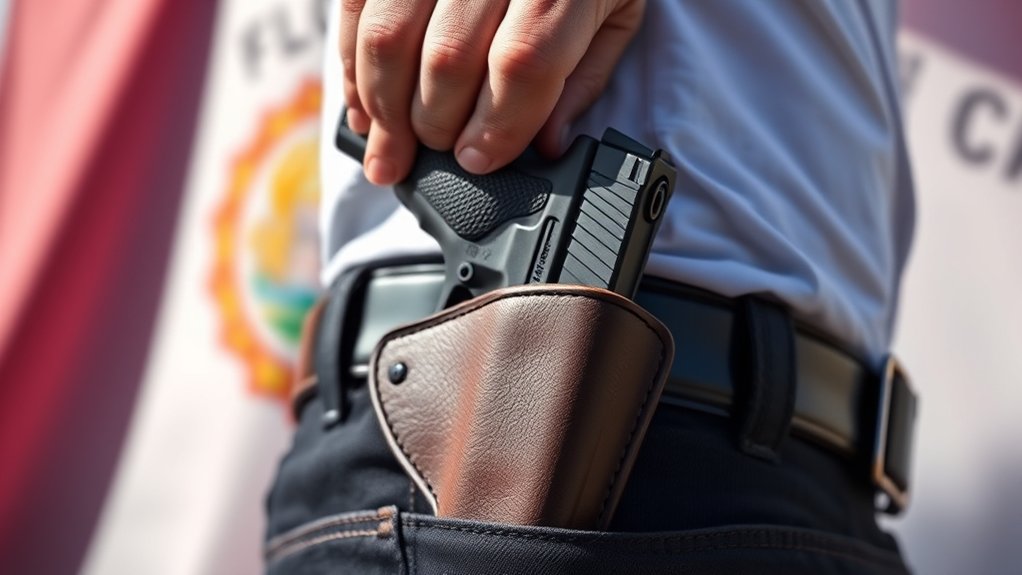
To carry a concealed weapon legally in Florida, you must meet specific eligibility requirements set by state law. These rules make sure that firearm ownership is responsible, especially when it comes to storing firearms or using concealed carry accessories.
Here’s what you need to qualify: Be at least 21 years old, or 18 if you’re active military or an honorably discharged veteran. You also have to be either a Florida resident or a non-resident who’s legally in the U.S. with proper status.
You can’t have recent felony convictions, domestic violence injunctions, or any declarations of mental incompetency.
Plus, you’ll need to show proof of firearm proficiency through training certificates, submit your fingerprints, and pass thorough background checks.
Following these steps helps keep everyone safe and makes sure you’re complying with Florida’s concealed carry laws.
Where Can’t You Carry Concealed in Florida?
Where exactly are you not allowed to carry a concealed firearm in Florida? You can’t carry in police, sheriff, or highway patrol stations, detention facilities, prisons, jails, courthouses, or courtrooms. Judges are exempt from this rule.
Gun safety and license requirements also prohibit concealed carry on school property, college campuses, and during school events. Additionally, carrying is forbidden in primary drinking areas of alcohol-serving establishments and inside airport passenger terminals.
Concealed carry is prohibited on school grounds, college campuses, during school events, alcohol primary drinking areas, and airport terminals.
You must avoid polling places, legislative meeting rooms, and any federal or state prohibited locations. Understanding these restrictions is essential to comply with Florida law and promote responsible gun safety.
Always verify you meet license requirements and respect these no-carry zones to avoid legal issues and uphold public safety.
What Concealed Carry Safety and ID Rules Should You Know?
You should always carry your valid concealed weapon license along with a government-issued ID, like your driver’s license, whenever you have a concealed firearm. It’s an easy way to stay prepared if you’re ever asked to show proof.
Also, make sure to practice responsible safety by securing your weapon when you’re not using it.
And remember to avoid prohibited areas, such as schools and government buildings—they’re off-limits.
Staying informed about Florida’s legal requirements is important too. Keeping up with the rules helps you stay compliant and avoid any issues with unlawful carry.
Identification Requirements
Although carrying a concealed firearm grants you certain rights, Florida law requires you to carry a valid form of identification at all times, such as a driver’s license or a concealed weapons license. This guarantees law enforcement can verify your legal authority to carry.
Keep these key points in mind:
- You must carry both your concealed weapons license and a valid ID whenever you carry a concealed firearm.
- The license application includes fingerprint submission and background checks to confirm your identity and eligibility.
- Proof of firearm proficiency from concealed carry training is mandatory for licensing.
- Firearm storage requirements complement these rules, emphasizing safety when not carrying.
Adhering to these identification requirements helps you stay compliant while responsibly exercising your rights.
Safe Carry Practices
Carrying your concealed weapons license and valid ID is just the starting point for responsible firearm ownership in Florida. To practice safe carry, you must choose appropriate concealed carry attire that allows quick access while keeping your firearm discreet.
Holster selection is critical. Opt for a secure, well-fitting holster that covers the trigger guard to prevent accidental discharge. Always keep your finger off the trigger until you intend to shoot, and never point your firearm at anything you don’t mean to engage.
Store your firearm securely when not in use, using a trigger lock or locked container, especially around minors.
Stay informed about prohibited locations, such as schools and courthouses, where carrying is illegal.
It’s a good idea to consistently review Florida’s concealed carry laws to maintain safety and compliance. That way, you’ll always be up to date and carry responsibly.
Legal Compliance Tips
When handling a concealed firearm in Florida, always keep your valid concealed carry license and identification on hand to guarantee immediate proof of legal authorization.
To stay legally compliant, carry your license and ID every time you have your firearm, including firearm accessories. It’s just easier that way.
Avoid prohibited places like schools, courthouses, police stations, and alcohol-serving venues. You don’t want to accidentally break the law.
Make sure to secure your firearm with a trigger lock or locked container to prevent access by minors. Safety first!
And remember, use shooting ranges to maintain proficiency while following all state regulations. Staying sharp is important, but so is staying legal.
What Are the Benefits of Getting a Florida Concealed Carry License?
If you obtain a Florida concealed carry license, you gain the legal ability to possess and transport firearms discreetly, which enhances both your safety and legal protection. This license allows you to carry firearms in locations where open carry is restricted, including on private property and certain public areas.
You also benefit from reciprocity agreements, enabling lawful concealed carry in multiple states. Additionally, a valid license streamlines firearm purchases and demonstrates your proficiency, often requiring concealed carry training as part of the licensing process.
This training ensures you handle firearms responsibly and safely, including the use of gun accessories. Overall, holding a Florida concealed carry license provides broader legal rights, access to same-day firearm purchases, and recognition in states honoring Florida permits.
It’s a valuable credential for responsible gun owners.
How Do You Apply and Renew a Florida Concealed Carry License?
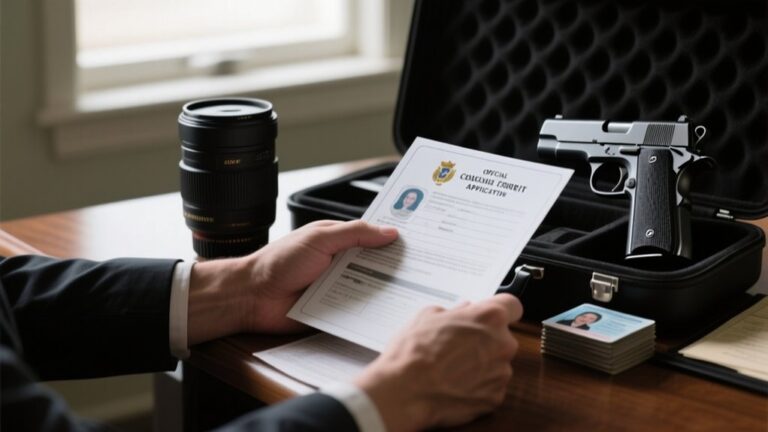
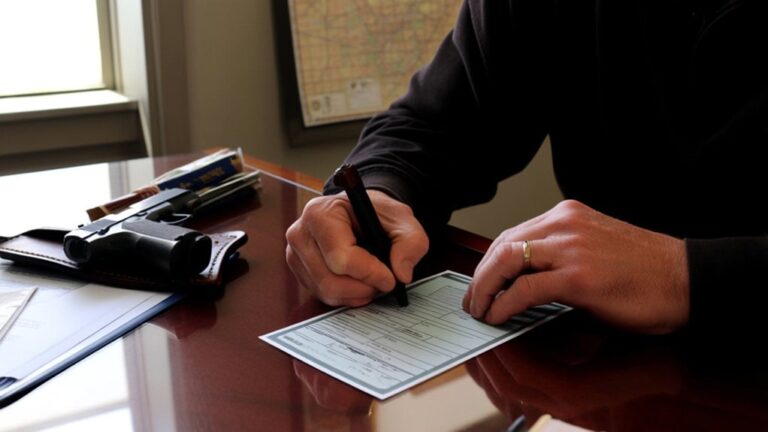
To apply for a Florida concealed carry license, you need to submit an application online, in person, or by mail. Make sure to provide proof of residency, get fingerprinted, and show evidence of firearm proficiency.
The application fee is $119, which covers fingerprint processing and background checks.
You also have to meet eligibility criteria like age requirements and mental health considerations. It’s pretty straightforward but make sure you have everything ready before you apply.
When it comes to renewal or replacement, here’s what you should know:
First, submit a renewal form and fee before your license expires. The processing usually takes about 90 days.
If you miss the deadline, you can still renew late but expect to pay additional fees.
If your license is lost or stolen, you’ll need to submit a notarized statement along with a $15 fee to get a duplicate.
And don’t forget—always practice safe gun storage. It’s important to comply with laws and keep your firearms away from unauthorized access.
Lastly, it’s crucial to maintain your mental health records and keep up your firearm competence throughout the licensing process.
This helps ensure you stay eligible and responsible as a license holder.
How Does Florida Handle Reciprocity With Other States’ Permits?
You’ll find that Florida recognizes concealed carry permits from 36 states, which means non-residents can legally carry within Florida. That said, eligibility depends on some specific criteria.
Also, some states only honor permits issued to their own residents, and a few don’t recognize Florida’s permit at all.
Reciprocity Eligibility Criteria
Although Florida recognizes concealed carry permits from 36 states for non-residents, allowing you to carry legally within Florida, the specifics of reciprocity vary widely.
To qualify under Florida’s reciprocity eligibility criteria, you should consider these points:
Your out-of-state permit must be valid and issued by a state with a reciprocity agreement.
You must comply with Florida’s gun safety and permit training requirements, which vary by state.
Non-residents can obtain a Florida concealed carry license, valid for seven years, enhancing reciprocity opportunities.
Other states may limit recognition to Florida resident permits or refuse reciprocity altogether.
So, it’s a good idea to verify each state’s rules before carrying.
Understanding these criteria guarantees you carry legally while respecting varied state laws on concealed carry permits.
Recognized State Permits
When carrying a concealed weapon in Florida, understanding which out-of-state permits the state recognizes is essential for staying compliant with the law. Florida honors concealed carry permits from 36 states through reciprocity agreements. It primarily recognizes resident permits from states with comparable concealed carry training and background check standards.
Non-resident permits are usually not accepted unless explicitly stated in Florida law. Since reciprocity agreements can change or be revoked, you should verify the current status before carrying.
Note that states like California, Illinois, and New York don’t recognize Florida permits. Additionally, proper firearm storage remains vital when carrying. This ensures safety and legal compliance regardless of permit origin.
Staying informed helps you carry responsibly and legally while respecting Florida’s firearm regulations. It’s always better to double-check before you carry to avoid any trouble.
Frequently Asked Questions
Can Minors Carry Concealed Firearms in Florida?
You can’t carry concealed firearms if you’re a minor in Florida because of strict age limits and restrictions. The law doesn’t allow minors to carry concealed guns under normal circumstances.
There are some exceptions, though. For example, minors can possess firearms for certain activities like hunting, but only when supervised.
Are There Specific Firearm Types Prohibited for Concealed Carry?
Yes, Florida firearm restrictions prohibit carrying machine guns and armor-piercing firearms or ammunition concealed. You can’t carry these prohibited weapons.
But handguns, electronic weapons, tear gas guns, knives, and billies are allowed under the law. So, while some things are off-limits, there are plenty of options for concealed carry.
How Does Florida Law Address Carrying Concealed During Emergencies?
You must follow emergency protocols and law enforcement procedures strictly. Florida law doesn’t relax concealed carry rules during emergencies, so you need a valid permit.
Also, you must avoid prohibited areas, even amid crises or law enforcement discretion. It’s important to remember that emergencies don’t give you a free pass when it comes to carrying concealed. Always stay within the legal boundaries.
Can Concealed Carry Be Revoked or Suspended in Florida?
Yes, your concealed carry can be revoked or suspended in Florida, especially if you fail background checks or violate reciprocity agreements. Authorities investigate thoroughly, and you must surrender your license immediately upon notice of suspension or revocation.
It’s important to stay on top of any legal changes or issues that might affect your eligibility. If something comes up, you’ll want to address it quickly to avoid losing your carry privileges. Just remember, the state takes these matters seriously.
Are There Penalties for Improper Concealed Carry Storage in Vehicles?
Yes, you’ll face penalties for improper concealed carry storage in vehicles. Florida’s storage regulations require vehicle security to prevent unauthorized access.
If you don’t follow these rules, you risk fines, license suspension, or felony charges for negligent firearm storage. So, it’s important to store your firearm properly when carrying it in your vehicle.
Conclusion
Exploring Florida’s concealed carry laws might feel like decoding a secret map, but understanding permitless carry, eligibility, and restricted areas keeps you compliant. While you can carry without a permit, getting a license offers essential benefits like reciprocity and streamlined renewals. Knowing safety and ID rules guarantees you avoid costly mistakes.
Stay informed and follow the application process carefully. That way, you’ll confidently protect yourself within Florida’s legal framework.