Is A Concealed Carry Permit Required – Laws And Permit Rules
You need a concealed carry permit in most states to legally carry a hidden firearm, as rules vary widely by jurisdiction. These permits typically require background checks, safety training, and sometimes live-fire testing. Some states allow permitless carry, but this can increase legal risks and impact public safety.
Knowing your state’s laws, reciprocity agreements, and application procedures is essential. It’s a good idea to stay informed so you can carry responsibly and within the law. Explore further to understand qualifications, restrictions, and responsible carry practices in detail.
What Is a Concealed Carry Permit and Why It Matters
What exactly is a concealed carry permit, and why should you care? A concealed carry permit legally allows you to carry a hidden firearm in public, but it comes with specific licensing and permit requirements. Usually, these permits involve background checks and mandatory firearm safety training.
A concealed carry permit lets you legally carry a hidden firearm, requiring background checks and safety training.
This training ensures you understand responsible handling under firearm laws. Around 21 states require these permits, focusing on public safety by reducing risks of accidents and unlawful carrying. By meeting these standards, you help create safer communities and follow the rules.
Some states, however, have permitless carry policies with fewer restrictions. This changes how firearm safety and public safety are managed.
Knowing how concealed carry permits work helps you navigate different state laws and supports informed, lawful firearm use.
Legal Differences Between Open Carry and Concealed Carry Permits
Although both open carry and concealed carry involve carrying firearms in public, the legal requirements and restrictions for each differ considerably.
Open carry often allows you to carry a visible firearm without a permit in many states, whereas concealed carry usually requires obtaining a permit.
Firearm laws for concealed carry typically mandate licensing procedures such as background checks, safety training, and sometimes live-fire testing.
In contrast, open carry frequently faces fewer legal restrictions and may not require any licensing.
Moreover, concealed carry permits provide legal protections in specific restricted areas where open carry might be prohibited or regulated differently.
Understanding these distinctions is essential to comply with state firearm laws and avoid legal issues related to carrying a firearm openly or concealed.
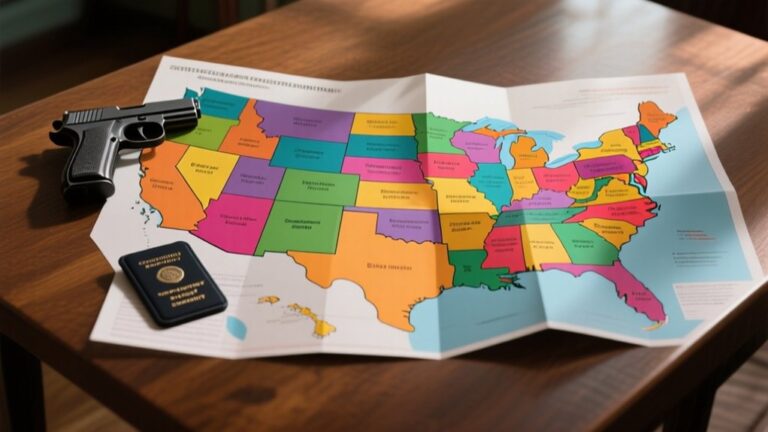
Which States Require a Concealed Carry Permit?

You should know that 21 states require a concealed carry permit. Usually, this means going through specific training and background checks.
On the other hand, some states allow permitless carry, so you can carry concealed without needing formal authorization.
Knowing these differences is really important—it helps you stay on the right side of the law and avoid any penalties.
States With Permit
Twenty-one states require individuals to obtain a concealed carry permit before carrying a firearm in public, including California, Illinois, and New York. These states enforce strict permit requirements, often mandating firearm training and thorough background checks to ensure responsible carry.
Public carry laws in these states tend to be more restrictive compared to permitless carry states, emphasizing safety and regulation.
For example, Colorado and Connecticut require both training and background checks as part of their permit issuance process. Obtaining a concealed carry permit also offers reciprocity benefits, allowing you to carry in other states recognizing your permit.
Understanding these permit requirements is essential to comply with legal standards and avoid penalties while carrying concealed firearms.
Permitless Carry States
While some states enforce strict permit requirements for concealed carry, nine states including Alabama, Alaska, Arizona, and Florida allow individuals to carry concealed firearms without a permit.
In these permitless carry states, you can legally carry concealed firearms without undergoing firearm safety training or background checks.
Although firearm permits remain available in some of these states, they mainly serve for reciprocity and extra legal protections rather than being mandatory.
The expansion of permitless carry laws has broadened legal access to concealed firearms and often reduced restrictions on where you can carry.
However, studies link these policies to increases in firearm-related homicides and overall violent crime rates.
This raises concerns about public safety and whether permitless carry really promotes responsible firearm use.
Which States Allow Permitless or Constitutional Carry?
Because firearm regulations vary widely, understanding which states allow permitless or constitutional carry is essential for responsible gun owners. Nineteen states permit permitless carry, letting you carry concealed firearms without a permit.
Key points include: States like Alaska, Arizona, Arkansas, Florida, and Texas allow constitutional carry without requiring permits. Permitless carry often means no mandatory firearm training or background checks for public carry.
States such as Alaska, Arizona, and Texas allow permitless carry without mandatory training or background checks.
Some states, such as Vermont and Wyoming, have longstanding permitless carry laws emphasizing minimal restrictions. Since 2010, more states have repealed permit requirements, broadening access under state laws.
These variations in firearm laws highlight the importance of knowing your specific state’s rules on permits and public carry before carrying concealed. So, it’s always a good idea to stay informed and follow your state’s regulations closely.
How Permitless Carry Laws Affect Public Safety and Crime Rates
You’ll notice that states with permitless carry laws often have higher rates of handgun homicides and overall violent crime.
This suggests that getting rid of permit and training requirements might actually hurt public safety.
It’s really important to understand how safety regulations help reduce crime when we’re looking at these laws.
Crime Rate Impacts
Although proponents argue that permitless carry laws enhance personal safety, data shows these policies correlate with notable increases in violent crime. When states remove the concealed carry permit requirement, the crime rate rises markedly.
You should consider these impacts:
- Handgun homicide rates increase by 11%.
- Overall violent crime rates climb between 13% and 15%.
- Firearm violence and gun-related injuries become more frequent.
- Law enforcement faces challenges due to increased firearm thefts and lower clearance rates.
Research clearly indicates that permitless carry laws don’t reduce crime or improve public safety. Instead, they contribute to more frequent firearm-related incidents, complicate law enforcement efforts, and elevate risks to communities.
Maintaining stricter concealed carry permit regulations appears essential for controlling firearm violence and enhancing public security.
Safety Regulation Benefits
When states implement permitless carry laws, you often see a direct impact on public safety and crime rates. Loosening or removing permit requirements correlates with an 11% rise in handgun homicides and a 13% to 15% increase in overall violent crime.
Without mandatory firearm training, permitless carry laws compromise firearm safety, leading to more accidental discharges and unsafe handling.
In contrast, concealed carry laws with strict safety regulations and enforced permit requirements help reduce firearm injury and death rates. These regulations ensure individuals carry firearms responsibly, emphasizing the importance of training.
Training and Background Check Requirements for Permits
A critical aspect of obtaining a concealed carry permit involves meeting specific training and background check requirements. To secure permit approval, you must comply with these essential steps:
First, complete a thorough background check. Most states require this to assess your eligibility. It’s an important way to ensure that only qualified individuals get permits.
Next, fulfill training requirements, which usually include firearm safety instruction. This helps you learn responsible handling and proper use of your weapon.
Many states, like California and Colorado, also require you to participate in live-fire exercises. These are designed to demonstrate your shooting proficiency and comfort with a firearm.
Finally, you’ll need to provide proof that you completed the necessary training. This often means certificates from authorized instructors.
In some states, such as New York, you might also have to go through interviews and provide character references.
Where Can You Legally Carry Your Firearm With a Permit?
Once you’ve met the training and background check requirements, understanding where you can legally carry your firearm with a permit becomes the next priority. Concealed carry is generally allowed in most public places unless firearm laws explicitly list prohibited areas.
Permitted locations often include private property where owners consent. But sensitive sites like schools, courthouses, and airports usually restrict carry even with a permit.
Many states also prohibit concealed carry in establishments serving alcohol, federal buildings, polling stations, police stations, detention centers, and certain event venues.
Since laws vary by state, you must consult local regulations to identify authorized and prohibited areas.
Staying informed about permitted locations guarantees compliance and responsible firearm carry within the legal framework. It’s always a good idea to double-check before you carry somewhere new.
The Benefits of Having a Concealed Carry Permit
When you get a concealed carry permit, you’re not just following the law—you’re also gaining important legal protections that people without a permit often don’t have. This can help reduce your chances of running into legal trouble.
Plus, there’s the benefit of reciprocity, which means you can carry your firearm legally in several other states that recognize your permit.
On top of that, the training required to get the permit really helps improve your firearm handling skills and safety awareness. So, you end up carrying more responsibly overall.
Legal Protections Offered
Although concealed carry permits primarily authorize you to carry a firearm, they also provide significant legal protections. Holding a concealed carry permit or license offers legal safeguards that extend beyond mere authorization. These include protection against certain charges when you comply with permit laws, such as carrying in restricted areas.
It also shows that you handle firearms responsibly and have undergone training, which can positively influence legal proceedings. Plus, there are requirements to follow safety and storage laws, adding layers of legal safeguards.
In some states, having a permit can even reduce your liability in self-defense cases by proving lawful possession.
While reciprocity benefits exist, the core legal protections emphasize your compliance and responsibility. This reinforces your lawful right to bear arms with a concealed carry permit.
Reciprocity Across States
Beyond the legal protections that come with holding a concealed carry permit, you gain the advantage of reciprocity, which allows you to carry your firearm legally in multiple states. Reciprocity depends on mutual recognition of permit requirements and adherence to varying state laws. This recognition enhances firearm mobility, especially when traveling for work or recreation.
However, some states have stricter recognition policies, limiting reciprocity benefits. Understanding these differences is essential to maintain compliance and avoid legal issues.
| State A | State B | State C |
|---|---|---|
| Recognizes permit | Recognizes permit | No recognition |
| Requires training | Requires training | No permit allowed |
| Background check | Background check | Stricter laws |
Reciprocity markedly expands your legal carrying options beyond your home state. So, it really pays off to know where your permit is recognized and what rules apply.
Training Enhances Safety
Since concealed carry permits often require safety and handling training, you benefit from reduced risks of accidental discharges and improved responsible firearm use. The training requirement embedded in concealed carry permits emphasizes firearm safety through structured firearm safety courses, often including live-fire instruction.
This approach guarantees you develop proficiency in firearm control, accuracy, and legal awareness.
Key benefits include:
- Lower rates of firearm-related injuries and accidents.
- Enhanced understanding of safe storage and handling.
- Increased awareness of legal restrictions and responsibilities.
- Contribution to overall public safety by minimizing firearm incidents.
How to Apply for and Renew a Concealed Carry Permit
How do you navigate the process of applying for and renewing a concealed carry permit? The application process usually requires completing safety training, which might include live-fire exercises. You’ll also need to submit documentation like references and background checks.
Many states ask for in-person interviews and proof of training. Law enforcement agencies typically handle these permit requirements, so you’ll be working closely with them.
Renewal procedures can vary, but they generally involve recertification, updated background checks, and sometimes additional safety training every few years. Permits usually expire within 3 to 5 years, so it’s important to renew on time to keep your legal carry status.
States are increasingly requiring specific training hours and live-fire tests during renewal to ensure firearm safety standards. Knowing these steps helps you stay compliant with the ever-changing rules around concealed carry permits.
Special Permit Rules for Younger Applicants and Protective Orders
What special rules apply if you’re under 21 or protected by a court order and want to carry concealed? States impose distinct permit rules for minors and those under protective orders.
For example, Texas allows ages 18-20 to apply for a concealed carry license only if covered by an active protective or emergency protective order.
New York permits certain minors with active protective orders to obtain firearm licenses, subject to eligibility requirements.
Florida’s permitless carry law requires meeting the same eligibility criteria as obtaining a concealed weapon license.
Generally, states enforce additional eligibility requirements for applicants under 21 or with protective orders.
Understanding these rules is vital to guarantee legal compliance when pursuing firearm licenses or concealed carry permits in your jurisdiction.
Traveling With a Concealed Carry Permit Across State Lines
When you carry a concealed firearm across state lines, you need to understand how your home state’s permit works with other states’ laws. Reciprocity laws decide if your concealed carry permit is recognized outside your state. So, it’s really important to check the regulations of each state you’re visiting.
For example, Texas recognizes permits from states that meet certain standards. On the other hand, Florida requires non-residents to have valid permits from their home state.
Traveling with a firearm also means following specific transportation rules. Especially at airports, the TSA requires you to declare your firearm. You must also keep it unloaded and secured in a locked, hard-sided container.
Always declare your firearm at airports and keep it unloaded in a locked, hard-sided container.
Since state laws and permit recognition can vary a lot and change pretty often, it’s a good idea to research current reciprocity agreements before you travel. This way, you can carry legally and avoid any legal trouble.
What Happens If You Carry Without a Concealed Carry Permit?
Although some might underestimate the risks, carrying a concealed firearm without the required permit in states that mandate one exposes you to serious legal consequences. Illegal concealed carry typically results in criminal charges, often classified as a second-degree misdemeanor, with penalties including fines or jail time.
Law enforcement can stop and arrest you for unlawful firearm possession. Moreover, carrying without a permit may prevent legal self-defense claims.
Key consequences include:
- Criminal charges and potential misdemeanor convictions
- Fines, jail time, or both
- License suspension or firearm confiscation
- Harsher penalties, including felony charges in restricted areas
Understanding these risks really shows why it’s so important to get and carry a valid concealed carry permit. It’s better to be safe and legal than to face serious trouble down the road.
Frequently Asked Questions
Can Concealed Carry Permits Be Revoked or Suspended?
Yes, your concealed carry permit can be revoked or suspended if you violate firearm laws or engage in criminal activity. Authorities often review such cases through law enforcement or judicial procedures.
If you’re deemed a threat to public safety or fail to follow safety regulations, your permit might be taken away.
Some states automatically revoke permits after certain convictions or disqualifying background checks.
Reinstatement may be possible if you meet specific legal conditions.
Are There Specific Firearm Models Restricted Under Concealed Carry Laws?
Unlike a knight’s sword, concealed carry laws rarely restrict specific firearm models. Instead, they focus on licensing, carry locations, and firearm categories.
You won’t usually see laws banning particular models outright.
That said, some states do prohibit carrying machine guns, assault weapons, or high-capacity rifles concealed.
How Do Concealed Carry Laws Impact Private Property Rights?
Concealed carry laws impact your private property rights by requiring you to get consent before allowing firearms on your premises, no matter the permits involved.
You have the power to set clear rules that prohibit firearms entirely. And those rules? They’re legally enforceable.
Even if someone has a concealed carry permit, they still need to respect your property restrictions.
Your rights to control whether firearms are on your property remain strong. This helps keep things safe and ensures you’re following local laws.
What Insurance Options Exist for Concealed Carry Permit Holders?
About 60% of concealed carry permit holders opt for specialized firearm liability insurance. You can choose programs like the NRA’s Carry Guard or state-specific legal defense funds. These cover legal expenses and liability in self-defense cases.
Standard homeowners’ policies often don’t extend to firearm incidents. So, you’ll likely need additional coverage for accidental discharges, property damage, and legal defense.
This way, you can protect yourself fully.
Are There Exemptions for Military or Law Enforcement in Concealed Carry Laws?
Yes, you often get exemptions if you’re active-duty military or law enforcement. Many states let you carry concealed without a permit while on duty, and some extend this off-duty.
Retired officers and military personnel may also qualify, but it varies widely.
You usually have to be acting within your official capacity or meet specific authorization criteria.
Always check local laws since exemptions depend heavily on jurisdiction. It’s important to know the rules that apply where you live.
Conclusion
Understanding whether you need a concealed carry permit depends heavily on where you live and travel. Some states allow permitless carry, while others require permits to regulate firearm access and enhance public safety.
The idea that permitless carry always increases crime isn’t clearly supported by data. The effects tend to vary depending on the region.
By staying informed and following your state’s laws, you can responsibly exercise your rights. Doing so also helps minimize legal risks and contributes to safer communities.