What Does A Glock Look Like – Visual Identification Guide
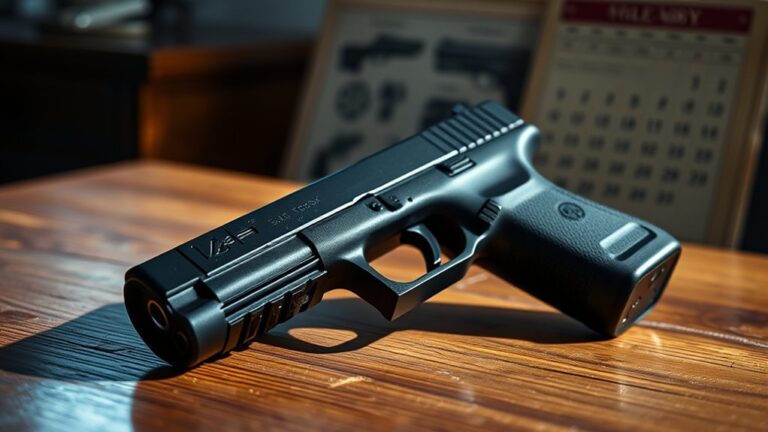
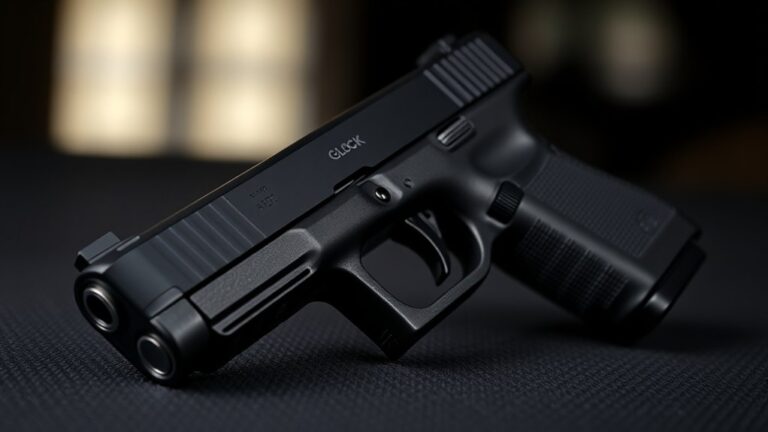
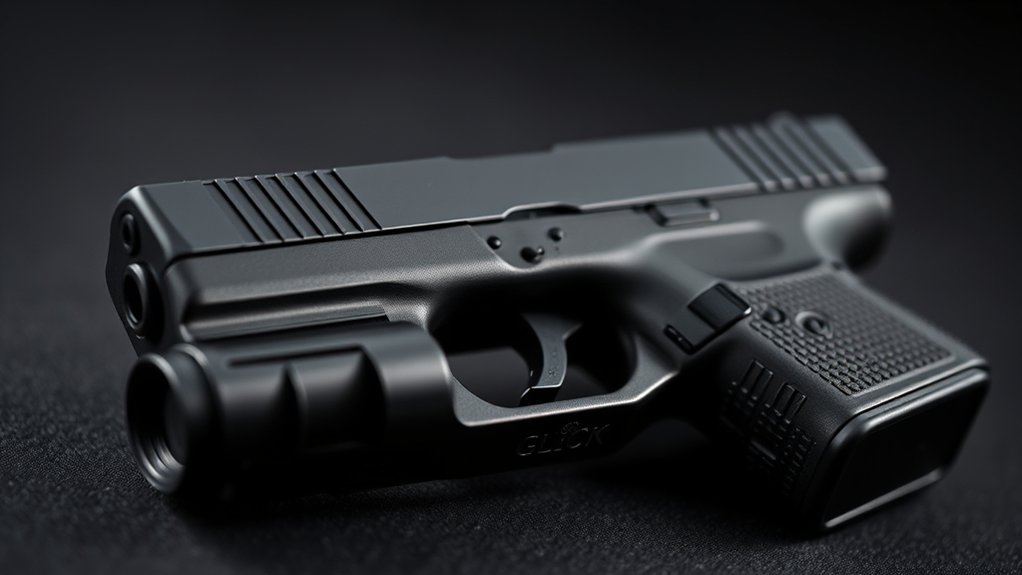
You’ll recognize a Glock by its modular polymer frame and the grip features that vary with each generation.
Early models have smooth grips, making them look quite simple.
Gen 3 models add finger grooves and an accessory rail for attaching lights or lasers.
Gen 4 introduces interchangeable backstraps and textured grips, giving you more customization options.
Gen 5 models remove the finger grooves, add grip dimples, and feature squared trigger guards for a modern look.
Slide serrations, cutouts, and the number of pins are also helpful clues to identify the generation.
Each Glock’s barrel and recoil spring design is built to boost reliability and make maintenance easier.
Looking closer, these details help fine-tune performance and make identification easier.
Quick Guide: Identifying Glock Pistols by Generation
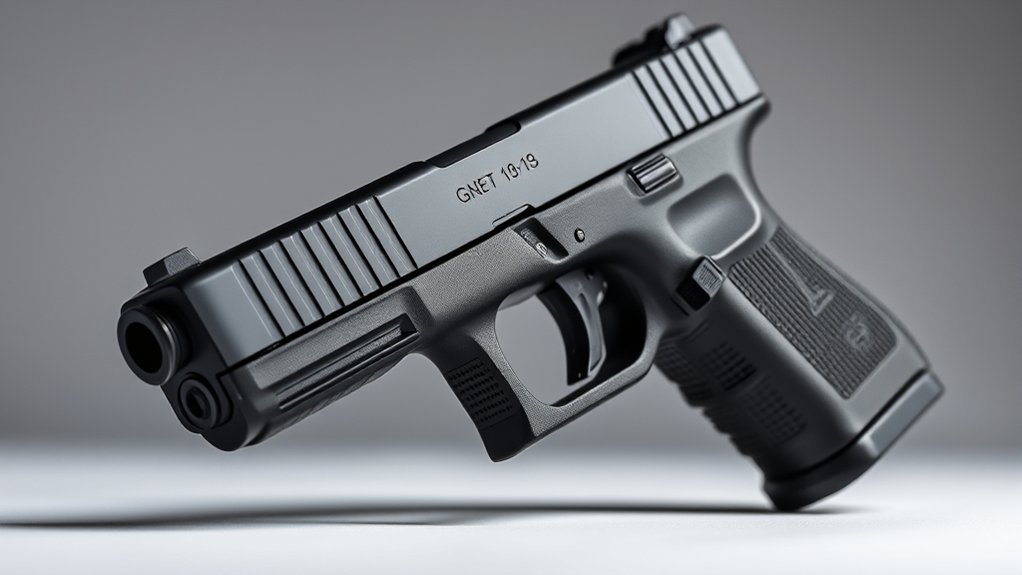
When you’re trying to identify a Glock pistol by generation, start by looking at the grip and frame details. These features give you the clearest visual clues.
Early Glock models, like Gen 1, have smooth grips without finger grooves. They also use two pins to secure the slide to the frame.
Gen 1 Glocks feature smooth grips without finger grooves and use two pins to secure the slide.
Moving on to Gen 3, you’ll notice finger grooves on the grip and an accessory rail. Typically, these models have three pins.
Gen 4 introduces interchangeable backstraps and a more aggressive grip texture. This makes the pistol easier to control and more ergonomic.
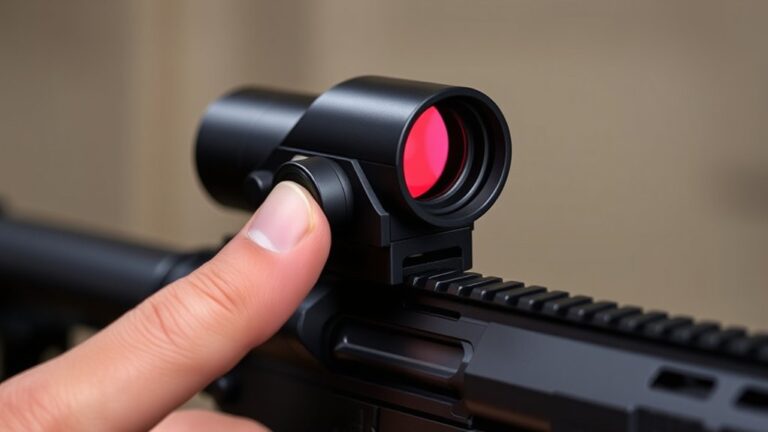
Gen 5 models remove the finger grooves altogether. They also have a squared-off trigger guard and slide cutouts, which are designed for mounting red dot sights.
Pay attention to these external features—finger grooves, grip texture, number of frame pins, and slide modifications. They’re key to quickly identifying the generation and specific model of a Glock.
Spotting Glock Generations: What to Look For
Want to tell the different Glock generations apart? It’s pretty straightforward once you know what to look for. Start by checking out the finger grooves, the slide and frame design, and how many pins are holding everything together.
For instance, Gen 1 Glocks don’t have finger grooves and only have two frame pins.
Then, when you move to Gen 3, you’ll notice the addition of finger grooves, an accessory rail on the frame, and a third pin.
As for the later models, Gen 4 and 5, they bring some new features like interchangeable backstraps, which help customize the grip, and slide cutouts that can change how the sights sit.
These tweaks also affect grip size and sight compatibility, so they’re good clues to spot the differences.
Finger Groove Presence
Although finger grooves might seem like a minor design detail, they actually serve as a pretty important visual cue for telling Glock generations apart.
You’ll notice finger grooves are prominent on Gen 3 and earlier models. They help improve ergonomics by giving your fingers a defined place on the grip. This makes handling and control a lot easier.
Later generations, however, don’t have those grooves. Starting with Gen 4, Glock removed the finger grooves and added interchangeable backstraps. This lets you customize the grip to fit your hand better.
Gen 5 takes it a step further with a smooth, groove-free grip surface. It looks sleek and modern but still offers good ergonomics thanks to refined contouring.
Being able to spot whether a Glock has finger grooves or not is an easy way to identify its generation. If it has grooves, it’s likely a Gen 3 or earlier. If it doesn’t, it’s probably a Gen 4 or Gen 5.
Slide And Frame Design
How can you distinguish Glock generations by their slide and frame design? Focus on slide serrations, cutouts, and frame features.
Gen 4 slides have pronounced serrations and cutouts, which make it easier to grip and manipulate the slide.
Earlier generations tend to have smoother slides with fewer features.
Gen 5 takes things a step further with angular slides that include cutouts designed for red dot sight mounting.
The frame also evolves over time.
Gen 1 and 2 frames lack accessory rails and have smooth dust covers.
In contrast, Gen 3 and later models include an integrated rail on the frame’s dust cover.
In Gen 5, finger grooves disappear, replaced by a more squared-off slide design.
This change signals a shift in both ergonomics and aesthetics.
These visual markers in slide and frame design make it easier to identify Glock generations at a glance.
Pin Configuration Differences
Beyond slide and frame design, pin configuration is another reliable visual cue for identifying Glock generations.
Typically, Generation 3 and 4 Glock models have three pins on the frame. This design enhances frame strength and allows for better accessory mounting.
In contrast, Gen 1, 2, and 5 usually have only two pins. Keep in mind that early Gen 3 variants might also show two pins, so close inspection is necessary.
Recognizing the number of pins can really help when identifying models like Glock 17, 19, or 23.
Always cross-reference pin count with other features for the most accurate identification.
Glock Frame and Grip Characteristics
When you look at a Glock’s frame, you’ll see it’s made from high-strength polymer. This material keeps the gun lightweight but still super durable. The polymer frame is paired with a grip that’s designed for control and comfort.
A Glock’s high-strength polymer frame ensures durability while keeping the gun lightweight and comfortable to handle.
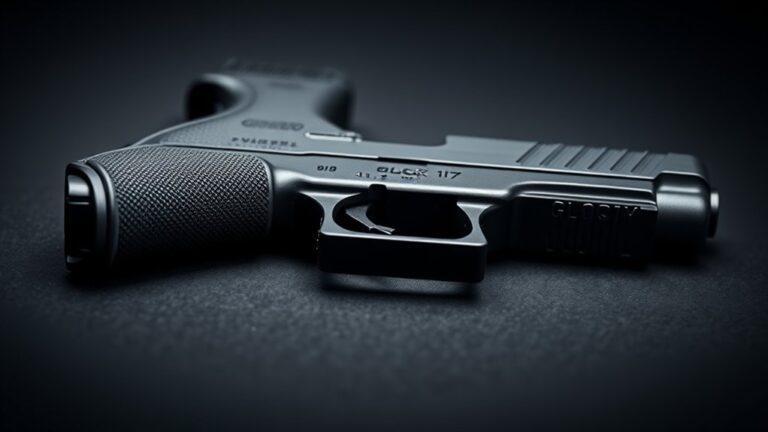
The grip has a textured surface that’s different depending on the generation. This helps you hold the gun securely. The angle between the grip and the slide is usually between 90 and 110 degrees, fitting the natural shape of your hand.
In newer models, Glock added a modular backstrap system. This lets you customize the grip size to fit your hand better.
Gen 5 and later models don’t have external finger grooves, making them more versatile.
Inside the frame, there are rails that support the structure and allow for accessory attachments. All these features combined make Glock pistols comfortable and reliable to handle, no matter the shooting situation.
How to Tell Glock Slides Apart
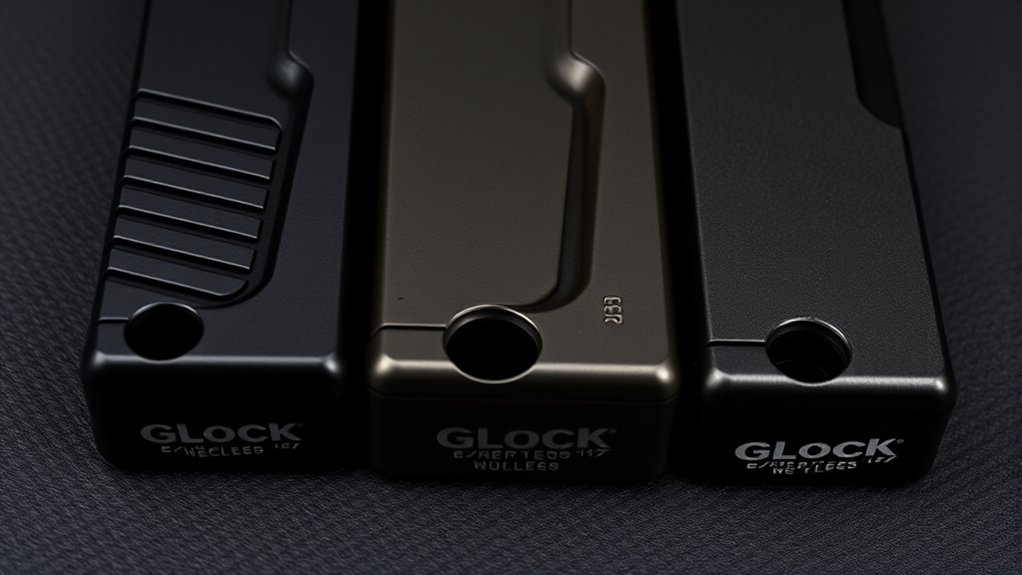
The frame and grip give you some initial hints, but the slide is really key for telling Glock generations apart.
You’ll notice that slide serrations get more aggressive from Gen 4 onward. In earlier models like Gen 3, the serrations are milder and more standard.
Starting with Gen 4, they become more prominent, especially at the rear.
Finger grooves are another clue. They’re present on Gen 3 and Gen 4 but disappear in Gen 5, giving the slide a cleaner look.
Newer models, especially MOS variants, often have slide cutouts and mounting plates for red dot sights. These are especially common on the more recent Glocks.
The way the front sight attaches also changes. Older models have it staked in, while newer ones use screws.
This subtle difference can help you identify the generation just by looking at the slide.
Finger Grooves, Thumb Rests, and Grip Dimples: Model Identification
Although finger grooves have long served as a tactile guide on Glock grips, their presence is limited to Gen 3 and Gen 4 models. When you’re trying to identify a Glock model, check out these grip features:
- Finger grooves are only on Gen 3 and Gen 4, giving you that textured feel through contouring.
- In Gen 5 models, the finger grooves are gone. Instead, they’ve a straighter grip profile for a cleaner look.
- Thumb rests make their first appearance in Gen 5 and later models, helping with ergonomic support during handling.
- Grip dimples, small textured indentations, also show up on Gen 5+ grips. They help with control without needing aggressive checkering.
- Older generations don’t have thumb rests or grip dimples. They rely solely on finger grooves to provide grip texture.
Common Glock Model Variations and Identification Pitfalls
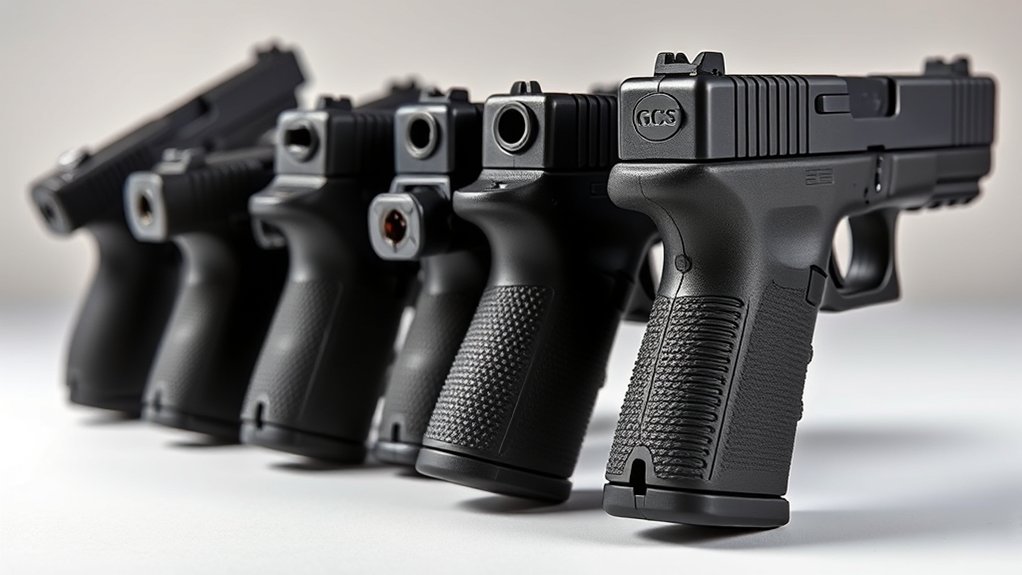
Since many Glock models look quite similar in size and shape, telling them apart just by looking can be tricky. You really need to pay close attention to small external details like the grip texture, slide serrations, and the contours of the frame to identify the model correctly.
Some variations, like the RTF2 and FBI M-series, have unique grip patterns and markings that help set them apart from standard Gen 3 or Gen 5 models. But keep in mind, modifications or wear and tear on finger grooves, thumb rests, and grip dimples can sometimes make it harder to spot these differences.
Many Glock models also share similar slide lengths and profiles, which can lead to confusion, especially if accessory rails or grip modifications are added. It’s important to look closely at markings on the slide or frame—like model numbers and generation stamps—but be aware that custom engravings or missing stamps can sometimes mislead you during identification.
Glock Barrel and Recoil Spring Features
When you check out Glock barrels, you’ll notice they’ve polygonal rifling. This design helps improve accuracy and reduces fouling compared to traditional rifling methods. It’s a smart feature that boosts overall performance.
The Glock barrel and recoil spring assembly are built to work together smoothly. This ensures reliable cycling every time you shoot.
The recoil spring assembly in newer models uses a dual spring system. This replaces the older single springs and offers better durability and a smoother recoil.
You’ll also find that recoil spring ratings, usually measured in pounds, let you customize your gun’s recoil and cycling. This makes it easier to fine-tune your shooting experience.
Plus, Glock’s design makes disassembly straightforward, so maintenance or caliber swaps are hassle-free.
Some key features include polygonal rifling for better ballistic performance, a dual spring recoil assembly for managing recoil effectively, and variable recoil spring ratings for tuning.
The slide and barrel are designed to work together reliably, and the system is easy to take apart for servicing.
Frequently Asked Questions
What Materials Are Used to Make Glock Pistols?
You’ll find Glock pistols use a high-strength polymer for the grip and trigger guard. This material is reinforced with glass fiber, which makes it durable.
The slide, slide serrations, barrel finish, slide lock, and magazine release are all made from hardened steel. These parts are coated with protective finishes like Tenifer or DLC to prevent corrosion.
These materials help keep the pistol lightweight yet tough. They ensure it resists impact and corrosion, so it performs reliably even in tough conditions.
All this without adding unnecessary weight, making it a practical choice for many users.
How Do Glock Safety Mechanisms Work Visually?
Oh, sure, just stare at the Glock and expect the trigger safety, slide lock, magazine release, safety indicator, hammer position, and grip safety to wave at you like a neon sign.
In reality, you’ll spot the trigger safety as a tiny tab on the trigger. The slide lock and magazine release sit ready for action, easy to identify.
The hammer position and grip safety remain pretty stealthy. They’re integrated internally, so only subtle hints are visible if you look closely.
What Accessories Can Be Attached to Glock Rails?
You can attach a variety of accessories to Glock rails, including flashlights and laser attachments for better targeting. These accessories can really make a difference in low-light situations.
Grip enhancements are also popular—they help improve handling and comfort during use.
Magazine extensions are another option; they increase your firearm’s capacity, so you’re better prepared in a pinch.
Sound suppressors can be added if your Glock has a threaded barrel and is compatible with the suppressor.
Just keep in mind, when you’re adding any of these accessories, you should check if your holster fits. This way, you can ensure secure carry and quick access when needed.
The rail’s design is built to support tactical lights and aiming devices. This allows you to customize your Glock based on your operational needs and personal preferences.
Are Glock Sights Customizable or Fixed?
Glock sights aren’t set in stone; they’re as adaptable as your grip texture options or slide serration design.
You can swap factory sights for aftermarket ones, which can improve holster compatibility and help you aim more precisely. This is great without changing magazine capacity or trigger safety features.
While some models have fixed sights molded for durability, many offer adjustable sights. These let you fine-tune your aim for better accuracy.
This kind of customization works well with different barrel lengths, making sure your Glock performs exactly how you want it.
How to Distinguish Genuine Glocks From Replicas?
You can distinguish genuine Glocks by closely examining the slide serration design and barrel finish quality. Authentic models have precise, consistent machining, so look for those details.
Check the grip texture options too—they’re uniformly patterned for better control.
Inspect the slide release location to see if it’s properly placed and functions smoothly.
Verify that the magazine is compatible with official Glock mags, as replicas often don’t match here.
Finally, proper Glock lubrication points are clearly defined, unlike the inconsistent or sloppy applications you might see on fakes.
Conclusion
Now that you understand the subtle differences between Glock generations, you’ll be able to spot specific slide shapes, frame features, and finger-friendly grooves more easily.
Focusing on small frame details, unique dimple patterns, and barrel basics helps you tell different Glock models apart. This way, you can avoid mistakes in identification and be more confident in your recognition skills.
Remember, learning the tiny details of each model makes all the difference. It helps you recognize every Glock you see with accuracy. Stay sharp, keep studying systematically, and you’ll quickly identify each sleek, sturdy, and streamlined Glock in sight. Precision really does pay off!