
Is Ohio A Concealed Carry State – Permit And Carry Laws Explained
Yes, Ohio is a concealed carry state that allows permitless concealed carry if you’re 21 or older and legally eligible. While you don’t need a permit to carry concealed, obtaining one offers legal protections and reciprocity benefits.
You’ll need to meet residency requirements, pass background checks, and complete firearm safety training unless exempt. Carrying is restricted in certain places like schools, courthouses, and bars serving alcohol.
Keep following to understand the full scope of Ohio’s concealed carry laws.
Key Takeaways
- Ohio allows permitless concealed carry for individuals 21 and older who are legally eligible since June 2022.
- A concealed carry license provides legal protections, reciprocity, and requires firearms safety training and background checks.
- Concealed carry is prohibited in places like police stations, schools, courthouses, airports beyond security, and certain alcohol-serving venues.
- Ohio recognizes some out-of-state permits based on reciprocity agreements and allows non-residents working in Ohio to apply for licenses.
- Permit renewals require updated documents, re-qualification through training, and can be processed online or in person up to 180 days before expiration.
What Is Permitless Concealed Carry in Ohio?
Although Ohio still offers a licensing program, since June 2022, you can carry a concealed handgun without a permit if you’re 21 or older and legally eligible. This change, known as permitless concealed carry or constitutional carry, affirms your self-defense rights by allowing gun ownership without mandatory permits.
While you’re no longer required to obtain a permit to carry concealed, Ohio maintains its licensing program for those seeking legal protections or reciprocity in other states. If you choose to apply for a permit, you must meet eligibility requirements, including background checks and firearm safety training.
Permitless carry simplifies lawful gun ownership while preserving options for those wanting formal recognition or additional legal benefits. So, it’s really about giving you more freedom while keeping the choice open if you want that extra layer of protection.
Who Qualifies for Permitless Concealed Carry in Ohio?

To qualify for permitless concealed carry in Ohio, you need to be at least 21 years old and meet certain residency requirements.
It’s important that you legally possess firearms and don’t fall under any prohibitions, like having certain criminal convictions or being deemed mentally incompetent.
Eligibility Criteria Overview
While Ohio allows permitless concealed carry, you have to meet some specific eligibility criteria to qualify. You need to be at least 21 years old and either an Ohio resident for 45 days or a non-resident employed in the state.
You can’t be under indictment, convicted of disqualifying crimes, or declared mentally incompetent.
Passing a firearm safety training course is required to show you’re competent before carrying concealed legally.
Even though permitless carry is allowed, many people still choose to get concealed carry permits for the extra legal benefits.
Proper gun storage is important, no matter if you have a permit or not, to ensure safety and follow state laws.
If you meet these criteria, you can carry a concealed handgun without a permit.
Just remember, you always have to follow Ohio’s laws on firearm possession and safety.
Age And Residency Requirements
Three key requirements determine who qualifies for permitless concealed carry in Ohio: age, residency, and legal eligibility.
Regarding age restrictions, you must be at least 21 years old to carry a concealed handgun without a permit.
For residency requirements, Ohio residents need to have lived in the state for at least 45 days to qualify.
If you’re a non-resident employed in Ohio, you can also carry concealed, provided you meet the same age and legal criteria.
In all cases, you must be legally eligible to possess a firearm under federal and state laws.
Meeting these age restrictions and residency requirements is essential before you consider carrying concealed without a permit in Ohio.
Prohibited Persons And Conditions
Meeting age and residency requirements isn’t the only factor in qualifying for permitless concealed carry in Ohio. You also have to be legally allowed to possess firearms, which means passing a background check that excludes people with felony convictions, certain misdemeanors, or mental health adjudications.
If you’re under indictment, convicted of domestic violence, subject to protective orders, or found mentally incompetent, you can’t carry concealed without a permit.
Federal law also bars illegal drug users and others prohibited from firearm possession from qualifying.
Proper firearm storage is super important to avoid legal issues and keep everyone safe.
Understanding these restrictions helps you stay on the right side of Ohio’s laws and responsibly exercise your right to carry concealed without a permit.
When and Where Is Concealed Carry Prohibited in Ohio?
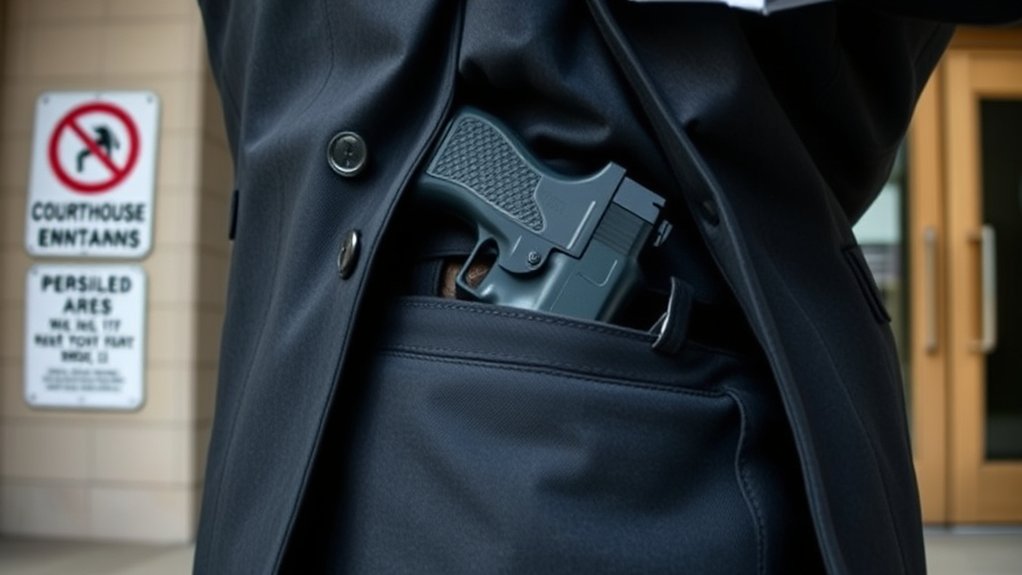
Although Ohio permits concealed carry in many locations, you must know where it’s explicitly prohibited to avoid legal issues. You can’t carry concealed firearms in police stations, sheriff’s offices, highway patrol posts, correctional institutions, or courthouses.
Airports restrict concealed carry beyond security checkpoints, and mental health facilities also prohibit it.
Schools, school buses, and designated safety zones limit concealed carry unless you hold a valid license and follow specific rules.
Places of worship may ban concealed carry unless allowed by the organization. Additionally, government buildings, detention centers, and venues serving alcohol generally forbid concealed firearms.
Proper gun storage is essential when not carrying, and license eligibility requires adherence to these restrictions to maintain compliance and avoid penalties.
Knowing these limits protects you and others. So, it’s a good idea to stay informed and always follow the rules.
Legal Risks of Carrying Without a Permit in Ohio
If you carry a concealed firearm without a permit in Ohio, you could face criminal charges that range from misdemeanors all the way up to felonies.
It’s not just about carrying without a permit, though. Mistakes in your permit application or simply misunderstanding the law can also land you in trouble.
That might mean fines, or even jail time.
Criminal Charges Risks
What happens if you carry a concealed firearm in Ohio without a valid permit? You risk facing criminal charges that can range from misdemeanors to felonies, depending on the situation. Carrying in restricted areas or with a loaded weapon makes things even riskier.
Law enforcement can arrest you for illegal concealed carry, and not producing a permit might lead to extra penalties. Violations involving improper firearm storage or ignoring ammunition restrictions also increase your legal exposure.
If your firearm is used in violence or you have prior firearm offenses, the charges get more severe. Penalties can include fines up to $500, license suspension, and possible imprisonment.
Application Mistakes Consequences
When you carry a concealed handgun in Ohio without a valid permit, application mistakes can really increase your legal risks. Errors like providing false information or submitting incomplete forms often lead to your permit being denied, suspended, or even revoked.
These mistakes don’t just block your permit; they can also bring criminal charges your way. Even with Ohio’s permitless carry law, failing to meet eligibility requirements can still land you in legal trouble.
Law enforcement can arrest or cite you if they find you carrying concealed unlawfully because of these application errors. Misreporting your criminal history or forgetting to disclose disqualifying factors seriously raises your chances of prosecution.
| Application Error | Potential Consequence |
|---|---|
| False information | Permit denial, criminal charges |
| Incomplete application | Permit suspension |
| Misreported criminal history | Increased prosecution risk |
| Failure to disclose factors | Permit revocation |
| Ineligible permitless carry | Arrest, legal penalties |
Ohio Concealed Carry Licensing Process
How do you obtain a concealed carry license in Ohio? First, you must be at least 21 years old and have lived in Ohio for at least 45 days. You’ll also need to complete a firearm safety training course that shows you know how to handle a gun safely.
When you apply, be ready to submit proof of your training, recent passport-sized photos, and if you’re a non-resident, proof of employment. The license comes with fees for both the initial application and renewals, which you pay when you apply or renew.
Ohio’s permit lasts for five years, and when it’s time to renew, you’ll need to provide updated documents. While carrying, make sure to follow proper gun storage practices to keep your firearm secure.
Also, keep in mind that Ohio recognizes some out-of-state licenses, but you can’t renew those if you stop living or working in Ohio.
Ohio Firearm Safety Training: What You Must Know to Carry Legally
Because Ohio requires completion of an 8-hour firearm safety training course before you can legally carry concealed or openly, understanding the specific training components is essential. The course involves live-fire range time and skills assessments to demonstrate your competency.
You’ll receive instruction on safe handling, ammunition safety, proper firearm maintenance, and secure storage practices.
Certification must be obtained within three years before applying for a license or carrying legally.
If you’re active military, retired law enforcement, or a federal officer with proper documentation, you may be exempt from this requirement.
Making sure your safety training covers Ohio’s laws on handling, storage, and transportation will help you avoid legal issues and keep you a responsible firearm owner.
Ohio Concealed Carry Reciprocity Explained
Although Ohio has its own concealed carry licensing requirements, it recognizes permits issued by other states. This means you can carry concealed if your permit meets Ohio’s standards.
Ohio accepts out-of-state concealed carry permits that align with its licensing standards.
Ohio honors out-of-state permits based on reciprocity agreements that focus on comparable licensing standards, including background checks and gun safety training.
These agreements are updated periodically by the Ohio Attorney General to make sure they stay current.
When carrying concealed in Ohio with an out-of-state permit, keep in mind that license verification may be required to confirm your eligibility.
Non-residents who work in Ohio can also apply for an Ohio concealed carry license. This gives them broader reciprocity benefits.
Understanding these reciprocity rules helps you carry lawfully and promotes responsible gun safety across state lines.
How to Renew or Replace an Ohio Concealed Carry License
If you hold an Ohio concealed carry license, you can renew it online or in person up to 180 days before it expires. To do this, you’ll need to submit a current application, provide proof of completed firearm safety training if required, and pay the renewal fee.
Renewing your license also means you have to re-qualify through a firearms training course. This shows you can safely handle and shoot your firearm.
When you renew, don’t forget to report any changes to your personal information, like your address or name, within 45 days of the update.
If your license is lost or damaged, you can apply for a replacement. Just submit a request along with the required fee.
Keep in mind that Ohio doesn’t allow renewal of out-of-state licenses once your residence or employment in Ohio ends.
Additional Rules and Restrictions for Carrying in Ohio
When carrying a concealed handgun in Ohio, you must follow specific rules and restrictions designed to guarantee public safety. You can’t carry firearms in police stations, courthouses, correctional facilities, airports beyond security, or places for mentally ill persons.
Carrying in schools or school zones without a valid CHL is a felony. Firearms aren’t allowed in places of worship unless explicitly permitted.
You may carry in bars or restaurants serving alcohol only if you don’t consume alcohol and no signs prohibit firearms.
Loaded concealed handguns can be transported in vehicles, but certain restrictions apply during traffic stops or in restricted areas.
Prioritizing gun safety and engaging in community outreach are vital to promoting responsible concealed carry and ensuring public trust in Ohio.
Frequently Asked Questions
Can Non-Residents Apply for an Ohio Concealed Carry License?
Yes, you can apply for an Ohio concealed carry license as a non-resident if you meet residency requirements through employment.
You’ll have to complete the application process, including background checks and firearm safety training. Make sure you provide proof of employment to support your application.
It’s a straightforward process, but staying organized with your documents will definitely help.
Are There Specific Vehicle Carry Laws for Ohio Concealed Carriers?
Yes, when you carry in a vehicle, you must store firearms securely, respecting concealed carry zones and vehicle registration laws. Firearms can’t be accessible and are prohibited in specific areas like school zones and government buildings.
It’s important to know where you can and cannot have your firearm while driving. Make sure you’re following all rules to avoid any trouble. Keeping your firearm out of reach is key for safety and compliance.
How Does Ohio Handle Concealed Carry in Private Businesses?
When in Rome, do as the Romans do: Ohio private business regulations let owners control concealed carry.
If you see concealed carry signage, respect it. Violating it could lead to criminal trespass or penalties on private property.
It’s pretty straightforward—business owners set the rules, and everyone needs to follow them.
What Are the Penalties for Losing a Concealed Carry License in Ohio?
If you lose your concealed carry license in Ohio, expect license revocation and severe penalties. Carrying without a valid license can lead to criminal charges, including misdemeanors or felonies. These charges reflect the high penalty severity for violations.
Does Ohio Recognize Permits From States Without Background Checks?
Like a telegraph connecting distant towns, Ohio recognizes permits from states without background checks. Its reciprocity agreements focus on permit validity, not background checks.
Conclusion
Understanding Ohio’s concealed carry laws is essential for carrying confidently and compliantly. Whether you choose permitless carry or pursue a license, knowing the legal limits, locations, and responsibilities protects you from penalties.
Stay sharp by staying informed about training, reciprocity, and renewal rules. By respecting regulations and recognizing risks, you guarantee safe, smart, and secure self-defense.
Always carry carefully and comply consistently for peace of mind and personal protection.