What States Do You Need A Concealed Carry Permit – Permit Laws By State
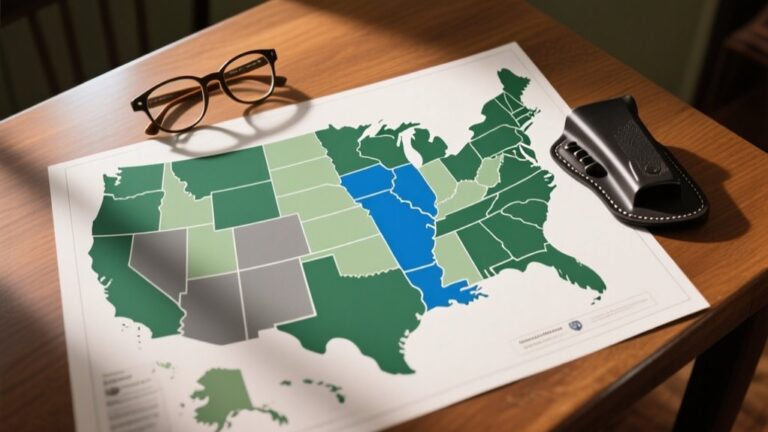
You need a concealed carry permit in 21 states, including California, Colorado, and New York. In these places, you’ll go through thorough background checks and complete safety training, often with live-fire exercises. These states have strict rules to promote responsible firearm use and usually require you to renew your permit regularly.
On the other hand, 29 states allow permitless concealed carry, but there are still restrictions in sensitive areas. So, it’s really important to understand the different laws, training requirements, and legal details before carrying concealed anywhere in the U.S.
Knowing more about the regulations and safety measures is key to staying on the right side of the law.
Which States Require a Concealed Carry Permit?
Which states require you to have a concealed carry permit to carry a firearm in public? Twenty-one states mandate a concealed carry permit for lawful public carry under their firearm laws. These states, including California, Colorado, and New York, enforce strict permit requirements involving thorough background checks, safety training, often with live-fire exercises, and proof of good moral character.
Twenty-one states require a concealed carry permit with strict background checks and safety training for public firearm carry.
Licensing procedures align with state regulations designed to guarantee responsible firearm possession. The permit authorizes concealed firearm carry in compliance with applicable gun laws and reciprocity agreements.
Understanding these requirements is essential, as states with permitless carry differ markedly in their approach.
If you plan to carry concealed, familiarize yourself with specific state regulations governing permit issuance. This way, you can ensure you meet all criteria and remain compliant with local firearm laws.
States Allowing Permitless Concealed Carry
You’ll find that 29 states allow permitless concealed carry, so you can carry without having to get a permit.
In places like Alaska and Florida, there’s no need for background checks or safety training before carrying concealed.
That said, federal background check laws still apply when you buy a firearm in these states.
States Without Permit
Twenty-nine states have adopted permitless carry laws, allowing you to carry a concealed firearm without obtaining a permit or completing training requirements.
In these permitless states, like Alabama, Alaska, Arizona, Florida, and Texas, no permit is required for law-abiding residents under current concealed carry laws.
State regulations often exclude mandatory firearm training and safety requirements. This simplifies legal carry but puts the responsibility on you to practice safe handling.
Also, many permitless carry states have minimal or no background checks for private sales.
This reflects a broader approach to gun laws that prioritizes ease of access. These policies tend to be more common in rural or less densely populated areas.
Knowing these distinctions helps you navigate permitless carry regulations accurately.
It also ensures you stay compliant with your state’s specific gun laws.
Permitless Carry Policies
Although permitless carry laws vary by state, many now allow you to carry a concealed firearm without obtaining a permit or completing formal training. Twenty-nine states, including Alaska, Arizona, Florida, Idaho, Montana, and Texas, have enacted permitless carry policies. This reflects evolving state legislation supporting gun rights.
These laws remove permit requirements, background checks, and firearm training mandates for qualified individuals. However, even in permitless carry states, restrictions often apply to carrying concealed handguns in sensitive locations like schools, courthouses, and bars to ensure public safety.
Permitless carry laws tend to be more common in rural areas, where attitudes toward gun rights influence gun laws. If you choose to carry firearms under permitless carry, it’s essential to understand your state’s specific regulations and limitations. Doing so helps you stay compliant and promotes responsible firearm ownership.
Training and Background Requirements
Permitless carry laws often eliminate the need for background checks and formal firearm training before carrying a concealed weapon.
In states like Arizona, Alaska, and Arkansas, you won’t face training requirements, live-fire training, or licensing mandates tied to a concealed carry permit. These state regulations don’t require you to demonstrate firearm proficiency or complete firearm safety courses before carrying concealed.
Furthermore, permitless carry laws often remove the necessity for background checks, including those for private gun sales.
This means gun laws in these states focus less on screening and more on individual responsibility. Without mandatory training or background verification, you carry without formal assessments of firearm handling or conflict avoidance skills.
It’s a significant departure from licensing frameworks in other states.
Training Requirements for Concealed Carry Permits
When you apply for a concealed carry permit in many states, you’ll need to complete specific safety and firearm handling training, which often includes live-fire exercises. States like California, Colorado, and New York explicitly require live-fire exercises as part of their training requirements.
These programs cover firearm safety, firearm laws, conflict avoidance, and proper firearm handling techniques.
Training programs emphasize firearm safety, legal knowledge, conflict avoidance, and proper handling skills.
Some states also require permit renewal that involves updated safety training or proficiency testing. This helps ensure ongoing responsible gun ownership.
This thorough approach aims to reduce accidental discharges and promote safe firearm use.
Understanding and fulfilling these training requirements is really important for legal compliance. It also helps you be a responsible concealed carry permit holder.
Background Checks and Suitability for Permit Issuance
Alongside training requirements, states carefully evaluate applicants through background checks and assessments of suitability before issuing concealed carry permits. These checks guarantee that only responsible individuals obtain firearm permits. Here’s what you should know:
Background checks vary; only Nebraska and Vermont require them for firearm purchases, while 27 states allow purchase and carry without them.
Suitability assessments examine moral character and potential danger. They often deny permits to those with a concerning criminal background.
Permit requirements typically include safety training focused on responsible firearm handling. Applicant evaluation balances public safety with individual rights. This ensures permit issuance aligns with responsible concealed carry.
Understanding these factors helps you navigate state-specific permit issuance policies effectively.
Permit Duration, Renewal, and Reciprocity Rules
Although concealed carry permits grant you significant rights, states require you to renew them periodically, with renewal intervals ranging from one to five years. Your permit renewal often involves a background check and, in some cases, re-qualification through safety courses.
The concealed carry duration and renewal interval are set by state law and can vary widely.
Be aware that permit revocation or permit suspension may occur if you violate state regulations, often requiring re-application.
Reciprocity rules differ markedly. Some states recognize permits from all states, while others limit permit recognition to those with comparable standards.
Understanding these rules helps you make sure you maintain valid authorization to carry concealed. This way, you avoid penalties and ensure your permit aligns with current state requirements and reciprocity agreements.
How Stricter Permit Policies Affect Crime Rates
Understanding how permit laws impact your ability to carry concealed is only part of the picture. You should also consider how these policies influence crime rates. Stricter permit policies have a measurable effect on reducing gun violence and violent crime.
Research reveals some important patterns. For example, states with weaker concealed carry permit laws experience an 11% increase in handgun homicide rates. Loosening permit requirements correlates with a 13% to 15% rise in overall violent crime.
Gun assaults increase by nearly 10% after permit restrictions are relaxed. Plus, repealing permit requirements is associated with decreased police clearance rates and increased police shootings.
How Permitless Concealed Carry Laws Affect Public Safety
You’ll notice that permitless concealed carry laws often go hand in hand with increases in handgun homicides and overall violent crime.
When there’s no requirement for mandatory training or background checks, more people who aren’t trained end up carrying firearms, which naturally raises safety concerns.
On top of that, these changes can lead to higher rates of gun theft, which only makes public safety more complicated.
Crime Rate Impacts
When states relax concealed carry permit requirements, they often see an increase in handgun homicides by about 11% compared to states that maintain stricter regulations. You should understand these impacts on crime rate when evaluating firearm laws.
Permitless carry correlates with a 13% to 15% rise in overall violent crime. Loosened permit requirements contribute to a 9.5% increase in gun assaults over ten years.
Higher gun theft rates occur in states with less restrictive firearm laws, fueling more gun violence.
Stricter concealed carry permit policies are linked to reductions in both gun homicide and violent crime.
Training and Safety
The impact of permitless carry laws goes beyond just crime rates—it also affects training and safety, which directly ties into public health outcomes. When you carry a concealed firearm in states without permitting requirements, you’re less likely to have completed formal safety training or received instruction in firearm handling.
This lack of mandated training can increase the risk of accidental discharges and unsafe practices.
State regulations that require thorough safety training promote better gun safety and responsible concealed carry. Research shows that permit laws including firearm safety education correlate with fewer firearm-related injuries and deaths.
Without these regulations, firearm safety awareness may decline, which raises risks for both carriers and the public.
Understanding how training requirements affect concealed carry is key to evaluating the broader safety implications of permitless carry policies. It’s important to consider these factors when discussing changes to gun laws.
Additional Legal Regulations: Background Checks, Storage, and Risk Laws
Although firearm regulations vary widely across states, many have implemented additional legal measures to address background checks, secure storage, and risk assessment. When browsing gun laws by state, consider these key points:
Background checks are required in most states for firearm purchases. But only Nebraska and Vermont mandate them for all sales, including private ones.
Storage laws often require using gun safes or locks to prevent unauthorized access. This supports overall gun safety and helps comply with permit requirements.
Child Access Prevention laws impose penalties if firearms are left accessible to minors. This reduces accidental shootings.
Extreme Risk Laws empower courts to temporarily remove firearms from individuals posing threats to themselves or others. This enhances public safety.
Understanding these firearm regulations helps you comply effectively with concealed carry permit and gun safety laws.
Federal Law and State Concealed Carry Permit Rules
Since federal law under 18 USC 922(g) prohibits specific individuals, such as felons and domestic abusers, from possessing firearms nationwide, you have to navigate both federal restrictions and varying state concealed carry permit rules.
State laws differ widely. Some require a concealed carry permit with licensing and background checks, while others allow permitless carry and private sales without checks.
Reciprocity agreements affect whether your permit is recognized out-of-state. Below is a summary of key aspects affecting your legal carry rights:
| Aspect | Variation by State |
|---|---|
| Concealed Carry Permit | Required or not |
| Background Checks | Federal NICS or none for private sales |
| Permitless Carry | Permitted in some states |
| Reciprocity | Varies by state agreements |
| Firearm Restrictions | Influenced by both federal and state laws |
Key Facts Before Applying for a Concealed Carry Permit
Before applying for a concealed carry permit, you need to understand the specific requirements and regulations in your state, as these can vary considerably. Some states require a permit for legal access to concealed firearms, while others allow permitless carry.
Here are key facts to take into account:
- Check your state laws for licensing requirements, including whether a permit is mandatory or optional.
- Understand the required firearm training or safety training, as many states mandate live-fire or classroom instruction.
- Review background checks and permit duration, since states differ in renewal procedures and validity periods.
- Investigate reciprocity agreements to know where your permit will be recognized legally.
Knowing these details ensures you comply fully with state laws and avoid legal complications.
Frequently Asked Questions
Can Non-Residents Apply for Concealed Carry Permits in Other States?
Yes, you can apply for concealed carry permits in some states even if you’re a non-resident, but eligibility varies widely.
States like North Dakota allow permitless carry for non-residents. Others require you to hold a permit from your home state or meet specific criteria.
Always check each state’s reciprocity agreements and laws, as recognition of out-of-state permits differs.
Plus, some states don’t require permits at all for concealed carry.
Are There Age Restrictions for Obtaining a Concealed Carry Permit?
Yes, you’ll generally need to be at least 21 years old to get a concealed carry permit. Some states set the minimum age at 18 if you meet extra requirements, like military service.
States vary quite a bit, with some allowing younger applicants under specific conditions.
Federal law prohibits firearm possession under 18, which influences these rules. So, the age limits are there to make sure you’re responsible and mature enough to carry concealed.
It’s always a good idea to double-check your state’s regulations carefully before applying. That way, you know exactly what you need to qualify.
How Do Concealed Carry Laws Apply on Private Property?
When carrying a concealed firearm on private property, you generally need the property owner’s permission, even if you have a permit.
Some states let property owners ban or restrict firearms entirely, regardless of your permit status.
If you own the property, you usually don’t need a permit to carry there.
Always check local laws, as some states designate private property as gun-free zones, overriding general carry allowances.
It’s a good idea to know the rules before you carry.
What Are the Penalties for Carrying Without a Required Permit?
Carrying without a required permit can land you in hot water faster than a telegram in the Wild West. You’ll face penalties like fines, misdemeanor or felony charges, and possible jail time ranging from months to years.
Authorities might confiscate your firearm, and you could end up with a permanent criminal record.
Repeat offenses or carrying in restricted zones worsen consequences, potentially affecting your job, voting rights, and future firearm ownership.
Can Concealed Carry Permits Be Revoked or Suspended?
Yes, your concealed carry permit can be revoked or suspended if you violate laws or permit conditions. Authorities may act if you commit firearm-related crimes, provide false application information, or carry in prohibited areas.
Convictions like felonies, domestic violence, or restraining orders can trigger revocation. You’re also subject to periodic background checks and renewals, where issues can lead to suspension.
Conclusion
Understanding concealed carry permit laws is essential before you decide to carry a firearm. Did you know that over 20 states now allow permitless concealed carry? This has changed the traditional requirements in many places.
Even if you live in one of these states, training and background checks are still really important for safety. Make sure you know your state’s specific rules on permits, renewals, and reciprocity so you stay compliant.
Staying informed helps you carry responsibly and legally. It’s the best way to protect both yourself and others.