How To Read Shooting Range Flags – Wind Reading Guide
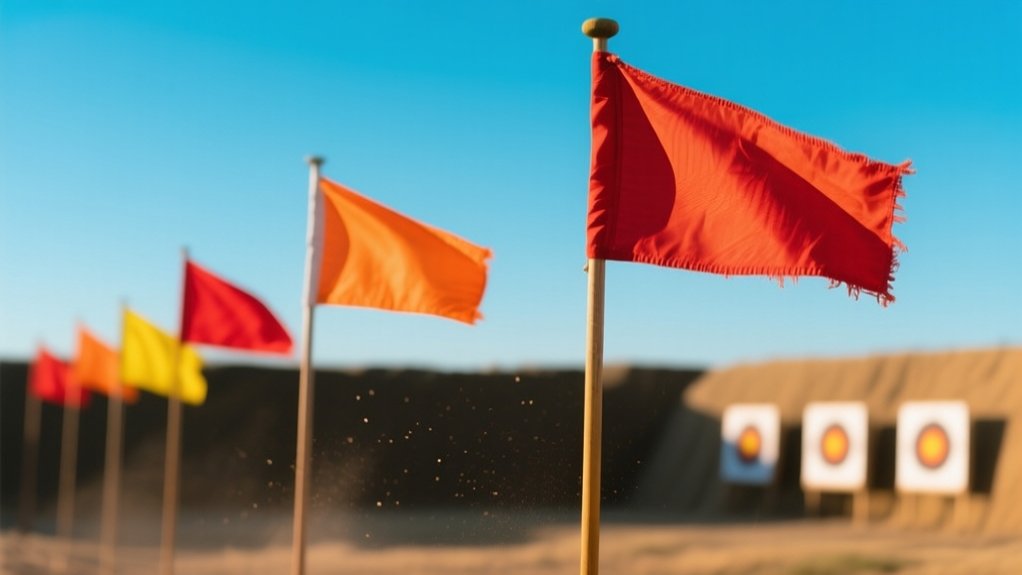
To read shooting range flags, watch their angles. Divide the angle by four to estimate wind speed in mph. Flags at 90 degrees mean full wind, while smaller angles show lighter breezes.
Use multiple flags downrange placed in a straight line to track wind changes accurately. Bright colors help visibility, and flag design reveals wind direction.
Combine flag observations with natural signs for better accuracy. If you keep exploring, you’ll uncover tips to set up flags correctly and sharpen your shot adjustments.
How To Read Wind Flags For Direction And Speed
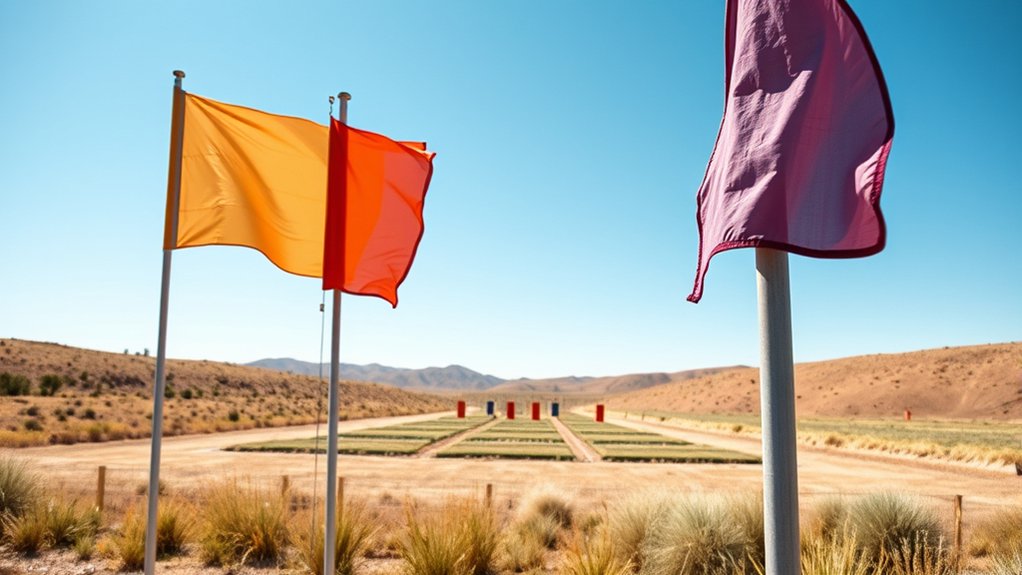
When you’re reading wind flags, pay close attention to the angle they make with the pole. Dividing that angle by four gives you a quick estimate of the wind speed in miles per hour. Wind flags at 90 degrees show a full-value wind, while smaller angles indicate lighter winds.
These wind indicators reveal both wind direction and wind speed, which is essential for reading the wind accurately at the shooting range. Bright-colored flags enhance visibility, and black flags often mark outgoing wind.
How To Use Multiple Wind Flags To Track Downrange Changes
To track downrange wind changes, start by placing multiple flags at key distances and angles between you and the target.
Then, watch how each flag moves—that’s how you can interpret shifts in wind speed and direction accurately.
By coordinating these readings, you’ll be able to adjust your shot for better precision.
It’s a simple way to stay on top of changing conditions and improve your accuracy.
Flag Placement Strategies
Although reading a single wind flag can give you a basic sense of conditions, placing multiple flags in a straight line from your shooting bench to the target lets you track wind changes at various distances more accurately.
For 100 yards, place four wind flags; for 200 yards, use six.
Stagger them slightly to the right of the shooting bench for a broader view of wind conditions. Use flags with distinct colors and shapes. Rectangular vanes work well because their front-third pivot point provides stability and clear wind angle readings.
Combine calmer ball flags with sensitive daisy flags to gauge wind speed effectively at different points downrange.
This flag placement strategy helps you monitor shifting wind conditions and make better-informed adjustments for precise shooting.
Interpreting Flag Movements
By aligning multiple wind flags from your shooting bench to the target, you gain a clear picture of how wind conditions change downrange. Carefully observe the flag movements as wind indicators; flags angled sharply indicate higher wind velocity. Use the ANGLE/4 formula to estimate speed in mph.
Notice differences in wind direction and velocity at various distances. If flags closer to the target angle differently than those near the bench, you’re seeing downrange wind shifts.
Combine daisy and ball flags for better accuracy in reading these changes. Use this info to adjust your sights accordingly.
Regularly practicing interpreting flag movements helps you anticipate how wind affects bullet trajectory, increasing your chances to hit the bullseye consistently.
Coordinating Multiple Flags
Interpreting individual flag movements gives you valuable insight into local wind conditions, but coordinating multiple flags lets you track how wind shifts along the entire shooting lane. To sharpen your wind reading skills, position flags in a straight line from the bench to the target for consistent visibility.
Monitor the angle and behavior of each flag, noting how closer flags react faster while those near the target in the background show long-range wind changes. You can also stagger flags horizontally to avoid confusion.
Regular practice with multiple flags enhances shooting accuracy by helping you understand downrange wind dynamics.
| Flag Position | Wind Direction Angle | Notes on Movement |
|---|---|---|
| 25 Yards | 15° Left | Quick response |
| 50 Yards | 10° Left | Slight lag |
| 75 Yards | 12° Left | Moderate flutter |
| 100 Yards | 8° Left | Subtle shift |
| Target Background | 5° Left | Long-range indicator |
How Flag Colors And Designs Improve Wind Reading Accuracy
When you rely on shooting range flags, their colors and designs play an essential role in reading wind accurately. Flag colors like black help you quickly identify outgoing wind direction and wind speed, boosting your reading accuracy.
Flag colors and designs are crucial for accurately reading wind direction and speed at the shooting range.
Bright vinyl colors improve visibility in all lighting conditions, so you never miss subtle changes. Design matters too. A pivot point in the front third of the flag enhances stability and responsiveness, letting you gauge wind shifts precisely.
Full-size rectangular flags show crosswinds, while half-size flags indicate quartering winds, helping you interpret angles better. Daisy flags respond more sensitively to wind speed changes than ball flags, giving you clearer signals for shooting adjustments.
Together, these elements make reading wind easier and more reliable.
How To Set Up Your Wind Flags Correctly
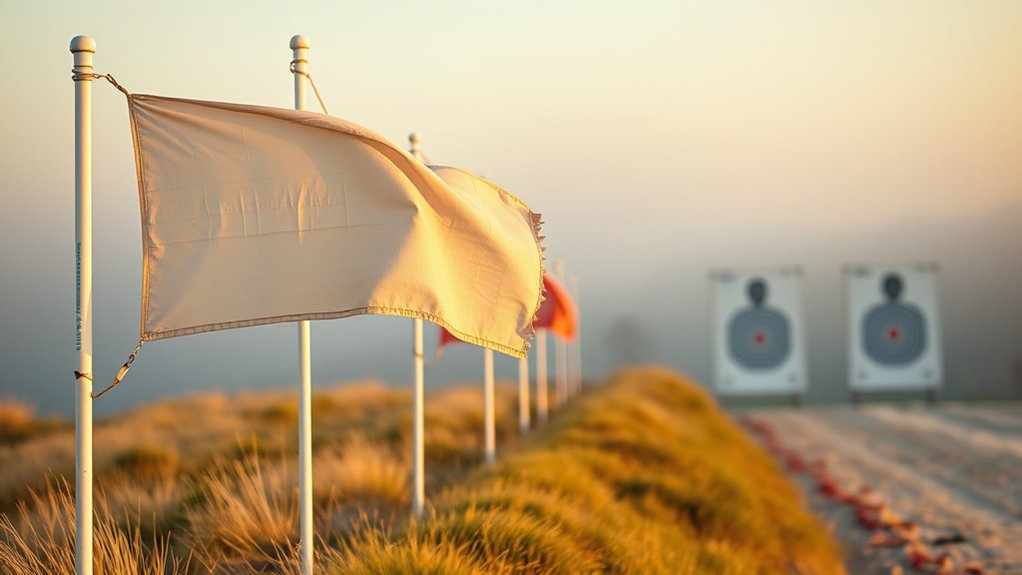
You’ll want to place your wind flags in a straight line from the target to your shooting bench so you can see them clearly.
It’s best to use the right number of flags—four if you’re shooting at 100 yards, or six for 200 yards. This way, you can keep track of the wind conditions more accurately.
Also, make sure to align and space them properly.
When you do that, you’ll get the most reliable information about the wind’s direction and speed.
Flag Placement Strategies
Setting up your wind flags correctly starts with positioning them in a straight line from the shooting bench to the target. This ensures consistent wind direction indicators for accurate readings.
Your flag placement strategies should focus on visibility and capturing wind shifts that influence bullet trajectory.
Here’s how to do it effectively: Use four wind flags for distances up to 100 yards, and six for 200 yards, to gauge varying wind conditions accurately.
Stagger flags horizontally to the right of the bench, keeping their heights between the bench top and target bottom to avoid interference.
Choose bright vinyl colors and place flags at different heights to monitor wind shifts at various elevations.
These tactics improve your wind flags’ visibility and provide precise wind indicators for better shot adjustments.
Optimal Flag Arrangement
Properly arranging your wind flags builds on careful placement strategies to give you the clearest view of wind conditions from bench to target. For the ideal arrangement, line up your wind flags evenly spaced between the shooting bench and target, using four flags for distances up to 100 yards and six for 200 yards.
This setup helps you accurately gauge wind angle and wind velocity. Keep flags below the line connecting the bench top to the target bottom to avoid range officer interference.
Incorporate a staggered arrangement for some flags horizontally to boost visibility and provide varied readings. Choose flags with bright colors and clear, rectangular shapes to enhance readability.
This combination guarantees you get precise, consistent wind information for better shooting decisions.
How To Combine Wind Flags With Natural Wind Indicators
Although wind flags provide valuable data, combining their readings with natural indicators like the movement of leaves and swaying branches gives you a clearer picture of wind speed and direction.
To improve your shooting accuracy, observe multiple environmental features and cross-reference them with wind flags. For example:
- Notice small branches swaying gently (6-10 mph), confirming moderate wind speeds shown by the flags.
- Use the angle of wind flags, around 60 degrees, to gauge wind strength—this suggests roughly 15 mph.
- Watch mirage effects; they reveal subtle wind shifts along the bullet flight path that flags might miss.
How To Adjust Your Shots Based On Wind Flags
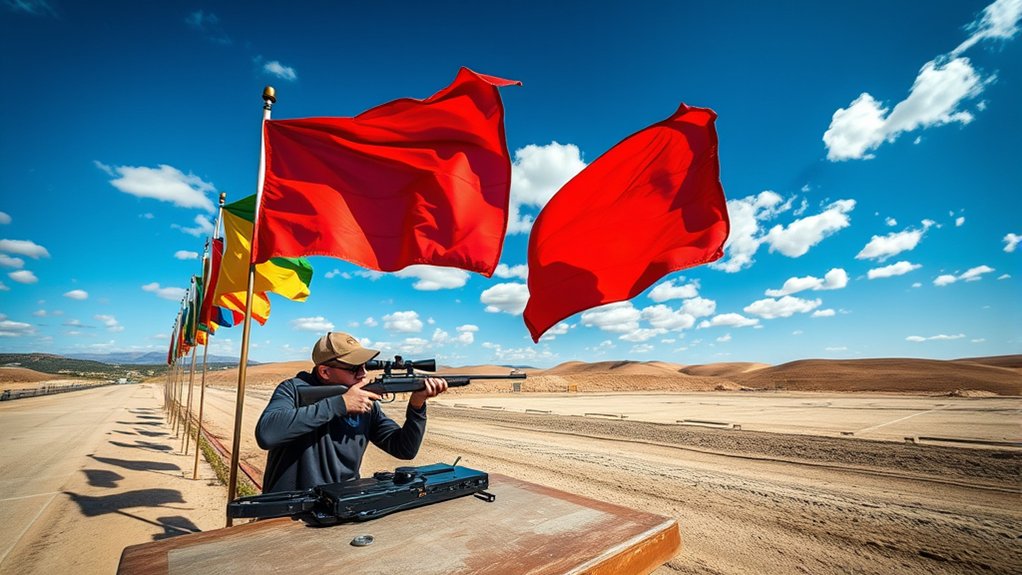
When you spot a wind flag at about a 60-degree angle, you can quickly estimate a 15 mph side wind by dividing the angle by four. This helps you adjust your aim effectively.
Use the Kentucky Windage method to correct your shooting trajectory by aiming into the wind based on the flag’s position and wind speed.
Always observe multiple flags at various distances to detect wind changes accurately. Combine these flag readings with natural indicators to anticipate shifts and fine-tune your adjustments.
By consistently practicing how wind affects your bullet’s path, you’ll sharpen your ability to adjust shots precisely.
Common Wind Flag Reading Mistakes And How To Avoid Them
Even if you rely on wind flags to guide your shots, mistakes in reading them can throw off your aim considerably.
To improve accuracy, you need to pay attention to multiple wind indicators and natural indicators, not just one flag.
Here are common mistakes to avoid:
- Relying on a single flag. Check multiple flags for a full picture of wind conditions and make better adjustments.
- Misjudging the angle. A flag at about 60 degrees means roughly 15 mph wind; don’t underestimate speed or direction.
- Ignoring proximity and natural indicators. Flags closer to you often reflect immediate wind affecting your shot, and trees or grass add valuable clues.
Practicing Wind Flag Reading To Improve Long-Range Accuracy
To improve your long-range accuracy, you should practice reading wind flags at various distances and understand how their angles and movements reflect wind speed and direction.
Use the typical setup of 4 range flags at 100 yards and 6 at 200 yards as wind indicators to gauge conditions.
Pay close attention to flag angles; for example, a 60-degree angle signals about 15 mph wind, helping you aim into the wind correctly.
Remember the proximity theory: flags nearer to you often give more accurate wind readings than those farther out.
Train to spot fast flag movements or subtle shifts, as these affect bullet drift and accuracy.
Combine flag reading with mirage observation to refine your reading skills and improve shot precision.
Frequently Asked Questions
What Materials Are Best for Making DIY Wind Flags?
For DIY flag materials, use lightweight, durable fabrics like nylon or polyester. They’re budget friendly and offer great wind resistance features.
Choose bright colors like fluorescent orange or neon yellow for maximum visibility in sunlight.
Opt for flag size recommendations around 12×12 inches to balance visibility and manageability.
Best mounting options include flexible poles or stakes that hold firm in wind. These choices guarantee your flag stays visible and durable without breaking the bank.
How Often Should Wind Flags Be Replaced or Maintained?
Think of your wind flag as a sentinel. Its flag durability determines how long it can guard effectively. You should replace or maintain it every six months to a year, depending on material wear and environmental effects like sun or rain.
Regularly check visibility factors. Faded flag colors or frayed edges signal it’s time for upkeep.
Adjust maintenance schedules based on mounting options and local conditions to keep your flag’s warning clear and reliable.
Can Electronic Wind Meters Replace Traditional Wind Flags?
Yes, electronic devices can replace traditional wind flags, but they don’t always guarantee better wind flag accuracy.
While technology advancement offers precise readings, you’ll need to evaluate cost comparison and how outdoor conditions might affect electronic meters.
Your shooting performance depends on reliable data, so user preferences play a big role.
Some shooters trust the simple, visual cues of flags, while others prefer digital precision for consistent feedback in varied environments.
What Is the History Behind Using Wind Flags in Shooting?
When it comes to flag evolution, you could say wind flags have been the bread and butter of shooting sports for centuries. They trace back to military origins, where soldiers relied on them for wind direction during battle.
Over time, design variations improved visibility factors and practical applications on ranges.
Your user experiences now benefit from these tweaks, helping you gauge wind like a pro and make smarter shots every time you step up to the line.
How Do Weather Conditions Affect Wind Flag Accuracy?
Weather conditions directly impact wind flag accuracy because changes in wind speed and environmental factors like rain or fog can alter flag positioning and visibility.
You’ll notice flag color matters too; bright colors improve visibility during poor weather, helping maintain range safety.
When visibility issues arise, it’s harder to judge wind direction accurately, which can reduce your shooting accuracy.
Always consider these conditions to interpret flags correctly and stay safe on the range.
Conclusion
Mastering wind flags can boost your shooting accuracy by up to 30%, making a huge difference in your performance. By reading flag direction and speed, and combining them with natural indicators, you’ll confidently adjust your shots and track downrange changes.
Avoid common mistakes by setting up your flags correctly and practicing regularly. The more you engage with wind reading, the sharper your long-range skills become, turning tricky conditions into your advantage every time you shoot.