Is There A Concealed Carry Permit For All States – Reciprocity Explained
You should know that no concealed carry permit is valid in all states due to varying reciprocity agreements. Some states fully honor your permit, others recognize it with restrictions, and some don’t recognize out-of-state permits at all. Requirements on age, residency, and permit status also differ widely.
Carrying without proper authorization can lead to serious legal trouble. Understanding these complexities and verifying current rules before travel is essential to stay compliant and secure. There’s more to learn about how these laws affect your carry rights.
Key Takeaways
- No single concealed carry permit is valid in all states due to varying reciprocity laws and agreements.
- Reciprocity ranges from full recognition to no recognition, with some states limiting carry rights despite recognizing permits.
- States like California, New York, and Oregon do not honor out-of-state permits, posing legal risks for travelers.
- Permit eligibility, age, and residency requirements differ widely, affecting recognition and application processes.
- Always verify current reciprocity and local carry laws before traveling to ensure legal compliance and avoid penalties.
Understanding Concealed Carry Reciprocity: What It Means for You

How does concealed carry reciprocity affect your ability to carry legally across state lines? Reciprocity means some states recognize your concealed carry permit, allowing you to carry without violating local laws.
Concealed carry reciprocity lets certain states honor your permit, enabling legal carry across state lines.
However, recognition varies. Some states honor permits from any state, others only from select states, and some don’t recognize out-of-state permits at all. Your permit’s validity depends on specific agreements and legislation, so understanding these nuances is essential.
States often require permit training and shooting proficiency as conditions for issuing permits. This helps ensure responsible carrying.
When traveling, you must verify whether your permit is recognized to avoid legal trouble. Staying informed about reciprocity rules empowers you to carry confidently and legally, respecting both federal and state laws.
Plus, maintaining the shooting proficiency and training your permit demands is always a smart move.
Age and Residency Requirements for Concealed Carry Permits

When can you legally obtain a concealed carry permit, and what residency conditions must you meet? Most states enforce age restrictions requiring you to be at least 21, though some permitless carry states allow those 18 and older to carry without a permit.
Residency requirements vary widely. Some states issue permits only to residents, while others, like Florida, allow nonresidents to apply if they hold a valid license from their home state.
Plus, certain states recognize non-resident permits or have reciprocity agreements.
Age restrictions and residency requirements can also include exemptions or expanded eligibility for military personnel and veterans.
It’s important to understand these specific conditions because failing to meet age or residency criteria can disqualify your application or limit permit validity in different jurisdictions.
States With Full or Partial Concealed Carry Reciprocity
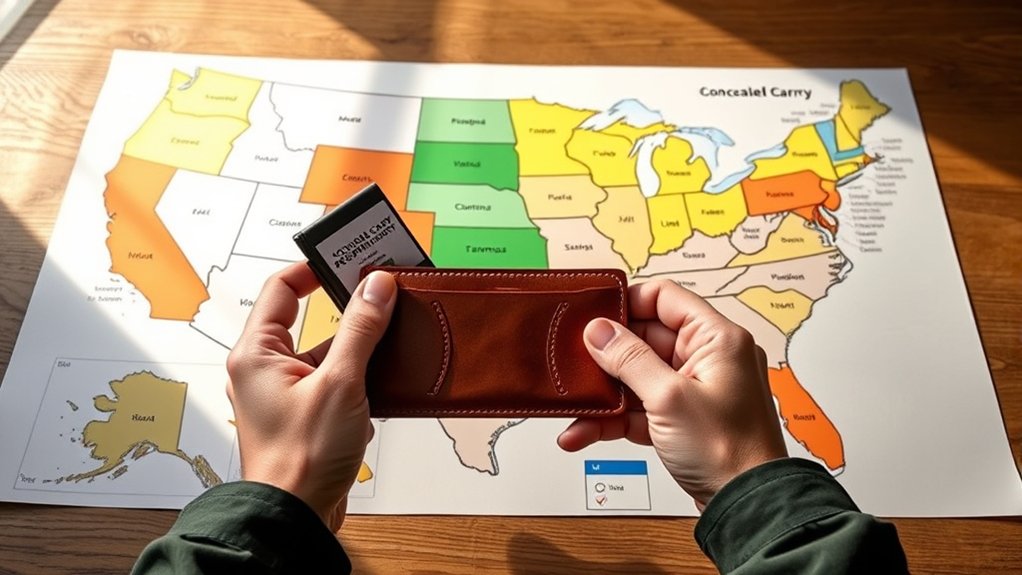
You need to understand how full and partial reciprocity impact your concealed carry rights when traveling across state lines. Some states recognize permits from a wide range of other states. Others only accept certain permits under specific conditions, like training or age.
Knowing which states offer full or limited reciprocity helps you stay compliant and carry confidently. It’s all about being informed so you don’t run into any surprises while on the road.
Reciprocal States Overview
Although concealed carry laws vary widely across the U.S., several states, such as Alabama, Alaska, Colorado, and Michigan, recognize out-of-state permits through full or partial reciprocity agreements. These agreements are formalized via statutes or proclamations, ensuring your permit’s validity across state lines under defined conditions.
Understanding reciprocity requires attention to state-specific details, including age requirements and residency status. You must also stay informed on permit renewal timelines, as failing to renew on time can void reciprocity privileges.
Additionally, law enforcement procedures differ, so you should familiarize yourself with local rules when carrying in reciprocal states.
Keep in mind, reciprocity is subject to legislative changes, so regularly reviewing current agreements is vital to maintaining lawful concealed carry across states.
Partial Reciprocity Explained
Reciprocity agreements vary not only in scope but also in the conditions under which out-of-state concealed carry permits are recognized. Partial reciprocity means some states accept permits with specific permit restrictions or only under certain licensing procedures.
For example, a state may recognize a permit solely for its residents or impose age limits. This limits your ability to carry compared to full reciprocity states. States like California and New York enforce strict permit restrictions, recognizing few or no out-of-state licenses.
On the other hand, states such as North Carolina and Michigan offer broader reciprocity but still may apply conditional licensing procedures.
Since reciprocity agreements can shift due to legislative changes or unilateral proclamations, you must verify current permit restrictions and licensing procedures before carrying across state lines to guarantee compliance.
What Unilateral Recognition Means for Your Permit
When a state unilaterally recognizes another state’s concealed carry permit, it acknowledges the permit’s validity but often stops short of allowing you to carry within its borders. This means permit recognition doesn’t automatically grant you the legal right to carry in that state.
Unilateral recognition typically results from official proclamations, which explicitly state that while your permit is acknowledged, legal restrictions still prevent carrying firearms there. For example, Texas recognizes certain out-of-state permits unilaterally but prohibits permit holders from carrying.
If you rely solely on unilateral recognition, you risk violating state laws due to these restrictions. So, understanding this distinction is essential to avoid legal trouble.
Recognition alone doesn’t mean you get reciprocal carry privileges or exemption from that state’s firearm regulations.
States Without Reciprocity: What You Should Know
You should know that several states and territories, such as American Samoa and Rhode Island, don’t recognize concealed carry permits from other states.
So, if you’re carrying a firearm without valid local authorization in these places, you could face serious legal trouble, including criminal charges.
It’s really important to understand these rules to avoid accidentally breaking the law and to protect your rights.
No Reciprocity States
Although many states honor concealed carry permits from others, several key states, including California, New York, and Oregon, don’t recognize out-of-state permits. This creates significant limitations for permit holders traveling through these areas.
This lack of license recognition means permit portability is severely restricted. You have to comply with each state’s unique regulations.
U.S. territories like Puerto Rico, Guam, and American Samoa also reject out-of-state permits entirely.
States such as Rhode Island and New Jersey may offer unilateral recognition but often prohibit carrying regardless. Since carrying without valid recognition can lead to criminal charges, you need to understand that a permit issued in one state rarely guarantees lawful carry rights elsewhere.
Always verify each jurisdiction’s licensing requirements before traveling to avoid serious legal consequences.
Legal Risks Awareness
Since states like California, New York, and Illinois don’t recognize out-of-state concealed carry permits, carrying a firearm with a permit from another state is illegal in these places. If you carry in these states without proper authorization, you could face serious legal consequences. These include fines, arrest, and even losing your permit privileges.
Even in states with limited recognition, you need to follow local laws carefully. This means paying close attention to gun storage rules and carry restrictions.
Before you travel, always check the current reciprocity status. Laws and permit renewal requirements change often, so it’s important to stay updated to avoid any misunderstandings.
Make sure you secure your firearm properly and understand the specific regulations in each state. Doing this helps you stay compliant and protects your rights.
Bottom line: prioritize legal awareness to avoid costly legal problems and carry responsibly across state lines.
Traveling With Concealed Carry Permits: Legal Tips
Whenever you plan to travel with a concealed carry permit, it’s essential to verify each state’s reciprocity agreements. This helps make sure your permit is legally recognized where you’re going. Always carry your valid permit along with any required documents, like proof of training.
Keep in mind that local laws might restrict certain firearm types or where you can carry, even if the states have reciprocity. So, it’s a good idea to check those details before you hit the road. Make sure your permit renewal is up to date to avoid any complications during your travels.
You might also want to consider travel insurance that covers legal issues related to carrying firearms across state lines. And whenever you’re planning a trip, it’s smart to consult official state resources or local law enforcement to get the most accurate information.
| Key Considerations | Recommendations |
|---|---|
| Reciprocity Status | Verify before travel |
| Permit Documentation | Carry valid permit & proof |
| Local Restrictions | Research firearm laws |
How to Verify Reciprocity and Permit Validity Before Traveling
Before traveling with your concealed carry permit, you need to verify its reciprocity status with the destination state’s official government or law enforcement websites. Reciprocity agreements change frequently, so make sure to confirm whether your permit is recognized and if any local restrictions apply.
It’s a good idea to contact the destination’s licensing agency or law enforcement directly for the most current information on permit validity and carry laws.
Keep in mind that some states don’t honor any out-of-state permits, so you’ll have to comply with their specific firearm laws.
Also, check your permit renewal status to ensure it remains valid throughout your trip.
Understanding the application process in the destination state can be helpful if you plan extended stays or residency.
This way, you can avoid any legal complications while carrying concealed firearms across state lines.
Frequently Asked Questions
Can Concealed Carry Permits Be Transferred Between Family Members?
You can’t transfer concealed carry permits between family members, as family transfer and permit inheritance aren’t legally allowed. Each person must apply individually, since permits are personal and non-transferable under state laws to prevent misuse.
It’s pretty straightforward—permits are tied to the individual, not the family. So even if you’re related, you need to go through the application process on your own. This helps keep things clear and lawful.
Are There Training Requirements for Concealed Carry Permits in All States?
You’ll find training standards vary sharply. Some states demand extensive firearm safety courses, while others require none.
This affects permit validity nationwide, so you must understand each state’s unique rules before carrying concealed across borders.
It’s always a good idea to check the latest requirements to stay compliant and safe.
How Do Background Checks Differ for Concealed Carry Permits?
Background checks for concealed carry vary widely, affecting permit restrictions and gun safety. Some states require fingerprinting and in-person interviews, while others rely on name-based checks. This means you’ll need to meet different standards depending on where you apply for your permit.
It’s important to know what your state requires so you can be prepared. The process can feel a bit overwhelming, but understanding these differences helps you navigate it more smoothly. Just remember, these checks are designed to keep everyone safer.
Can Non-U.S. Citizens Obtain Concealed Carry Permits?
When it comes to concealed carry permits, you can’t paint with a broad brush. Some states allow non-U.S. citizens with proper international licensing and visa restrictions.
Others strictly prohibit them based on residency and legal status requirements. It really depends on where you are and the local laws. So, it’s important to check the specific rules in each state before assuming anything.
Do Concealed Carry Permits Cover Open Carry Rights?
You shouldn’t assume concealed carry permits cover open carry rights, as open carry restrictions vary by state. Permit validity for open carry depends on specific state laws, so always verify local regulations before carrying openly.
It’s a good idea to double-check the rules where you live or plan to visit. That way, you won’t accidentally break any laws. Open carry isn’t automatically allowed just because you have a concealed carry permit.
Conclusion
So, does a concealed carry permit work in all states? Not quite. Reciprocity varies widely, and understanding each state’s rules is essential before you travel. You need to verify your permit’s validity and know where it’s recognized to avoid legal trouble.
Staying informed helps you carry confidently and responsibly across state lines. Don’t risk your safety or freedom. Take the time to research and respect the laws wherever you go.