What Is The Best Scope For Long Range Shooting – Buying Guide And Tips
You’ll want a scope with at least 18x magnification for clear shots beyond 1,000 yards, paired with precise turret adjustments to fine-tune windage and elevation. Choose between First Focal Plane reticles for consistent holdovers at any zoom or Second Focal Plane for lighter setups.
Prioritize durable construction, quality glass, and weight balance to maintain zero and comfort during long shoots. Keep these factors in mind, and you’ll be ready to explore more ways to elevate your accuracy.
How to Choose the Right Magnification for Long Range Scopes
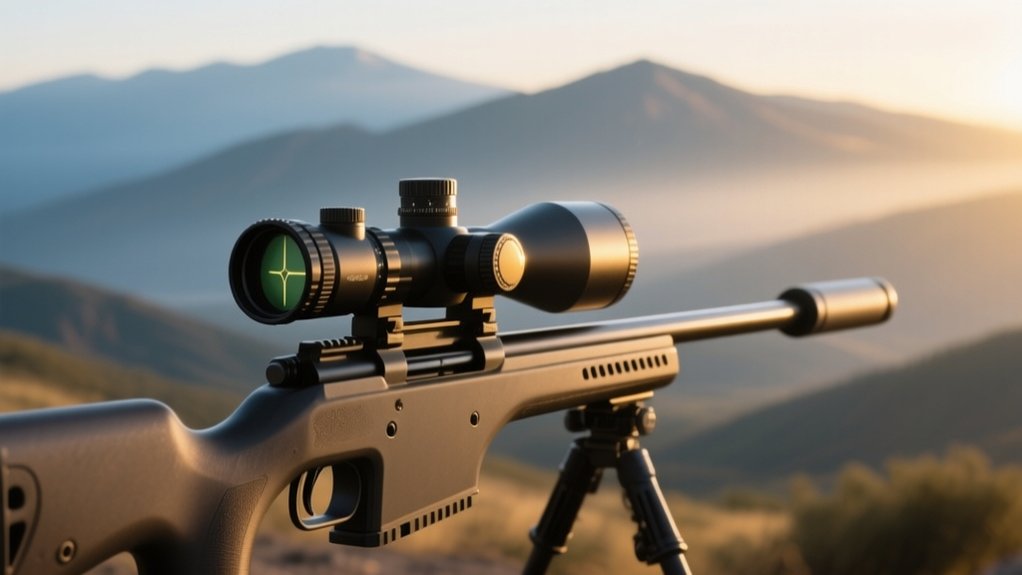
How do you pick the right magnification for long-range scopes? For long-range shooting, you’ll want a minimum magnification of 18x to guarantee clear, precise shots beyond 1,000 yards.
A variable power scope, typically ranging from 5-25x, gives you the flexibility to adjust based on your shooting scenario. Higher magnifications, like 24x or more, help identify distant targets but can narrow your field of view and reduce stability.
Conversely, lower magnifications are better for quick target acquisition and wooded or close-quarter environments.
Also, match your scope’s magnification with your rifle’s caliber to complement your ammunition’s ballistic performance.
Should You Choose First Focal Plane or Second Focal Plane Reticles?
Why does reticle placement matter when choosing a scope for long-range shooting? It directly affects how you read your holdovers and make range calculations.
With a First Focal Plane (FFP) reticle, the reticle scales with magnification, keeping subtensions accurate at any zoom level. This means your holdovers stay precise whether you’re zoomed in or out, which is essential for long-range shooting.
On the other hand, Second Focal Plane (SFP) reticles remain the same size regardless of magnification, so holdovers only align correctly at maximum zoom.
SFP scopes tend to be lighter and more affordable, ideal if you shoot mostly at known distances or lower magnifications.
Understanding these differences helps you choose the reticle type that best suits your shooting style and accuracy needs.
Illuminated vs. Non-Illuminated Reticles: Which Is Best?
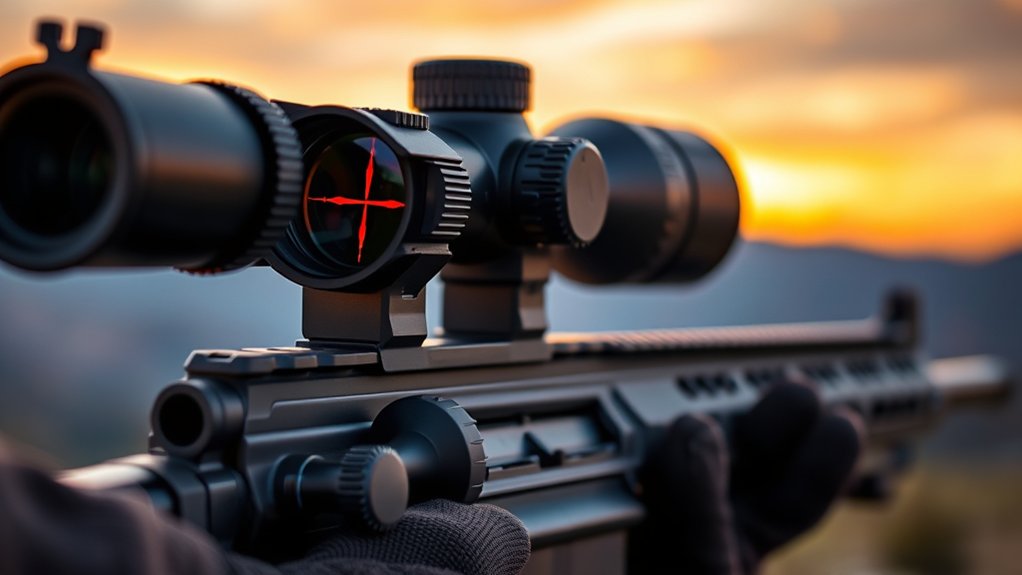
When do you need an illuminated reticle for your scope? Illuminated reticles shine in low-light conditions like dawn or dusk, enhancing visibility when non-illuminated reticles struggle. Here’s what to evaluate:
Illuminated reticles enhance visibility in low-light conditions like dawn and dusk when standard reticles fall short.
- Visibility in Low-Light Conditions: Illuminated reticles improve target acquisition. Non-illuminated rely on ambient light.
- Battery Dependency: Illuminated reticles need batteries, which might fail. Non-illuminated reticles work anytime.
- Weight and Complexity: Illuminated scopes are heavier and more complex. Non-illuminated scopes are lighter and simpler.
- Sight Picture and Cost: Non-illuminated reticles offer a cleaner view in bright light and are usually more affordable.
Choose illuminated reticles if you often shoot in low-light conditions.
Otherwise, non-illuminated reticles provide reliability and simplicity for most daylight scenarios.
Selecting Elevation and Windage Adjustments for Precision Shooting
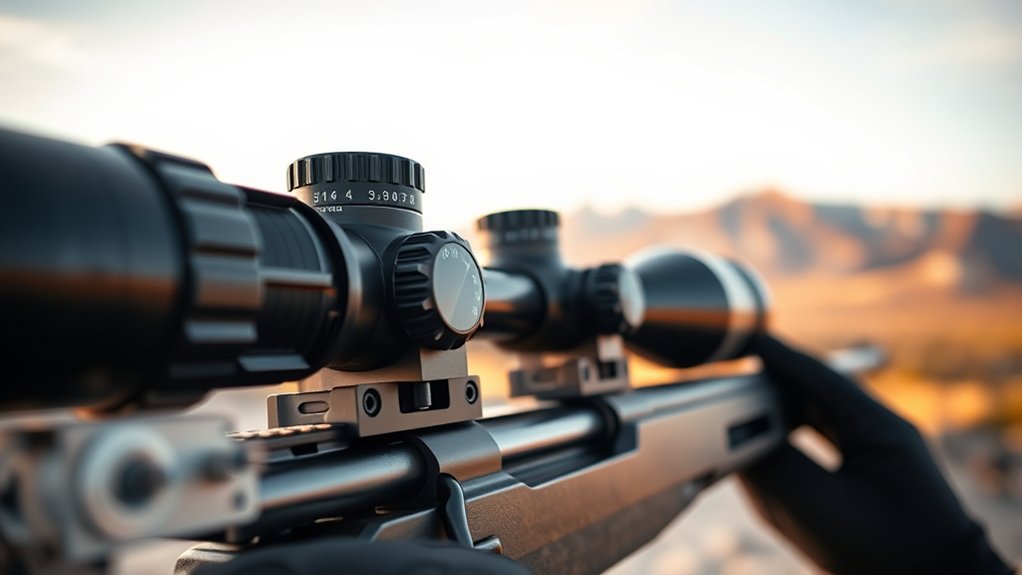
When you’re picking out a scope, you want turrets that give you precise, consistent clicks so you can make accurate elevation and windage adjustments.
It really helps to have that kind of reliability when you’re lining up your shot.
Also, make sure the elevation range covers at least 100 MOA. This way, you won’t run into any limitations when taking long-distance shots.
And don’t forget to look for scopes with reliable zero return features. They let you quickly reset your settings in the field without any hassle, which can save you a lot of time and frustration.
Turret Precision Importance
Although long-range shooting demands many skills, you can’t overlook the importance of precise turret adjustments. Even tiny errors can cause major point-of-impact shifts at distance.
To maximize accuracy, focus on these key factors:
- Confirm turret adjustments are repeatable. Each 10.0 mil click should deliver consistent results.
- Choose turrets with clear, tactile clicks for quick, confident changes without constantly looking.
- Match turret adjustments to your reticle type, like MOA with MOA or mil with mil, to simplify calculations.
- Opt for an elevation adjustment range exceeding 100 MOA (27.3 mil) to cover various shooting distances.
Adjustment Range Requirements
Precise turret adjustments only matter if your scope offers enough elevation and windage range to cover your shooting distances. For long-range shooting, you’ll want an adjustment range with a minimum of 100 MOA (27.3 mil) elevation adjustments to compensate for bullet drop effectively.
Scopes with larger tube diameters, like 30mm or 34mm, usually provide greater adjustment range, giving you more flexibility for various scenarios.
Confirm your windage adjustments match your elevation settings. Using MOA with MOA or mil with mil simplifies calculations.
Each click should correspond accurately to 1 MOA or 0.1 mil to maintain precision.
Importantly, your scope must consistently return to zero after adjustments to guarantee reliable point-of-impact tracking during extended shooting sessions.
Zero Return Reliability
Zero return reliability is essential for long-range shooters who need their scopes to consistently bring them back to the original point of impact after making elevation and windage adjustments.
To achieve this, focus on these key factors:
- Zero Stop: Choose scopes with a zero stop feature to quickly return your elevation turret to the zero point without guesswork.
- Return to Zero Accuracy: Guarantee your scope provides precise return to zero after adjustments to maintain consistent shot placement.
- Crisp Turret Clicks: Opt for scopes with tactile, crisp clicks on turrets for accurate and repeatable elevation and windage changes.
- Calibration Matching: Match your reticle and turret units (MOA or mil) for easier, faster calculations under pressure.
These features help you stay on target, save time, and maintain confidence during long-range shooting sessions.
How Glass Quality and Lens Coatings Impact Scope Clarity
When you choose a scope, the quality of the glass and the lens coatings play an essential role in how clearly you’ll see your target. High-quality glass greatly boosts optical clarity, offering sharper images and better target identification while minimizing distortion, especially at higher magnifications.
Lens coatings, like anti-reflective and hydrophobic treatments, enhance light transmission and reduce glare, ensuring clear visibility in various lighting conditions. Multi-coated lenses can transmit over 90% of light, improving performance during low-light scenarios such as dawn or dusk.
Moreover, premium glass reduces chromatic aberration, delivering sharper edges and more accurate color contrast. These are key factors for precision at long range.
Balancing Scope Weight and Size for Long Range Comfort and Stability
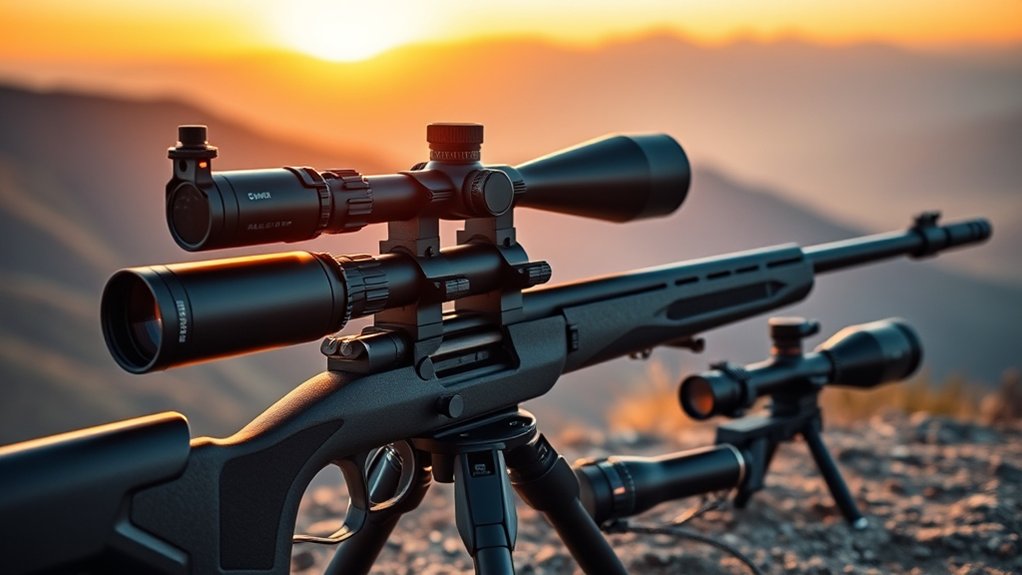
You’ll want to find a scope that balances weight and size so you can keep your shots steady without getting tired. If a scope is too heavy, it can throw off your stability.
On the other hand, a scope that’s too big might slow you down when you’re moving around in the field. Picking one made from durable materials with a compact design helps make sure you stay comfortable and reliable during those long-range shots.
Weight Impact On Stability
Although a heavier scope might seem cumbersome at first, it actually helps steady your aim by minimizing the effects of wind and recoil during long-range shooting.
Proper weight distribution plays a vital role in enhancing stability and overall shooting comfort.
When selecting a scope, keep these points in mind:
- Aim for a scope weighing between 20 to 30 ounces for ideal balance and reduced shooter fatigue.
- Make sure the weight distribution favors the front to improve muzzle control and stability.
- Remember, a heavier scope dampens environmental impacts, giving you steadier shots.
- Match the scope’s weight with your rifle and physical strength for ergonomic long-range shooting.
Balancing these factors will boost your shooting precision and endurance.
Size Versus Maneuverability
Balancing scope size and weight plays an essential role in long-range shooting comfort and stability, especially during extended hunts or tactical scenarios.
You want a scope light enough to carry without fatigue but with a larger objective lens to maximize light transmission for clear images.
Keep in mind, a bigger lens often adds bulk and weight, affecting maneuverability.
Choose a magnification range that suits your needs, typically between 5x to 25x, so you get versatility without unnecessary size.
Also, consider tube diameter; while 30mm or 34mm tubes offer better adjustments, they add weight.
Ultimately, striking the right balance between size and weight guarantees you stay comfortable and stable, whether moving through rugged terrain or setting up for a precise shot.
Balancing Durability And Comfort
Finding the right scope means weighing not just size and magnification but also durability and comfort. You want a scope that feels stable without becoming a burden during long shoots or hikes.
Consider these factors:
- Weight consideration: Choose scopes between 2 to 3.5 pounds to maintain comfort and stability.
- Tube diameter: Opt for 30mm to 35mm tubes to boost durability and adjustment range, but watch for added weight.
- Eye relief: Guarantee 3.5 to 4 inches for safe, comfortable shooting, especially with high-recoil rifles.
- Compact design: Shorter scopes with low profiles improve maneuverability and reduce fatigue.
Test different models in the field to find your ideal balance of comfort and durability for long-range precision.
Scope Features That Ensure Durability and Maintain Zero
Durability and zero retention are critical when choosing a scope for long-range shooting, as you need equipment that performs reliably under tough conditions.
Look for scopes with single-piece construction to boost durability and reduce misalignment risks caused by heavy recoil.
You want repeatable adjustments with turrets that click precisely and return to zero consistently, guaranteeing your point of impact stays accurate after every dial.
Weather resistance also plays a key role. Opt for gas-purged, O-ring sealed designs to prevent fogging and protect against moisture.
Don’t overlook high-quality glass, which enhances clarity and reduces distortion, helping you acquire targets accurately even in challenging environments.
Combining these features guarantees your scope maintains zero and stands up to the rigors of long-range shooting.
Frequently Asked Questions
How Do Environmental Factors Affect Long-Range Shooting Accuracy?
Environmental factors impact your long-range shooting accuracy by causing wind drift, bullet drop, and mirage effects.
Wind drift pushes your bullet off course, so you’ll need to adjust for crosswinds.
Temperature and altitude affect bullet drop, making your shots fall short or go long if you don’t compensate.
Mirage effects distort your target’s image, especially in heat, so you’ll have to wait for stable air or adjust your aim to stay accurate.
What Is the Ideal Reticle Type for Low-Light Conditions?
For low-light conditions, you want reticle illumination features that boost visibility without overpowering your target.
Choose reticles with red or green reticle color contrast to help you see clearly against varying backgrounds.
A fine crosshair design effectiveness is key, as it minimizes target obstruction and aids precision.
First Focal Plane reticles also keep holdovers accurate at any magnification, making them ideal when light is limited and every shot counts.
How Important Is Parallax Adjustment in Long-Range Scopes?
Parallax adjustment is essential for long-range shooting because it prevents parallax error, which can throw off your shot when your eye moves.
By using distance calibration and focus adjustment, you guarantee the reticle stays aligned with your target, improving accuracy.
Without it, your shots can be inconsistent, especially at varying distances.
Can Scope Mounting Height Impact Shooting Precision?
Think of your scope mounting height like the foundation of a house. It directly impacts shooting precision.
Using proper mounting techniques guarantees your scope alignment matches your rifle’s bore axis, giving you consistent accuracy.
Height advantages come into play by balancing comfort and visibility while minimizing parallax errors.
If your scope sits too high or low, your shots might wander. Fine-tuning that height is key to hitting your mark every time.
What Maintenance Routines Extend a Scope’s Lifespan?
You’ll extend your scope’s lifespan by regularly using proper lens cleaning techniques. Microfiber cloths and lens cleaner prevent scratches and maintain clarity.
Always check weatherproof coatings and keep them intact to protect against moisture and corrosion.
Don’t forget to inspect and tighten mounting rings to protect internal adjustment mechanisms from damage.
Store your scope properly and recalibrate zero after temperature changes to guarantee consistent performance and long-term durability.
Conclusion
Choosing the perfect long-range scope isn’t just about specs. It’s about what feels right in your hands and eyes. You’ve weighed magnification, reticles, adjustments, and durability. But the real question is: can you trust your gear when it counts most?
As you gear up for your next shot, remember that the right scope doesn’t just enhance your aim. It transforms your confidence. The best scope? It’s the one that makes every long-range shot unforgettable.