Can You Concealed Carry In California – Laws And Permit Requirements
You can carry a concealed firearm in California only if you get a state-issued CCW permit. You must be at least 21, meet strict eligibility criteria, complete required training, and pass thorough background checks.
Your permit is valid mainly in the issuing county and allows carry in limited locations while following storage and transportation rules. California doesn’t recognize out-of-state permits.
Understanding these laws guarantees you stay compliant and responsible when carrying concealed. More details clarify legal nuances and recent changes.
Key Takeaways
- You must obtain a California Concealed Carry Weapon (CCW) permit from local authorities to legally carry concealed firearms.
- Applicants must be 21+, demonstrate good moral character, complete training, and provide a valid objective reason for carrying.
- CCW permits are generally valid only within the issuing county or city and require renewal every two years with updated training.
- Concealed carry is prohibited in schools, courthouses, alcohol-serving venues, federal buildings, and other designated restricted areas.
- California does not recognize out-of-state CCW permits; a state-issued permit is required to carry concealed legally.
Who Can Get a Concealed Carry Permit in California?

Who qualifies for a concealed carry permit in California? You must be at least 21 years old and either a resident, worker, or active military member in the state.
To qualify, you need to show good moral character and provide a valid, objective reason, like concerns for personal safety or specific job needs.
Local authorities such as sheriffs or police chiefs review applications using clear, objective standards. They don’t use subjective “good cause” requirements.
Before you get the permit, you’ll go through a thorough background check to make sure you have no recent criminal convictions, restraining orders, or pose a danger to yourself or others.
Also, responsible firearm storage practices are important to keep things safe.
Meeting these criteria means you’re following California’s strict concealed carry regulations.
How to Apply for a California CCW License
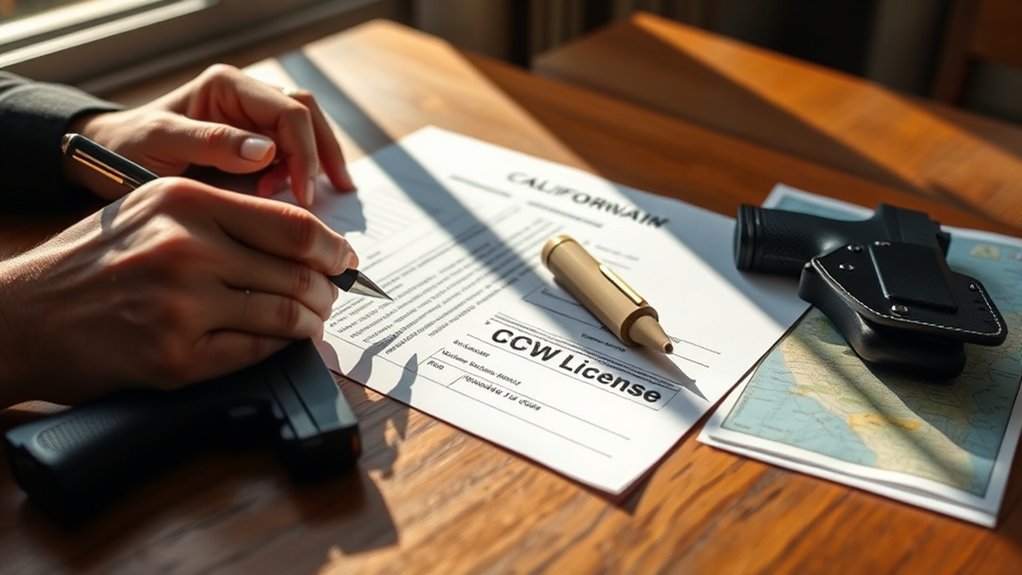
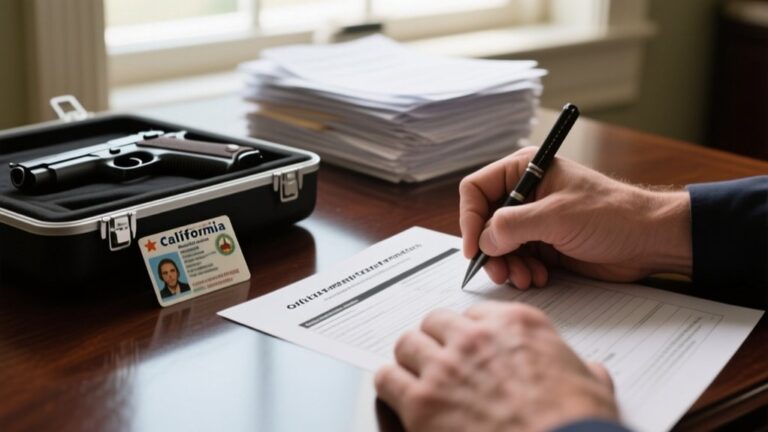
Although the process may vary slightly by location, you must submit your California CCW license application through the local sheriff’s office or police department where you live or work. Your application must include proof of good moral character, completion of a weapons training course, and a demonstration of “good cause” for carrying a concealed firearm.
Submit your California CCW application locally with proof of good character, training, and valid cause.
Expect a background check, fingerprinting, and possibly psychological testing. Approval or denial comes within 120 days.
To apply effectively, make certain you:
- Provide detailed personal and firearm information
- Understand and comply with current concealed carry laws
- Prepare to explain your approach to safe firearm storage
- Be ready to challenge disqualifications through a superior court hearing
Your CCW license will be valid statewide for two years once granted.
Training and Renewal Requirements for CCW
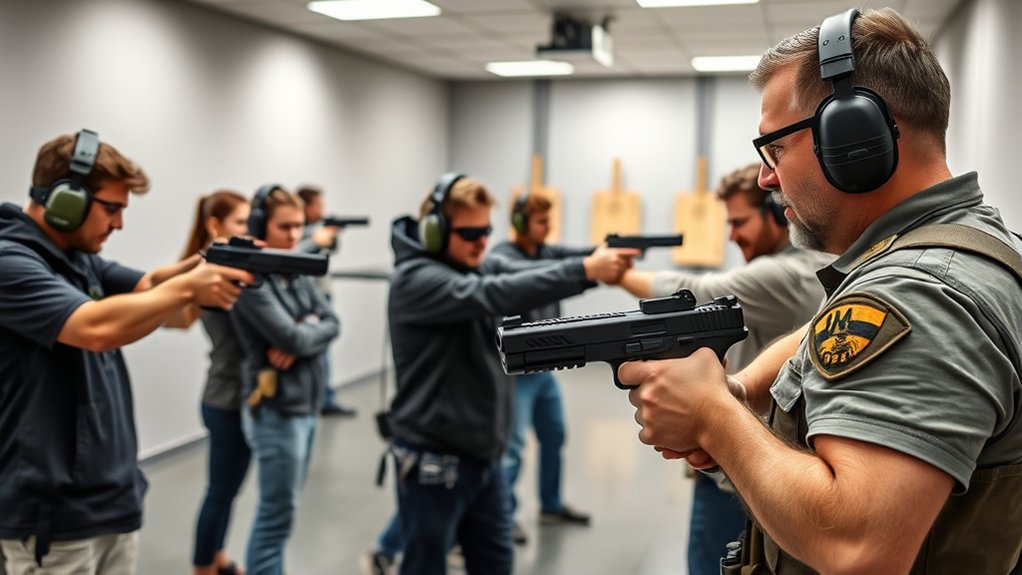
To get a California CCW license, you’ll need to complete at least eight hours of safety and firearms training. It’s a solid way to make sure you’re prepared and responsible with your firearm.
When it comes time to renew your license every two years, you’ll have to meet most of the original requirements again. This includes updated training and a proficiency test to keep your skills sharp.
Keeping up with these requirements not only ensures you stay eligible but also shows that you’re committed to handling your firearm safely. It’s all about staying responsible and informed.
Mandatory Safety Training
Because California prioritizes responsible firearm ownership, you must complete at least 8 hours of safety and firearm handling training to obtain a concealed carry weapon (CCW) license. This training guarantees you understand essential firearm safety and comply with state-specific training standards.
The course typically includes proper firearm handling techniques, safety protocols to prevent accidents, relevant California laws governing concealed carry, and demonstration of shooting proficiency.
You may need to present proof of completed training when applying or renewing your CCW license. The Department of Justice regulates training standards and may approve specific instructors or courses to maintain consistent safety education.
This mandatory training is designed to promote secure, lawful firearm use and reduce risks associated with concealed carry in California. It’s all about making sure you’re prepared and responsible every step of the way.
Renewal Eligibility Criteria
When you renew your CCW license in California, you must demonstrate ongoing proficiency in firearm handling and shooting skills. License renewal requires completing at least eight hours of safety and training courses comparable to those for initial licensing.
Additionally, you’ll need to provide proof of firearm training and shooting proficiency, as most counties require this for renewal eligibility.
During the renewal process, you must also undergo a background check and submit updated fingerprints. Keep in mind that license renewal typically occurs every two years. Any extensions or amendments won’t extend the original expiration date.
Training Hours Required
Although obtaining and renewing a CCW permit involves multiple steps, completing a minimum of eight hours of firearm safety and handling training remains central to the process. You must meet specific certification standards to show you’re proficient and can handle firearms safely. The training covers essential topics and uses effective techniques to ensure you’re competent.
Here are the key requirements:
- At least 8 hours of approved training for both initial and renewal permits
- Instruction on firearm safety, laws, and proper use
- Demonstration of shooting proficiency and safe handling skills
- Training provided only by licensed instructors approved by local authorities
Meeting these criteria guarantees your training aligns with California’s rigorous certification standards. It prepares you well for responsible concealed carry.
Where Can You Carry a Concealed Firearm in California?
You can carry a concealed firearm in public only if you have a valid CCW license issued by your local sheriff or police department. That’s an important first step.
But keep in mind, some places are off-limits no matter what. Schools, courthouses, and businesses that serve alcohol usually have strict rules against carrying concealed weapons.
Also, your license often only works within the county or specific area that issued it. So, it’s a good idea to know exactly where you’re allowed to carry before you head out.
Permitted Public Locations
Where can you legally carry a concealed firearm in California? You must have a valid concealed carry permit issued by local law enforcement to carry a loaded concealed firearm in public.
Public safety is a top priority, so California restricts where you can carry even with a permit.
Generally, you can carry in private property and residences where firearms aren’t prohibited. You can also carry in private businesses that allow concealed firearms.
Certain less populated counties permit open carry with a license.
Plus, you can carry in public places not explicitly restricted by law or signage.
You must always follow firearm storage requirements to prevent unauthorized access.
Carrying without a permit or outside permitted locations is illegal and carries severe penalties.
Understanding these permitted public locations helps you stay compliant and prioritize public safety while carrying concealed in California.
Restricted Areas Overview
Carrying a concealed firearm in California comes with strict limitations despite having a valid permit. You can’t carry in restricted areas like schools, courthouses, or any alcohol-serving establishments.
Additionally, federal buildings and police stations prohibit concealed carry regardless of your permit.
Private properties or businesses may also ban firearms through posted signs or local ordinances.
To comply, you must guarantee proper gun storage and keep up with firearm registration laws.
Local jurisdictions might add extra restrictions, so always verify regulations before carrying concealed.
License Geographic Limits
Although a California CCW license grants you the legal authority to carry a concealed firearm, its validity typically extends only within the county or city of issuance. You need to be aware of strict geographic limits to avoid legal issues related to license validity and firearm storage.
Here are some key points to keep in mind: Your CCW license is generally valid only in the issuing jurisdiction, with limited reciprocity exceptions. Concealed carry remains prohibited in designated areas such as schools, courthouses, and alcohol-serving venues.
Also, you must carry your license visibly when carrying a concealed firearm in public. Some less populated counties may allow open or loaded carry with a CCW license, but most urban areas restrict carry to concealed methods only.
Sticking to these limits helps ensure you’re following California’s firearm storage and carry laws without any trouble.
California Concealed Carry Restrictions and Prohibitions
Because California enforces strict regulations on firearm possession, you must understand that concealed carry without a valid permit is illegal throughout the state.
California strictly prohibits concealed carry without a valid permit statewide.
You can’t openly carry firearms except in certain counties with fewer than 200,000 residents or with a Concealed Carry Weapon License (CCWL).
Carrying loaded, exposed firearms in public is heavily restricted, and transporting firearms in vehicles without authorization risks criminal charges.
You have to comply with firearm storage laws and guarantee proper gun registration to avoid legal issues.
Even with a CCW permit, you can’t carry firearms in restricted areas like schools, courthouses, and establishments serving alcohol.
Always carry your CCW license visibly and cooperate with law enforcement to prevent license revocation or other penalties.
Understanding these restrictions is essential for legal concealed carry in California.
Make sure you’re aware of where and how you can carry to stay on the right side of the law.
It’s all about being responsible and informed.
How California’s Reciprocity Rules Affect Your CCW Permit
Understanding California’s strict concealed carry restrictions naturally leads to questions about how your out-of-state CCW permit applies within its borders. California doesn’t offer interstate recognition of CCW permits, meaning reciprocity agreements don’t extend concealed carry rights to non-residents.
Specifically, California explicitly refuses to recognize CCW permits issued by other states. Reciprocity agreements are limited nationally, but California’s permits aren’t honored elsewhere.
Even valid out-of-state permits don’t grant carry privileges within California.
You must obtain a California-specific CCW license to carry concealed legally in the state.
In short, if you plan to carry concealed in California, relying on reciprocity or interstate recognition won’t suffice. You need to meet California’s permit requirements directly to comply with its stringent laws.
Recent Legal Changes Affecting California CCW
Since the U.S. Supreme Court’s 2022 ruling in *NYSRPA v. Bruen*, the legal landscape for concealed carry in California has changed markedly.
The Court struck down New York’s “proper cause” requirement, which set the stage for California’s Attorney General to declare the state’s “good cause” standards under Penal Code sections 26150 and 26155 unconstitutional.
In response, California enacted Senate Bill 2 (SB 2), replacing the subjective “good cause” criteria with objective standards for issuing CCW permits.
Emergency regulations finalized in 2025 now require licensing authorities to grant permits if applicants meet these clear, non-disqualifying criteria.
What does this mean for you? The process to get a concealed carry permit in California is now more straightforward and constitutionally compliant.
It eases previous restrictions while still keeping public safety safeguards in place.
Frequently Asked Questions
Can Non-Residents Apply for a California Concealed Carry Permit?
You can apply for a California concealed carry permit as a non-resident only if you meet specific residency or employment requirements. Permit reciprocity doesn’t apply here, so out-of-state permits won’t be recognized.
Also, there are travel restrictions to keep in mind. Basically, if you’re from out of state, it’s not as simple as just showing your permit. You’ll need to follow California’s rules to get your own permit.
What Types of Firearms Are Allowed for Concealed Carry?
You carry a sleek revolver or handgun, not a beast like machine guns or assault rifles. Firearm classifications limit you to small arms, while carry restrictions bar high-capacity magazines and illegal models under California law.
Basically, you’re sticking to the smaller stuff that’s easier to handle and legally allowed. Those big guns? They’re off-limits for concealed carry, no exceptions. So, keep it simple and within the rules.
Are There Penalties for Losing a Concealed Carry Permit?
Yes, if you lose your concealed carry permit, penalty enforcement can include fines or criminal charges. You must report the loss promptly and complete permit renewal to avoid these consequences and continue carrying legally.
It’s really important to stay on top of this. Losing your permit and not reporting it could lead to bigger issues down the road. So, make sure you handle it as soon as possible.
Can You Carry a Concealed Firearm in Federal Buildings in California?
You can’t carry a concealed firearm in federal buildings in California because of strict federal restrictions and security protocols. Even if you have a valid permit, the rules are clear.
Compliance is mandatory to avoid legal consequences. So, it’s best to follow the law closely and not take any chances.
How Does California Handle Concealed Carry for Peace Officers?
You benefit from peace officer exemptions in California, which means you can carry concealed firearms without a permit.
Permit reciprocity doesn’t apply here because your official status overrides local carry restrictions and licensing requirements across the state.
Conclusion
Understanding California’s concealed carry laws can feel like decoding a complex puzzle. But knowing who qualifies, the application steps, and the restrictions will help you stay compliant.
Just like a skilled driver knows the rules of the road, you need to master training, renewal, and location limits to carry responsibly. Stay informed about reciprocity and recent legal changes so you don’t get caught off guard.
With careful attention, you’ll confidently exercise your rights while respecting California’s unique regulations.