Which States Have Reciprocity For Concealed Carry – Permit Recognition Guide
You can carry your concealed weapon across many states that fully recognize out-of-state permits, like Missouri, Arizona, and Florida, without needing extra permits. Some states offer partial reciprocity but may have conditions on permit types, age, or background checks.
Others, such as California and New York, don’t recognize any out-of-state licenses. Always verify each state’s specific reciprocity rules, age limits, and permit requirements before traveling to stay compliant.
Understanding these details helps you navigate concealed carry laws confidently. It’s a good idea to double-check before you hit the road so you’re always on the right side of the law.
Concealed Carry Reciprocity: What It Means and How It Works
How does concealed carry reciprocity affect your ability to carry across state lines? Concealed carry reciprocity determines whether a state will recognize a concealed carry permit issued by another state. This directly impacts where you can legally carry your firearm.
States vary widely. Some recognize permits from all states, while others only honor specific ones or have residency and age restrictions. Reciprocity often comes from formal agreements or statutory laws.
States differ in recognizing concealed carry permits, with some accepting all and others imposing strict conditions.
But some states, like California and New York, refuse to recognize out-of-state permits because of differing training or background check requirements. Understanding these nuances is important to stay compliant and avoid legal trouble when traveling.
Always double-check how a state’s concealed carry reciprocity policies apply to your permit before you carry concealed across its borders. It’s better to be safe than sorry!
States Fully Recognizing Out-of-State Permits
You’ll find that several states fully recognize out-of-state concealed carry permits. This means they accept all valid licenses, no matter the type.
For example, states like Missouri, Arizona, and Florida have clear laws allowing permit holders to carry without needing to get a new license.
Just keep in mind, most of these states require permit holders to meet certain age and eligibility criteria to qualify for full reciprocity.
States With Full Reciprocity
Four states, Missouri, Alaska, Arizona, and Florida, stand out for offering full reciprocity. They recognize concealed carry permits issued by all other states with valid licenses.
With full reciprocity, you can carry your concealed firearm across state lines seamlessly. These states honor permits from virtually every other state that issues valid licenses. This means you don’t need to apply for additional permits when traveling to these states with your concealed carry permits.
However, full reciprocity usually applies only to residents holding valid permits. It often excludes permits issued to individuals under 21 or non-residents.
These states maintain mutual recognition agreements, ensuring consistent legal status for permit holders. Understanding full reciprocity helps you confidently carry concealed firearms without worrying about complex permit recognition issues.
License Types Recognized
While some states impose restrictions on the types of concealed carry permits they recognize, states that fully accept out-of-state permits generally honor all valid license types without exception.
In these states, such as Missouri and Florida, reciprocity laws explicitly acknowledge every permit type issued by other jurisdictions, whether resident or non-resident.
You won’t face additional requirements or restrictions based on the license type when carrying in these states, as full reciprocity means uniform acceptance.
This approach guarantees that all validly issued permits are treated equally, providing clarity and consistency for permit holders traveling across state lines.
Understanding which states fully recognize all license types helps you confidently carry your concealed weapon without worrying about varying permit restrictions.
States With Partial or Conditional Reciprocity
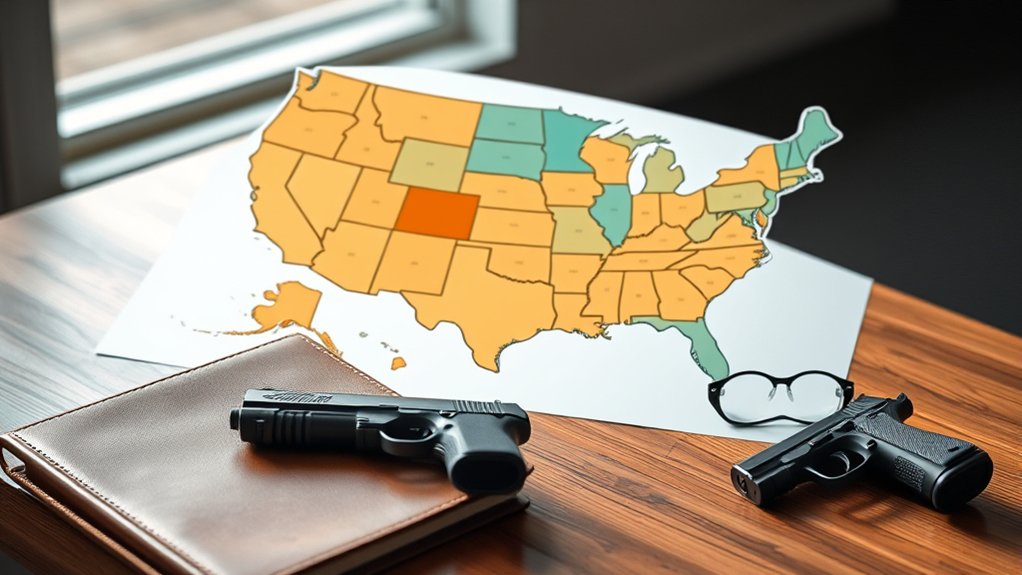
Although many states fully honor concealed carry permits from other jurisdictions, several apply partial or conditional reciprocity. They recognize out-of-state permits only under specific circumstances.
Many states fully honor concealed carry permits, but some recognize them only under certain conditions.
You’ll find that these states often require the issuing state to meet defined standards, such as training, background checks, or licensing criteria, for their permits to be acknowledged. Partial reciprocity may limit recognition to certain permit types, like enhanced or unrestricted licenses. Or it might restrict it to residents and permit holders above a specific age.
Some states maintain a list of approved states whose permits they accept, while others require ongoing legislative approval for reciprocity agreements.
Understanding these nuances helps you comply with each state’s unique conditions. That way, you can avoid legal issues when carrying concealed outside your home state.
States That Do Not Recognize Out-of-State Permits
You should know that a few states—like California, New York, and Illinois—don’t recognize out-of-state concealed carry permits. They don’t accept them because their training requirements, background checks, and licensing standards are quite different from those in other states.
Non-Recognition States
Why do some states refuse to acknowledge out-of-state concealed carry permits? Non-recognition states, like California, New York, and Massachusetts, reject any out-of-state permits because they don’t have reciprocity agreements and have different licensing standards. These states prioritize local regulations over external permits to make sure concealed carry is enforced consistently.
When you’re traveling or moving, keep in mind that non-recognition applies to all out-of-state permits, no matter where they were issued.
Often, differences in training, background checks, and licensing criteria are the reasons behind non-recognition policies.
Carrying concealed without a valid local permit in these states can lead to legal penalties or criminal charges.
Understanding non-recognition states helps you avoid unintended violations and ensures you stay responsible with your concealed carry compliance.
Reasons For Denial
States that refuse to recognize out-of-state concealed carry permits do so for specific reasons tied to their licensing criteria and legal standards. These states often require stringent background checks, including mental health and fingerprint-based screenings, which some out-of-state permits lack.
Reciprocity law depends on uniform training, age requirements, and all-encompassing evaluations. If your permit doesn’t meet these standards, it won’t be honored.
| Reason for Denial | Example States | Key Requirement |
|---|---|---|
| Lack of all-encompassing background check | California, New York | Mental health & fingerprints |
| Insufficient training | Oregon, D.C. | State-specific training |
| Age restrictions | Multiple states | Minimum age 21 |
Knowing these reasons can help you navigate permit recognition laws more easily. It’s always a good idea to check the specific rules before traveling or carrying in a new state.
Age Restrictions and Concealed Carry Reciprocity

Although many jurisdictions recognize concealed carry permits from other states for individuals aged 21 and over, the rules get more complex for younger adults. Age plays a big role in reciprocity agreements and often restricts recognition of permits issued to those under 21.
Some states, like Florida, have recently allowed 18-to-20-year-olds to obtain permits. But not all states honor these licenses. So, it’s important to know that states such as Virginia and Wyoming issue permits to under-21 applicants, but other states may not recognize them.
Recognition often depends on meeting specific criteria like background checks and training. Also, federal and state rulings can change age restrictions that affect reciprocity.
Always double-check each state’s age requirements before relying on reciprocity for concealed carry permits. It’s better to be safe than sorry!
Background Checks and Concealed Carry Reciprocity
You need to understand how background check requirements impact concealed carry reciprocity between states. Some states require thorough fingerprint and mental health screenings, while others don’t.
This difference affects whether your permit is recognized when you travel.
Basically, your permit’s validity often depends on if the state you’re visiting has stricter standards and whether the state that issued your permit meets those standards.
Background Check Requirements
When applying for a concealed carry permit, understanding the background check requirements is essential, as they vary considerably between states. Some states, like Virginia, Wisconsin, and Wyoming, don’t require fingerprint-based criminal background checks or mental health screenings for issuing concealed carry permits. This means fewer screening steps are involved compared to states with more thorough checks.
Here are some key points to keep in mind about background check requirements:
States without fingerprinting or mental health checks often have simpler application processes. Recognition of your out-of-state permit may depend on whether your state’s background checks are complete.
And states requiring detailed background checks may have stricter reciprocity agreements.
Knowing these distinctions helps you navigate concealed carry laws efficiently. It also ensures you stay compliant when it comes to interstate permit recognition.
Age And Licensing Restrictions
Because age and licensing requirements vary considerably across states, understanding these restrictions is essential for concealed carry permit holders seeking reciprocity. Most states require you to be at least 21 years old to qualify for a permit, and many exclude permits issued to minors from recognition.
Licensing standards also play a critical role. States that mandate thorough background checks and specific training are more likely to honor out-of-state permits.
On the other hand, if your permit was issued without detailed background or mental health evaluations, other states may deny reciprocity.
To guarantee your permit is recognized, make sure your licensing meets the minimum age and background screening criteria of the state you plan to carry in. Staying informed about these age and licensing restrictions helps you avoid legal complications while exercising your rights across state lines.
Enhanced and Restricted Permits: Reciprocity Rules
Although states generally honor concealed carry permits from other jurisdictions, they often impose specific conditions based on the type of permit held. Enhanced permits require stringent criteria like fingerprinting and thorough background checks. These are recognized only if your permit aligns with the host state’s standards.
Reciprocity for restricted permits varies more widely. Some states recognize only limited or age-specific permits.
Key points to contemplate include:
- Enhanced permits gain broader reciprocity when both states have comparable or stricter requirements.
- Restricted permits may be honored only under specific conditions, such as age or carrying limitations.
- Reciprocity agreements fluctuate, so you must verify current rules before traveling.
Understanding these distinctions helps you comply with each state’s reciprocity rules effectively. It’s always best to double-check before you hit the road.
How Permitless Carry Laws Affect Concealed Carry Reciprocity
How do permitless carry laws impact the recognition of concealed carry permits across state lines? Permitless carry laws allow you to carry concealed without a permit in certain states, but they rarely come with reciprocity agreements.
States with permitless carry generally don’t recognize out-of-state permits, which limits your ability to carry legally when traveling.
Permitless carry states typically do not honor out-of-state permits, restricting legal concealed carry when traveling.
Even if your home state allows permitless carry, you still have to follow the licensing requirements of the state you visit.
Some permitless carry states recognize permits for residents only, but reciprocity for non-residents is usually minimal or doesn’t exist at all.
As permitless carry laws expand, existing reciprocity agreements become less effective. This makes legal concealed carry across state lines more complicated.
Traveling With Your Concealed Carry Permit: Reciprocity Tips
When traveling with your concealed carry permit, you need to verify whether the destination state recognizes your permit through reciprocity agreements before carrying your firearm. Reciprocity laws differ markedly. Some states accept all permits, others only specific ones, and some none at all.
To lawfully carry concealed weapons, nonresidents often must meet additional criteria like residency or age requirements. Even if your permit is recognized, you must comply with the destination state’s unique laws on where and how you can carry.
Before traveling, consider these tips:
- Confirm reciprocity status through official state resources or local law enforcement.
- Understand the specific restrictions on carrying concealed weapons in your destination.
- Ensure you meet any additional requirements imposed on nonresident permit holders.
How to Verify Reciprocity Status Before Carrying in Another State
Before carrying concealed in another state, you must verify whether your permit is acknowledged there. Start by consulting the official government or law enforcement websites of the destination state for the most current reciprocity agreements.
You can also contact local law enforcement or state police directly to confirm your out-of-state permit’s recognition and any specific restrictions tied to your permit type. It’s a good idea to use updated reciprocity maps and lists from reputable firearm organizations or official state resources to cross-check status.
Keep in mind that laws can change rapidly, so stay informed about recent legislative updates or court rulings that might affect reciprocity.
This thorough verification process helps you comply with all legal requirements and avoid potential penalties while carrying concealed in another state.
Written vs. Statutory Reciprocity: Key Differences
Understanding the type of reciprocity that governs permit recognition in different states can help you navigate concealed carry laws more effectively.
Written reciprocity involves formal agreements that explicitly outline which permits are recognized. These often include specific conditions like age or permit type.
Statutory reciprocity, on the other hand, depends on state laws automatically granting recognition without formal treaties.
Here’s what sets them apart:
- Written reciprocity offers detailed, negotiated terms tailored to both states’ requirements.
- Statutory reciprocity simplifies recognition based on aligned legal provisions.
- Written reciprocity may require you to meet additional conditions, while statutory relies solely on law.
Knowing whether a state follows written reciprocity or statutory reciprocity helps you understand exactly how your permit will be treated across state lines. It’s a key detail to keep in mind when traveling.
Resources for Up-to-Date Concealed Carry Reciprocity Information
Since concealed carry reciprocity laws often change, you need reliable resources to stay informed about which permits are recognized across states. State reciprocity maps and official websites provide the most current information on recognized concealed carry permits. Many states publish detailed reciprocity agreements, listing recognizing states and accepted permit types. These are updated regularly by law enforcement and firearm departments.
Also, online resources like the NRA-ILA and specialized legal firearm law databases offer exhaustive, up-to-date guides on reciprocity. To make sure you’re following the rules, always verify reciprocity status directly with state authorities before traveling with a concealed weapon.
Using these trusted resources helps you navigate varying state laws confidently and avoid legal issues related to concealed carry reciprocity. It’s always better to double-check than to assume when it comes to carrying concealed across state lines.
Frequently Asked Questions
How Do Reciprocity Agreements Impact Concealed Carry Insurance Coverage?
Reciprocity agreements directly impact your concealed carry insurance by determining where your permit is legally recognized. If you carry in a state that doesn’t honor your permit, your insurance mightn’t cover incidents there.
Insurers often limit coverage based on these agreements.
So, you need to know which states recognize your permit to maintain valid protection. Always check reciprocity before traveling to avoid coverage gaps or legal complications.
It’s better to be safe than sorry when it comes to insurance and legal issues.
Can Reciprocity Affect Concealed Carry Permit Renewal Processes?
You might think reciprocity could turn your renewal process into an endless maze, but it usually doesn’t. Reciprocity rarely affects how you renew your concealed carry permit. That’s controlled by the state that issued it.
However, if a reciprocity agreement ends, your permit’s legal standing in that state might vanish. This could complicate your carry rights.
Always check the issuing state’s renewal rules and stay updated on reciprocity changes to avoid surprises.
What Are the Penalties for Unknowingly Violating Reciprocity Laws?
If you unknowingly violate reciprocity laws, you can face serious penalties like criminal charges, fines, or even license suspension.
Law enforcement may arrest or cite you, and ignorance won’t protect you legally.
Repeated or severe violations could lead to jail time and permanent loss of your carrying privileges.
It’s essential you verify each state’s recognition before carrying concealed to avoid these consequences.
Do Reciprocity Agreements Influence Training Requirements for Permit Holders?
Don’t count your chickens before they hatch. Reciprocity agreements don’t change your training requirements.
Even if one state recognizes your concealed carry permit, you still have to meet the training standards of the state you’re in.
These agreements only acknowledge your permit’s validity. They don’t waive mandatory safety courses or qualifications.
How Do Reciprocity Laws Interact With Federal Concealed Carry Regulations?
Reciprocity laws operate independently from federal concealed carry regulations, so you need to understand state-specific rules before carrying across state lines.
Federal laws don’t guarantee nationwide permit recognition, meaning your permit mightn’t be valid in every state you visit.
While federal statutes protect certain law enforcement officers, they don’t override state authority on reciprocity.
Always check local reciprocity agreements to verify your concealed carry permit is recognized where you intend to carry.
Conclusion
So, before you play “Where’s My Permit Valid Today?” with your concealed carry license, remember: reciprocity isn’t a nationwide free pass. It’s more like a complicated dating scene. Some states say “yes,” some say “maybe,” and others just ghost you.
Your best move? Check the latest rules before you hit the road. Otherwise, you might find yourself in a legal pickle that no one wants to carry, not even you. Stay informed, stay safe.