How To Get A Concealed Carry Permit In Virginia – Licensing Requirements Explained
To get a concealed carry permit in Virginia, you must be at least 21, pass a background check, and prove handgun competency through an NRA-certified course or equivalent training.
You’ll need to submit a completed application with a photo and valid ID to your local court or the Virginia State Police, along with the required fees. Virginia issues permits if you meet all the legal requirements.
It’s also important to know the renewal steps and carry restrictions. These help ensure responsible ownership and compliance with the law.
Key Takeaways
- Applicants must be at least 21 years old, meet legal background requirements, and demonstrate handgun competency through approved training.
- Complete a mandatory NRA-certified 3-hour firearms safety and Virginia law course or provide equivalent training certification.
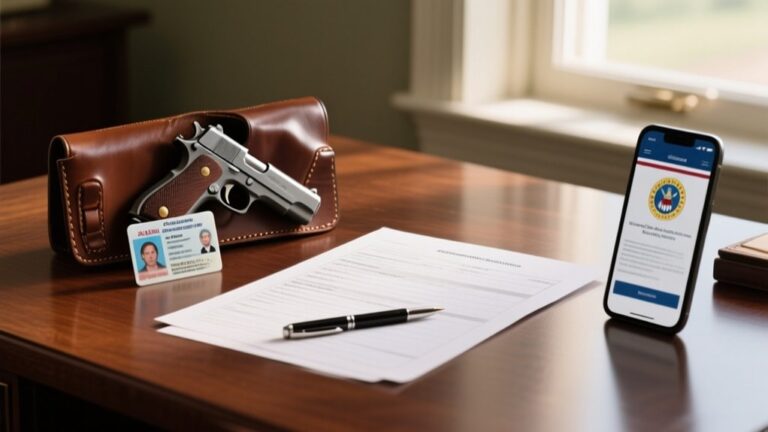
- Submit a completed Virginia Concealed Handgun Permit application with a recent photo, valid ID, fingerprints, and proof of competency.
- Pay applicable fees, including $50 for residents or $100 for non-residents, plus additional court and investigation fees.
- Permits are issued within 45 days under Virginia’s shall-issue law; denial can be appealed through a formal hearing process.
Who Can Apply for a Virginia Concealed Carry Permit?
Although the process may seem straightforward, you must meet specific criteria to apply for a Virginia concealed carry permit. You need to be at least 21 years old and either a resident or non-resident who fulfills all other requirements.
Demonstrating handgun competency through approved safety courses or equivalent experience is essential for gun safety and legal compliance.
Certain individuals, including those with recent felony convictions, specific misdemeanors, or recent mental health commitments, are disqualified from applying.
Lawful permanent residents can apply, but other non-citizens usually cannot.
What Training and Documents Do You Need?
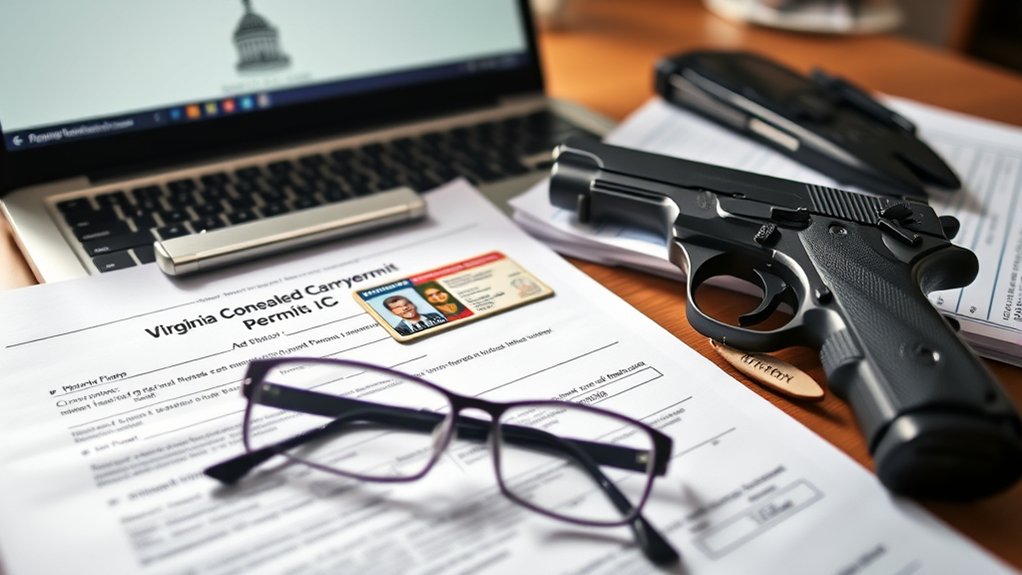
Before you apply for a Virginia concealed carry permit, you’ll need to complete specific training and gather the required documents to prove your handgun competency. You must finish a state-approved firearms safety course, such as hunter safety, NRA, or USCCA, or show equivalent experience.
Proof can include certificates, instructor affidavits, military service records, or previous firearm licenses.
Along with your training certificate or proof, submit the completed Application for Concealed Handgun Permit Form SP-248.
Make sure to include a recent 2×2 inch photo that meets Virginia’s guidelines and a valid government-issued photo ID that matches your current appearance.
Understanding concealed carry laws also means you should be familiar with safe firearm storage requirements. Proper storage is essential to comply with legal standards and ensure responsible handgun ownership.
It’s important to stay informed and follow these rules carefully.
How to Complete the NRA-Certified Course for Virginia Concealed Carry
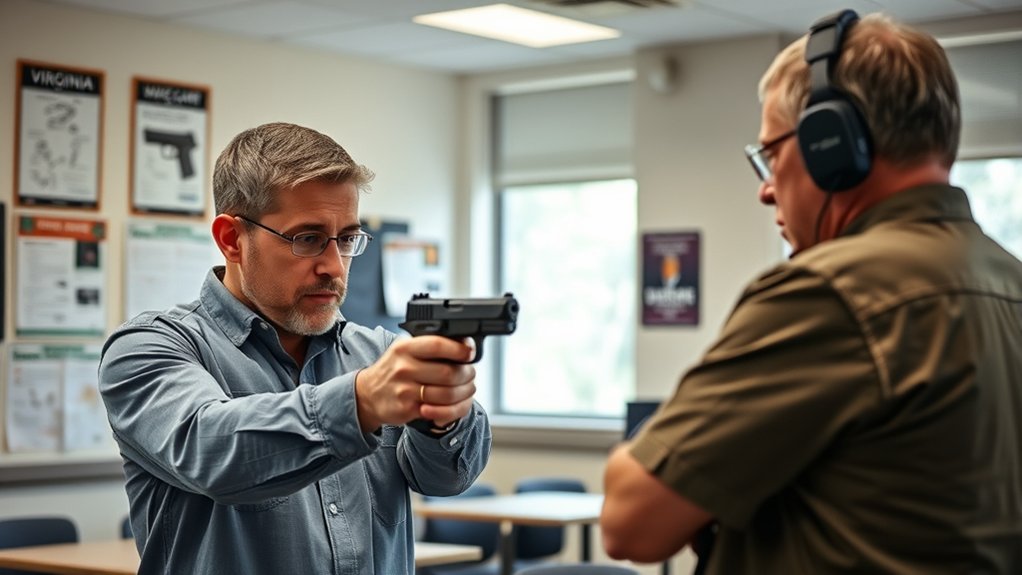
How do you complete the NRA-certified course required for a Virginia concealed carry permit? This mandatory 3-hour class covers Virginia firearms laws, self-defense, and carry restrictions. To succeed, you’ll attend an NRA-certified instructor-led session at approved venues like Chesapeake or Lynchburg.
Complete the mandatory 3-hour NRA-certified class on Virginia laws and self-defense at approved venues.
The course focuses on firearm safety and proper handling techniques, legal responsibilities, and carry restrictions. You’ll also learn firearm maintenance basics to guarantee your weapon functions reliably, along with shooting range etiquette that emphasizes safe and respectful behavior.
No live ammunition is used, but practical demonstrations help you grasp essential skills. After completing the course, you’ll receive a certificate required for your permit application.
Just make sure you stay attentive and prioritize safety throughout the training so you can confidently move forward in the concealed carry permit process.
Where and How to Submit Your Permit Application
Once you’ve completed the NRA-certified course and gathered your documents, you can submit your Virginia concealed carry permit application either in person or by mail.
For application submission in person, visit your local circuit court clerk’s office with a completed Form SP-248, proof of handgun competency, a recent photo, valid photo ID, and proof of residency if your ID lacks a Virginia address.
If you’re mailing your application, send your completed package to the Virginia State Police.
Regardless of how you submit, you must include fingerprints on an FD-258 card. This fingerprint process is essential for background checks through federal and state databases.
Make sure your application is complete and accurate to avoid any delays in processing your concealed carry permit. Taking a little extra time now can save you a lot of hassle later.
What Application and Course Fees Should You Expect?
Understanding the fees involved in obtaining a Virginia concealed carry permit helps you budget effectively and avoid surprises. When planning, consider both permit fees and training costs, as they’re essential expenses.
Here’s what you should expect:
- $50 application fee for residents, $100 for non-residents
- Approximately $55 for the required firearm training course
- Additional $10 court fee and up to $35 for investigation fees (total fees won’t exceed $105)
- Replacement permits cost $5; address changes require a $10 fee
Payments can be made via cash, check, money order, or credit/debit cards (with a 2% processing fee). Factoring these in guarantees you’re prepared for all financial requirements in the licensing process.
It’s pretty straightforward once you know what to expect. Just keep these numbers in mind, and you won’t have any surprises along the way.
How Virginia’s “Shall Issue” Policy Works for You
Virginia’s “shall issue” policy means you’ll get your concealed carry permit as long as you meet the legal requirements. The circuit court is required to approve your application without any delay or personal judgment.
Permit Issuance Criteria
Although the process may seem complex, you’ll find that Virginia’s “shall issue” policy works in your favor by requiring authorities to grant a concealed carry permit as long as you meet all legal eligibility criteria. The permit issuance criteria focus on ensuring only qualified individuals receive permits by verifying your background and qualifications thoroughly.
To secure your permit, you must pass thorough background checks confirming no disqualifiers like recent felonies or domestic violence convictions. You also need to submit fingerprints for identity verification and demonstrate proof of handgun competency.
Plus, you have to be at least 21 years old and meet residency or non-residency requirements.
Once you satisfy these permit eligibility standards, the circuit court or Virginia State Police must issue your concealed carry permit without discretionary denial. This streamlines your path to lawful concealed carry in Virginia.
Application Processing Timeline
How long does it take to get your concealed carry permit once you apply? In Virginia, thanks to the “shall issue” policy, if you meet all legal requirements, the circuit court or Virginia State Police must grant your permit within 45 days.
During this period, background checks and suitability assessments ensure your eligibility, supporting both gun safety and legal compliance.
If no decision is made within 45 days, your application expires, but you receive a de facto permit valid for 90 days.
Renewals and address changes are streamlined, with renewals accepted 90-180 days before expiration and address updates requiring simple notification.
This process guarantees qualified applicants timely access to permits while upholding responsible gun ownership and adherence to the law.
What to Do If Your Permit Is Denied
If your permit is denied, don’t worry—you’ll get a written notice explaining the reasons behind the decision.
After that, you have 21 days to request an ore tenus hearing, where you can present your case in person.
If you’re not satisfied with the outcome, you can also appeal the decision to the Virginia Court of Appeals.
Just keep in mind, you need to file a petition within 60 days.
Knowing these steps is really important if you want to challenge the denial and protect your rights.
Appeal Process Overview
What steps should you take when your concealed carry permit application is denied in Virginia? The denial order will detail the reasons, often related to background checks or permit restrictions, and explain how to appeal. Here’s what you need to do:
Submit a written appeal to the court within 21 days of the denial notice. Then, request an ore tenus hearing to personally challenge the decision. Be ready to present your case or have legal counsel do so during the hearing.
After the hearing, you’ll need to wait for the court’s final order, which will conclude the appeal process. If the appeal is denied, don’t worry—you still have options.
You can petition the Virginia Court of Appeals within 60 days to keep contesting the decision. Taking prompt, informed action is key to steering this process effectively.
Hearing and Court Procedures
Although receiving a denial for your concealed carry permit can be frustrating, you have the right to challenge the decision through a formal hearing process.
If your application is denied after background checks reveal issues or permit restrictions apply, the issuing authority must provide a written explanation.
You can request an ore tenus hearing within 21 days to present your case in court.
At the hearing, you’ll have the opportunity to submit evidence and argue why you should receive the permit.
If the court upholds the denial, you can appeal to the Virginia Court of Appeals within 60 days.
Be prepared to cover court costs during the appeal, though the Commonwealth may reimburse you if your appeal succeeds.
This process guarantees your rights are protected throughout.
How to Renew and Maintain Your Virginia Concealed Carry Permit
When should you start the renewal process for your Virginia concealed carry permit to avoid any lapse in its validity? Begin between 90 and 180 days before your permit expires. Timely renewal is essential to maintain continuous permit validity.
Here’s what you need to keep in mind: Use renewal reminders to track your permit’s expiration date. Submit your application by mail or online with your current permit and valid ID. Include updated photographs and, if required, new fingerprint impressions.
Use reminders to track your permit expiration and submit renewal applications with ID, photos, and fingerprints as needed.
Also, report any changes in name or address to Virginia State Police with a written request and fee. Proper permit storage ensures your documents stay safe and accessible during this process.
Staying proactive with renewal reminders and requirements helps avoid any interruptions in your concealed carry privileges.
Where You Can and Cannot Carry Concealed in Virginia
While Virginia allows concealed carry in most public areas, you need to know the specific locations where carrying is restricted to avoid legal trouble. You can’t carry concealed on school property, in airports, or certain government buildings.
Carrying in places of worship during services is prohibited unless you have the owner’s permission. Licensed restaurants and clubs serving alcohol also restrict concealed carry. Plus, consuming alcohol while armed is a misdemeanor, so be careful about that.
Private property owners can ban firearms with posted signs, but those signs only have limited legal effect if they’re not properly designated.
You may carry in state or national parks, forests, and Wildlife Management Areas with a valid permit, except where local rules say otherwise.
Understanding these concealed carry laws helps you practice responsible gun safety and stay within legal boundaries. It’s always better to be informed than to risk running into trouble.
Frequently Asked Questions
Can I Carry Concealed in Other States With a Virginia Permit?
Yes, you can carry concealed in other states with a Virginia permit, but only where state reciprocity agreements recognize it.
Always check current permit recognition rules and follow each state’s specific carry laws to stay compliant. It’s a good idea to look up the rules before you travel, just to be safe.
What Firearms Are Legal to Carry Concealed in Virginia?
You can carry handguns legally concealed in Virginia, but firearm restrictions exclude other weapons. Be sure to follow concealed carry laws strictly, especially regarding prohibited locations and specific semi-automatic restrictions starting July 2026.
Are There Specific Requirements for Renewing a Lost or Stolen Permit?
Yes, the permit renewal process for a lost permit requires you to submit a written request, a notarized explanation, a recent photo, and pay a $5 fee.
Make sure to follow the lost permit procedures carefully. This will help guarantee a timely replacement by the Virginia State Police.
How Long Does It Take to Process a Concealed Carry Permit Application?
You might expect quick results, but application processing usually takes about 45 days. Background checks play an essential role, and any issues or incomplete info can delay your concealed carry permit approval beyond that timeframe.
Can Permit Holders Carry Concealed in Federal Buildings?
You can’t carry concealed in federal buildings because of strict federal restrictions and building security protocols. Even if you have a Virginia permit, federal law still prohibits firearms in these areas unless you get explicit authorization.
Conclusion
Getting your Virginia concealed carry permit is like building a sturdy bridge. You need the right materials: eligibility, training, and a proper application. Just like a bridge ensures safe passage, following Virginia’s requirements guarantees your legal protection.
Remember, over 90% of applicants get approved under the “shall issue” policy, so stay organized and informed. With the right steps, you’ll confidently carry, knowing you’ve crossed every legal checkpoint safely and responsibly.