Top 12 Best Astrophotography Scope for Clear Night Shots
Trying to capture clear images of distant galaxies or nebulae with a cheap or poorly chosen scope often leads to frustrating results. The best astrophotography scope makes a big difference by providing sharper focusing and better tracking, which avoids blurry photos caused by Earth’s rotation.
Without one that suits astrophotography specifically, users struggle with low light gathering and awkward mounting systems that make long exposure shots nearly impossible.
Quality astrophotography scopes typically feature high-quality optical glass and apertures around 80mm to 130mm, striking a balance between light gathering and portability. A sturdy equatorial mount that supports smooth motorized tracking is essential to keep stars from trailing during long exposures.
The scope’s compatibility with cameras and ease of cleaning optics without scratching coatings also set apart reliable models from disappointing ones.
Need a Quick Check?
| Image | Product | Price |
|---|---|---|
Our Top Picks 1  | ZWO Seestar S30 Pro | Check Price |
Our Top Picks 2  | Celestron Origin Mark II | Check Price |
Our Top Picks 3  | SQA106 Petzval Astrograph | Check Price |
Our Selected Top 12 Astrophotography Scope Picks for Every Need
This list covers a variety of astrophotography telescopes suited for different experience levels and budgets. Each review explains how well the scope performs, highlights its best uses, and points out any limitations to help match the right scope with your needs.
1. ZWO Seestar S30 Pro Telescope
Metal and glass come together in a compact design meant for hobbyists new to astrophotography. It suits beginners aiming to start capturing clear celestial images without fuss. The biggest strength lies in its smart, app-controlled operation that automates tracking and imaging with minimal setup.
Setup involves powering the telescope and connecting it to a smartphone app, which handles object targeting and tracking automatically. The built-in light pollution filters and apochromatic optics help keep images sharper in urban areas. Auto and manual focus options give control, while the included battery powers away from outlets.
The reflex finderscope aids initial alignment, simplifying nightly use.
Astrophotography quality is excellent for its class, offering vibrant 4K images and dual-camera detail that impress with deep-sky shots. The mount supports both alt-azimuth and equatorial use, improving tracking over longer sessions.
Most users praise the one-tap imaging modes and AI noise reduction. Some notes mention the device requires a steady base to avoid tracking issues during long exposures.
The telescope produces sharp and detailed astrophotography with minimal input thanks to app control and smart imaging. The most commonly noted drawback is the need for a firmly steady platform to avoid image blur during extended deep-sky exposure sessions. The tracking and capturing are mostly hands-off but depend on stable mounting.
The S30 Pro suits beginners wanting simple, portable astrophotography focused on deep sky and wide-field shots in urban or outdoor environments. Those seeking detailed views of planets or needing heavy-duty mounts for professional imaging will want to consider other options better suited to those uses.
Pros
- Automatic GOTO targeting and tracking
- Built-in light pollution filters
- Compact and lightweight at 3.64 lb
- Single-tap modes for deep sky, Moon, and Sun
Cons
- Requires stable setup for long-exposure tracking
- Not intended for planetary observation
| Specification | Details |
|---|---|
| Focal Length | 160mm |
| Mount Type | Alt-Azimuth (Supports Equatorial Mode) |
| Focus Type | Auto and Manual Focus |
| Power Source | Battery Powered (1 Nonstandard Battery Included) |
| Field of View | 4.6 degrees |
| Imaging | Dual-Camera 4K, AI Smart Imaging |
2. Celestron Origin Mark II Home Observatory
Exceptional clarity stands out in the Celestron Origin Mark II Home Observatory, a scope designed for serious deep-sky imaging enthusiasts. It’s ideal for someone who values both wide-field views and professional-grade astrophotography.
The most compelling feature is the 152mm aperture paired with a Rowe-Ackermann Schmidt Astrograph design delivering stunningly sharp and detailed images.
Setting up involves mounting the scope on its equatorial mount with manual focus, which suits those familiar with precise adjustments. Sharing views is simple with live feeds cast to smart TVs or saving raw image files compatible with smartphones, tablets, or cameras. The all-in-one home observatory design also lets you experiment with filters or switch to land-based or night-vision observing modes.
Performance shines through its flat field across images, helping avoid distortion common in deep-sky photos. Build quality feels solid and precise, reflecting careful engineering. The most frequent positive feedback highlights outstanding image sharpness and brightness.
The main drawback noted is the dependence on a single nonstandard battery, which may require sourcing replacements carefully.
Exceptional image clarity and wide-field views receive consistent praise, especially for capturing faint deep-sky objects. Dependence on a single nonstandard battery is the most common issue, causing concern about replacement availability and runtime during extended sessions.
Anyone serious about astrophotography and comfortable with manual adjustments will appreciate this scope. Beginners or those preferring motorized focus and more standard power sources might consider more conventional or simpler models. The ability to share live views and save raw images supports collaborative observation and experimentation.
Pros
- Flat field across entire image for detailed astrophotography
- Large 152mm aperture gathers abundant light
- Live feed casting to smart TVs for group viewing
- Compatible with multiple devices for flexible image capture
Cons
- Requires one nonstandard battery, not widely available
- Manual focus may challenge beginners
| Specification | Details |
|---|---|
| Aperture | 152mm (5.98″) |
| Optical Design | Rowe-Ackermann Schmidt Astrograph |
| Mount Type | Equatorial Mount |
| Focus Type | manual focus |
| Compatible Devices | Smartphone, Tablet, Camera |
| Eyepiece Type | Plössl |
3. SQA106 106mm Petzval Astrograph Refractor OTA
Perfect for photographers aiming for sharp, wide-field astrophotography, the SQA106 106mm Petzval Astrograph Refractor OTA offers a standout feature: its integrated self-flattened optical design. This eliminates the need for extra flatteners and complicated back focus calculations, saving time and reducing gear when attaching cameras.
Setting up the OTA is straightforward thanks to its dual finder bases on either side of the focuser, providing flexibility without disassembly when adjusting or adding accessories. The manual dual-speed rack and pinion focuser, with 30 mm travel and engraved scales, allows precise focusing.
The multiple toothed adapters fit various camera mounts, making attachment quick and secure. The solid focuser is compatible with motorized units, supporting evolving setups.
Images are sharp with a central star RMS radius under 1.7 μm, holding well at the full 55 mm image circle, producing finely defined star points across the field. The 106 mm aperture and quintuplet air-spaced lens deliver excellent illumination above 90% at 44 mm. The solid CNC-machined focuser with anti-reflective coating controls stray light well.
Some users find the manual focusing slower compared to electronic focusers, but the rigidity and scale markings aid accuracy.
Sharp star points and excellent field illumination are top strengths, ensuring clear astrophotography without extra flattening optics. The focuser’s rigidity and engraved scales support precise focusing, though manual operation slows down rapid adjustments compared to motorized alternatives.
Photographers seeking a wide, flat, and sharp field will value this scope’s design, especially those comfortable with manual focusing. Those needing quick autofocus or integrated motorized focusing might prefer other models better suited for automated operations.
Pros
- Integrated flattener means no extra optics needed
- Dual finder bases for accessory flexibility
- High precision star points across wide image circle
- Durable CNC-machined focuser with anti-reflective coating
Cons
- Manual focus slower than some motorized focusers
- Limited to manual focus; no motor included
| Specification | Details |
|---|---|
| Aperture | 106mm |
| Optical Design | Petzval Quintuplet air-spaced lens |
| Focal Ratio | F4.8 |
| Focus Type | Manual dual-speed rack and pinion |
| Back Focus | 48mm to 78mm, self-flattened design |
| Finder Base | Two finder bases |
4. Explore Scientific ED80 Apochromatic Triplet Refractor

Capturing sharp and detailed images of the night sky calls for a telescope that balances clarity and portability. The Explore Scientific ED80 Apochromatic Triplet Refractor answers this need with clean, high-contrast optics in a compact design. It is ideal for astrophotographers who want dependable image quality without lugging heavy gear.
Setting up involves attaching an equatorial mount and manually focusing with the precise push-pull collimation system on the front cell. Its 480mm focal length and retractable dew shield make it easy to pack for quick trips or to mount alongside other equipment. Multi-coated optics reduce glare, making targeting and adjustments during sessions easier.
The 80mm aperture and FCD1 HOYA ED glass deliver crisp views with minimal color fringing, essential for astrophotography of planets and nebulae. The tube’s build feels solid but stays light enough for handheld use.
Some mention the manual focusing can demand patience during fine adjustments, but optics are consistently praised for sharpness and contrast.
Everyone appreciates the sharpness and color correction from the apochromatic ED triplet glass. The clear detail it reveals on planetary and deep-sky objects stands out. The manual focus mechanism demands steady hands and can slow down quick changes, which some mention as a hassle during longer sessions.
Those wanting a compact scope capable of high-quality astrophotography without complex electronics will be satisfied. Beginners needing motorized focusing or an included powered mount might prefer other models. This scope fits well with users who value optical performance and portability over automatic features.
Pros
- High-contrast views with minimal chromatic aberration
- Lightweight and portable design
- Precise collimation system for sharp images
- Multi-coated optics reduce glare effectively
Cons
- Manual focus can require patient fine-tuning
- Mount not included, must be purchased separately
| Specification | Details |
|---|---|
| Aperture | 80 millimeters |
| Focal Length | 480 millimeters |
| Focal Ratio | f/6 |
| Optical Design | Air-spaced triplet apochromatic |
| Mount Type | Equatorial Mount |
| Focus Type | Manual Focus with push-pull collimation |
5. Professional Auto-Focus Digital Refractor Telescope
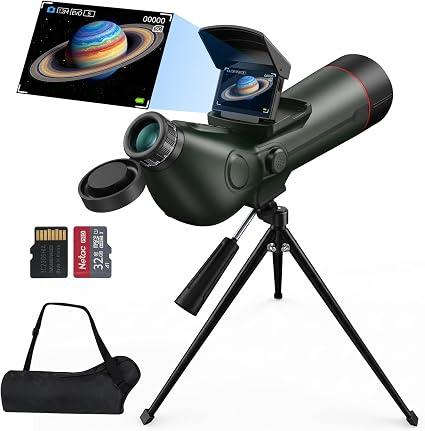
Equipped with an 80mm objective lens and a 300mm focal length, this digital refractor captures sharp images with up to 350X zoom. Ideal for people who want high-resolution astrophotography without extra devices, it delivers 4K photos and videos directly from the scope. Its biggest strength lies in combining strong optics with easy digital capture.
Setting up takes only a few minutes thanks to the stable adjustable tripod and auto-focus feature. The dual-screen setup includes an eyepiece screen with vision adjustment and a foldable external display, making framing objects easy in all lighting conditions. The built-in sunshade cuts glare during day use, so it also works well for birdwatching or wildlife observation.
The optics pull in a good amount of light for clear views of lunar details and planets. The auto-focus saves time on adjustments, and the 4K camera captures crisp images and videos. The battery lasts up to 6 hours, ideal for long nights.
Some users find switching between screens slightly fiddly, but most praise the sharp image quality.
The scope produces detailed photos and videos with sharp focus and bright images. Users highlight the clear optics and long battery life, making it practical for extended stargazing. Some find the interface for toggling displays less intuitive, which can interrupt smooth operation during sessions.
People wanting a ready-to-use option for astronomy and daytime nature watching will find this scope a good fit. Those needing more advanced manual controls or professional-grade optics might consider other models better suited for detailed adjustments and durability under rough conditions.
Pros
- Sharp 4K imagery without extra equipment
- Auto-focus reduces setup time
- Dual screens allow clear viewing in daylight
- Long battery life supports all-night use
Cons
- Screen switching can be awkward to manage
- Nonstandard batteries may complicate replacements
| Specification | Details |
|---|---|
| Objective Lens Diameter | 80mm |
| Focal Length | 300mm |
| Magnification | 350X |
| Battery Capacity | 4500mAh rechargeable |
| Focus Type | Auto-focus |
| Storage Support | TF card up to 512GB |
6. Dwarf Mini Portable Astronomy Telescope

Ideal for hikers, campers, and casual stargazers who want a lightweight and easy-to-use astrophotography scope, it delivers fast setup and solid digital tracking. Its standout feature is the combination of a compact size with automated star targeting, making it useful for those who prioritize portability without losing imaging quality.
Setting it up takes just a few minutes with smartphone app control, letting you point and shoot without wrestling with complex alignment. The all-in-one design fits easily into a backpack or large pocket, weighing only 1.85 lbs.
Battery operation and app integration simplify night sessions, while the 360° pivot and auto GOTO guide the scope to your chosen celestial target quickly.
It excels at capturing faint nebulae and star clusters clearly thanks to a Sony IMX662 sensor and long exposure support up to 90 seconds with an equatorial mount option. The build is solid yet compact, though manual focusing alongside auto modes can feel finicky at times. Some users find the battery life limiting, especially on extended outings, despite the overall ease of use.
Quick setup through the app and precise digital tracking receives high praise for simplifying astrophotography sessions. The most frequent complaint concerns battery endurance, as heavier usage drains the power faster than expected. The manual focus mode occasionally requires extra patience to nail sharp images in low light.
Anyone wanting a portable, user-friendly scope for casual or beginner astrophotography will appreciate this model. Those planning long, uninterrupted sessions under very dark skies or who need fully automatic focusing might consider a larger or more traditional telescope instead.
Pros
- Compact and lightweight for easy travel
- Intuitive app with built-in star map
- Accurate auto tracking and 360° pivot
- Supports long exposures with light pollution filter
Cons
- Battery life can limit long sessions
- Manual focus sometimes feels imprecise
| Specification | Details |
|---|---|
| Weight | 1.85 lbs (840g) |
| Focal Length | 150 mm |
| Sensor | Sony IMX662, 1/2.8-inch, 2.9μm pixels |
| Mount | Altazimuth and Equatorial Mount |
| Exposure Time Support | Up to 90 seconds |
| Power Source | Battery Powered |
7. Dwarf 3 Smart Astrophotography Telescope

Weighing only 3lb/1.35kg, it fits in a standard backpack and works well for anyone wanting a lightweight, smart scope for both celestial and terrestrial photography. Its key advantage is the dual lens design that covers telephoto and wide-angle needs, making it great for capturing stars, planets, wildlife, and landscapes.
Setting up takes just minutes thanks to the intuitive DWARFLAB app and automatic features. It uses an altazimuth mount with autofocus and 4K auto-tracking, so you can focus on framing shots rather than fiddling with controls. The included carrying bag and magnetic filters add convenience when carrying and switching settings outdoors.
Image quality is sharp in both day and night modes, benefiting from the advanced dual lens and 4K tracking that follows moving subjects. The lightweight build makes it easy to carry but some find the plastic parts less durable compared to heavier models.
The app handles processing in the cloud, which speeds up getting final pictures. A few users mention occasional tracking jitters under certain conditions.
Consistent praise centers on how easily it fits into outdoor activities due to its weight and size, making quick setup and travel simple. The most frequent issue involves occasional tracking instability, which can affect shots of fast-moving or faint celestial objects. Its app-based image processing keeps the workflow smooth but relies fully on cloud connectivity.
Photographers who prioritize portability and want a straightforward experience will appreciate this scope. Those needing heavy-duty hardware or more stable tracking for complex astrophotography might look towards sturdier, professional-grade models that offer manual controls and durable mounts.
Pros
- Very lightweight and portable for travel
- Dual lens system for day and night use
- 4K auto-tracking delivers clear shots
- Cloud-powered app simplifies image processing
Cons
- Some plastic parts feel less durable
- Tracking can jitter in challenging conditions
| Specification | Details |
|---|---|
| Weight | 3lb/1.35kg |
| Mount Type | Altazimuth Mount |
| Focus | Auto Focus |
| Imaging | 4K Auto-Tracking |
| Power Source | 1 Lithium Ion battery (included) |
| Compatible Devices | Smartphone, Laptop, Personal Computer |
8. SVBONY SV105 1.25 CMOS Eyepiece Camera

SVBONY SV105 1.25 CMOS Eyepiece Camera specializes in basic astrophotography for beginners. It suits people who want simple planetary and lunar imaging with clear results.
Its biggest strength is easy setup that connects directly to your laptop without extra drivers.
Setting up the camera involves plugging it into your telescope’s 1.25-inch eyepiece holder and connecting it via USB to a Windows, Linux, or Android device. The software needed is free and straightforward to install. You get real-time viewing on your screen and manual focus adjustments.
The dark light compensation helps improve clarity under low light during night observation.
The SV105 performs well capturing detailed video of the moon and bright planets at 1920×1080 resolution and 30 frames per second. It uses a solid 1/2.8-inch IMX307 sensor coated for better light management. It feels sturdy, but manual focusing can be slow.
The main complaint is incompatibility with iOS devices, limiting use with Apple mobile hardware.
Real-time viewing and simple connection to a laptop make it excellent for casual astrophotography. Dark light compensation improves image quality noticeably, but macOS compatibility is limited to laptops, and iOS devices cannot be used, which narrows options for Apple users.
Beginners who want an affordable introduction to lunar and planetary imaging will find this easy and effective. People wanting to use Apple tablets or phones should consider other options that support iOS. The manual focus might challenge those expecting automatic adjustments or faster setups.
Pros
- Plug and play with no driver needed on most systems
- Clear images with dark light compensation technology
- Compact size fits standard 1.25 inch eyepieces
- Records 2K video at high speed
Cons
- Not compatible with iOS phones or tablets
- Manual focus can be fiddly in low light
| Specification | Details |
|---|---|
| Imaging Sensor | 1/2.8″ IMX307 CMOS |
| Resolution and Frame Rate | 1920×1080 at 30fps |
| Mount Size | 1.25 inch, threaded M28.5×0.6 |
| Field of View | 1.5 degrees |
| Focus Type | Manual Focus |
| Compatibility | Windows, Linux, Android, macOS (laptops only) |
9. Auto-Focus Portable Digital Refractor Telescope

Crystal-clear images of stars and planets come alive with an 80mm aperture and sharp 300mm focal length. Ideal for hobbyists who want a good balance between portability and detailed astrophotography, it stands out mainly for its autofocus system and 4k imaging capabilities.
It suits those ready to connect their phone or tablet for easy control and viewing.
Setting it up takes just a few minutes thanks to the lightweight tripod mount. The autofocus eliminates fiddling with manual adjustments under dark skies, making it more user-friendly during night sessions. Switching between photo and video modes happens through an app or remote control, and dual screens help in framing shots alongside remote viewing options.
Compatibility with smartphones, tablets, and computers keeps the experience flexible for different users.
The optical clarity at up to 350x magnification really shows crisp details on the moon and some faint deep sky objects. The aluminum body feels sturdy enough for casual outings but few rough shakes could affect the sharpness if not handled gently. Auto-focus consistently works well, although the reflex finderscope might require recalibration occasionally.
Note that battery life depends on device compatibility rather than the telescope itself, as it relies on connected gadgets for imaging and control.
The powerful zoom with crisp details and the autofocus are praised for creating enjoyable stargazing and photography sessions. Difficulty can arise from occasional need to recalibrate the reflex finderscope and the sensitive build which requires steady handling. It performs best in clear, calm conditions where setup is stable.
Astronomy beginners who want to record high-quality images without complex optics will find it a suitable pick. Those seeking heavy-duty construction for rugged environments or highly specialized deep-sky imaging might want to consider more advanced or sturdier models available elsewhere.
Pros
- Auto-focus simplifies night sky adjustments
- 4k camera captures detailed astrophotos and videos
- Dual screen support aids in framing and viewing
- Compact tripod mount easy to carry and set up
Cons
- Reflex finderscope sometimes needs recalibration
- Body requires careful handling to prevent image blur
| Specification | Details |
|---|---|
| Aperture | 80mm |
| Focal Length | 300mm |
| Zoom Ratio | 350x |
| Focus Type | Auto Focus |
| Mounted On | Tripod Mount |
| Compatible Devices | Computer, Tablet, Smartphone |
10. Vortex Crossfire HD 20-60×80 Spotting Scope

Great value and solid performance make the Vortex Crossfire HD 20-60×80 a reliable spotting scope for astrophotography enthusiasts who want clear, sharp images without spending too much. Its key strength lies in the combination of wide magnification range and rugged build quality.
Setting it up is quick thanks to the Arca-Swiss compatible foot, fitting most tripods right away. Twisting the eyecups works well with or without glasses, while the helical focus allows both fast and precise adjustments. The built-in sunshade keeps glare at bay during outdoor use, and rubber armor offers a firm grip even in wet conditions.
The image clarity and edge-to-edge sharpness stand out during use, with good color fidelity and reduced chromatic aberration. The body feels tough and the waterproof, fogproof features hold up well in damp or cold weather. Some mention that at the highest magnification, the view can occasionally wobble, but the overall build and optics deliver on their promise.
Images are crisp across the zoom range with strong color accuracy and minimal distortion thanks to HD glass and coatings. The main drawback is slight shakiness at the top magnification, which can affect steady image capture on unsteady mounts. The waterproof design and tough rubber coating add confidence to outdoor use in varied weather.
Amateurs and serious hobbyists who want solid optical performance and ruggedness without spending excessively will find this scope fitting. Those needing ultra-lightweight or specialized high-end optics might consider other options better tailored to long field hikes or very fine detail work.
Pros
- Wide magnification range for versatile viewing
- Durable rubber armor improves grip and impact resistance
- Anti-reflective coatings boost clarity in low light
- Built-in sunshade reduces glare and weather effects
Cons
- View can wobble at maximum 60x magnification
- Some users may find it heavier than smaller scopes
| Specification | Details |
|---|---|
| Objective Lens Diameter | 8 centimeters |
| Magnification Range | 20 – 60x |
| Optical Coatings | Anti-reflective on all air-to-glass surfaces |
| Focus Mechanism | Helical focus |
| Water Resistance | Waterproof and fogproof, nitrogen purged |
11. 4K Wireless Universal Eyepiece Telescope Camera

Aluminum construction and a compact design make the 4K Wireless Universal Eyepiece Telescope Camera a solid choice for anyone interested in astrophotography or nature observation. Its strength lies in combining a 4K video capacity with an 8MP sensor and manual focus, offering clear and detailed images right from your telescope or binoculars.
Setting up involves mounting the camera on eyepieces from 23mm to 60mm, thanks to a universal locking groove. The 2.8-inch IPS screen rotates for easy viewing and supports WiFi connections within 32 feet, letting you control the camera remotely from two devices.
Battery life is boosted by a built-in 2000mAh rechargeable battery, supporting long sessions without interruption. You can store plenty of images and videos on a microSD card up to 512GB, and the XDVPRO app adds time-lapse and social sharing features.
Image quality holds up well with 4K video and an 8MP CMOS sensor. The camera is generally sturdy, although some users find the manual focus requires patience to get sharp shots.
Most praise goes to the clear, color-accurate screen and versatile mounting options, while some report the fit can feel a little loose on smaller eyepieces. Battery life meets expectations for extended outdoor use.
Clear visuals with 4K video and the adjustable IPS screen get a lot of positive remarks, while the manual focus takes some getting used to for crisp shots. Mounting flexibility pleases many, but the occasional looseness on smaller eyepieces stands out as a recurring issue.
Photographers wanting good image quality and remote operation will appreciate the camera’s features and compatibility. Those needing faster autofocus or a more secure fit on small eyepieces might explore other options better suited to those demands. It serves well for moon and planet observation under low light.
Pros
- Universal locking groove fits 23-60mm eyepieces
- Rotatable 2.8-inch screen with high color accuracy
- WiFi control supports two simultaneous devices
- Long-lasting rechargeable 2000mAh battery
Cons
- Manual focus can be tricky for sharp images
- Feels loose on smaller diameter eyepieces
| Specification | Details |
|---|---|
| Sensor Resolution | 8MP CMOS |
| Video Resolution | 4K |
| Display Size | 2.8-inch IPS |
| Battery Capacity | 2000mAh lithium polymer |
| Zoom Ratio | 16x |
| MicroSD Card Support | Up to 512GB |
12. WiFi Electronic Eyepiece Telescope Camera

WiFi Electronic Eyepiece Telescope Camera suits anyone interested in astronomy or wildlife observation who wants clear, digital images from their optical devices. It stands out for its built-in 1.5” IPS screen that shows live pictures right on the device, so you don’t always need a phone or tablet to see what you’re aiming at.
Setup is straightforward with its mounting groove fitting scopes between 28mm and 50mm. The manual focus adjusts easily to sharpen images.
The WiFi connection lets you view and control the camera remotely within about 49 feet, meaning you can watch on a phone or tablet while the camera stays put. Battery life lasts roughly three hours and you can recharge via USB, which is handy for longer sessions if you bring a power bank.
Photo quality is solid with 1080P for video and 2MP for images, including a dark light compensation feature that helps when viewing faint objects like the moon or distant wildlife. The camera feels well built with an aluminum battery casing.
The clearest praise is for the crisp images it delivers. The main complaint relates to compatibility; it fits a good range of scopes but not every model, so checking size is important.
Crisp image quality and the built-in screen get plenty of praise for making observation simple even without an extra device. Issues mainly stem from device compatibility and the delay manual focus causes with moving targets. Battery life suits most evening sessions, and the option to recharge via USB extends use outdoors.
Anyone wanting a simple plug-and-play digital eyepiece for standard-sized scopes will find this camera suitable. It works well for beginners and casual stargazers who care about image clarity and flexible viewing options. Users with larger or unusual scopes may need to find a different model.
Pros
- 1.5” screen allows independent viewing without phone
- 1080P video with dark light compensation improves low-light shots
- Fits binoculars, telescopes, microscopes with 28-50mm barrel
- Long-lasting 1000mAh battery with USB charging
Cons
- Only supports scopes with 28-50mm diameter
- Manual focus can be slow for fast-moving subjects
| Specification | Details |
|---|---|
| Screen Size | 1.5” IPS mini screen |
| Battery | 1000mAh lithium ion, USB rechargeable |
| Resolution | 1920P * 1080P video, 2MP photos |
| Compatible Lens Diameter | 28-50 millimeters |
| Memory | 64G TF card included, supports up to 256G |
| Mount Type | Altazimuth Mount |
Best Astrophotography Telescopes Comparison Table
| Product | Mount Type | Focus Type | Focal Length | Additional Features |
|---|---|---|---|---|
| ZWO Seestar S30 Pro | Alt-Azimuth (EQ Mode) | Auto/Manual Focus | 160mm | Auto Tracking, App Controlled |
| Celestron Origin Mark II | Equatorial Mount | Manual Focus | – | Integrated Astrophotography Tech |
| SQA106 Petzval Astrograph | Equatorial Mount | Manual Focus | F4.8 | Quintuplet Lens, Self-Flattened |
| Explore Scientific ED80 | Equatorial Mount | Manual Focus | 480mm | Apochromatic, Portable |
| Professional Auto-Focus Refractor | – | Auto Focus | 300mm | 4K Camera, Dual Screens |
| Dwarf Mini Portable | Altazimuth & Equatorial | Manual & Auto Focus | 150mm | App-Controlled, Auto GOTO |
| Dwarf 3 Smart Astro | Altazimuth Mount | Auto Focus | – | 4K Tracking, Auto GOTO |
| SVBONY SV105 Camera | Fixed Mount | Manual Focus | ~83.7mm | Plug and Play |
| Auto-Focus Digital Refractor | Tripod Mount | Auto Focus | 300mm | 4K Camera, Remote Control |
| Vortex Crossfire HD 20-60×80 | – | – | – | 20-60x Magnification |
| 4K Wireless Telescope Cam | – | Manual Focus | – | WiFi, 16x Zoom |
| WiFi Electronic Eyepiece | Altazimuth Mount | Manual Focus | 50mm | WiFi, Multi-Device Compatible |
- Mount TypeAlt-Azimuth (EQ Mode)
- Focus TypeAuto/Manual Focus
- Focal Length160mm
- Additional FeaturesAuto Tracking, App Controlled
- Mount TypeEquatorial Mount
- Focus TypeManual Focus
- Focal Length–
- Additional FeaturesIntegrated Astrophotography Tech
- Mount TypeEquatorial Mount
- Focus TypeManual Focus
- Focal LengthF4.8
- Additional FeaturesQuintuplet Lens, Self-Flattened
- Mount TypeEquatorial Mount
- Focus TypeManual Focus
- Focal Length480mm
- Additional FeaturesApochromatic, Portable
- Mount Type–
- Focus TypeAuto Focus
- Focal Length300mm
- Additional Features4K Camera, Dual Screens
- Mount TypeAltazimuth & Equatorial
- Focus TypeManual & Auto Focus
- Focal Length150mm
- Additional FeaturesApp-Controlled, Auto GOTO
- Mount TypeAltazimuth Mount
- Focus TypeAuto Focus
- Focal Length–
- Additional Features4K Tracking, Auto GOTO
- Mount TypeFixed Mount
- Focus TypeManual Focus
- Focal Length~83.7mm
- Additional FeaturesPlug and Play
- Mount TypeTripod Mount
- Focus TypeAuto Focus
- Focal Length300mm
- Additional Features4K Camera, Remote Control
- Mount Type–
- Focus Type–
- Focal Length–
- Additional Features20-60x Magnification
- Mount Type–
- Focus TypeManual Focus
- Focal Length–
- Additional FeaturesWiFi, 16x Zoom
- Mount TypeAltazimuth Mount
- Focus TypeManual Focus
- Focal Length50mm
- Additional FeaturesWiFi, Multi-Device Compatible
How to Choose the Right Astrophotography Scope
Choosing the right astrophotography scope depends on factors like aperture size, focal length, and mount stability. These elements affect image clarity and ease of use. Getting them right helps avoid costly upgrades and frustration during long observation sessions.
Optical Quality and Aperture
Stargazing on a clear night reveals how critical aperture size is for brightness and detail in celestial images. Smaller lenses struggle to gather enough light, making distant stars and faint nebulae appear dim or even invisible. Sizes above 80mm tend to offer a noticeable difference, capturing more photons and delivering brighter, clearer views.
The drawback is the extra weight and bulk, but that’s a fair tradeoff for sharper images that don’t force you to constantly squint or guess at faint objects.
Optical coatings significantly reduce glare from stray light sources, improving contrast and color accuracy. Cheap or uncoated lenses might show annoying ghosting or flare in images, especially near bright planets or the moon. Look for scopes with multi-coated optics; they provide cleaner, crisper views even under urban sky conditions.
The focal length determines how close and detailed the view is; longer focal lengths bring distant objects larger but narrow the field of view, making it easier to lose track of targets when scanning the sky.
Mount Stability and Tracking
Long exposure photography requires the scope to stay perfectly still for several minutes. Vibrations from a lightweight or poorly built mount cause blurry images that waste time and effort. A mount made from solid materials like steel or high-grade aluminum, with a weight capacity well above the scope’s weight, makes a measurable difference here.
Stability isn’t just about the mount’s weight but also its design, look for wide legs and a low center of gravity to prevent shaking. This reduces the need for repeated adjustments during a session under the stars.
Motorized or computerized systems that track celestial objects help the camera remain locked on a target as Earth rotates, avoiding those subtle drift lines that ruin exposures. Both equatorial and altazimuth mounts can work, but equatorial mounts are usually preferred for astrophotography since they follow one axis aligned with Earth’s rotation. Enhanced tracking accuracy typically comes with motors rated for precise incremental adjustments, often controlled via a handpad or smartphone app.
Good tracking means less manual correction and more crisp, detailed images.
Camera Compatibility and Connectivity
Many scopes come with a standard T-ring mount or adapters compatible with DSLR and mirrorless cameras, which makes attaching your camera straightforward without extra purchases. Using the right adapter ensures a secure fit, preventing wobbling or misalignment during long exposures.
Neglecting this can cause frustration with shaky images or even damage the camera mount. Look for scopes that specify support for popular sensor sizes, such as APS-C or full-frame, so you can use your existing camera without cropping or vignetting issues.
Some models include USB or dedicated ports for remote control or support wireless options through Bluetooth or Wi-Fi. This allows for image capture and focus adjustments without touching the camera, reducing vibrations that blur photos.
Check compatibility with your camera’s capture software and whether the scope supports common image formats like RAW. Having an easy-to-use connection setup makes nightly imaging sessions less fiddly and more productive.
Portability and Weight
Carrying gear to a dark sky site quickly becomes exhausting if the optical tube weighs more than 15 pounds without a sturdy carrying case. Heavier scopes put stress on mounts, leading to vibrations that blur long exposures. Some mounts rating up to 20 pounds handle lighter scopes well, but pushing weight limits sacrifices stability.
Materials like carbon fiber can drop weight significantly compared to aluminum tubes, although they cost more.
Balance is key for enjoyable setup and use. A scope around 10 to 12 pounds paired with a reliable equatorial mount allows for steady tracking and easier transport.
Oversized scopes might deliver brighter images but require more time to assemble and align, reducing time under the stars. Compact designs with folding legs and manageable length make packing and hiking practical, especially in remote locations.
Build Quality and Durability
Spotting corrosion or loose screws on a telescope after a damp night can ruin a planned session. The use of aluminum or stainless steel for structural parts often makes a clear difference.
These materials withstand dew and occasional rain better than cheaper metal alloys or plastic. A solid metal frame means no wobble during long exposures, which keeps stars sharp on camera. Look for scopes quoting an IPX3 or higher rating for moisture resistance, especially if you expect to image in humid or cold environments.
Focusing mechanisms in lower-end models tend to loosen or develop backlash over time. This affects sharpness urgently because even minor slip means missing fine details on a photograph. A reliable rack-and-pinion or Crayford focuser with smooth, grease-filled bearings stays precise for years.
Alignment systems relying on metal dovetails and keyed fittings maintain setup stability better than plastic parts that expand or crack with temperature changes. This reliability reduces frustrating recalibration before every outing and helps keep tracking locked on target during long exposures.
Maximizing Image Quality: Tips for Stable Mounting and Tracking
Using a stable mount significantly reduces blur caused by vibrations, which is crucial when capturing long-exposure images of faint celestial objects. A solid equatorial mount with smooth, adjustable tracking helps align the telescope with Earth’s rotation, keeping objects centered during extended shots.
Even slight shifts result in star trails rather than pinpoint stars.
To achieve this stability and precise tracking:
- Place the tripod on a firm surface, avoiding soft ground that absorbs vibrations.
- Use vibration suppression pads under tripod feet if you are on concrete or metal surfaces.
- Balance the telescope carefully to reduce stress on the mount’s motor and maintain smooth movement.
- Regularly calibrate the tracking system and polar align the mount to minimize drift during exposures.
- Consider a guided tracking system that uses a secondary camera to make constant small corrections.
Combining these practices leads to sharper, more detailed astrophotography results, especially during long exposure sessions. A shaky setup can ruin hours of preparation and space photography, so investing time in mounting stability pays off.
Essential Maintenance Practices to Keep Your Astrophotography Scope in Top Shape
Your scope’s lenses and mirrors accumulate dust and smudges quickly, which affects image clarity. Clean optical surfaces sparingly with a soft brush or an air blower designed for cameras. Avoid wipes or cloths unless they’re microfiber and specifically meant for lenses, and even then, use them with very gentle pressure.
Regular alignment of the mirrors, known as collimation, is crucial. This practice ensures the light path is correctly focused, which directly impacts photo sharpness. Depending on how often you use the scope, check collimation every few sessions or after transport.
Storage matters as well. Keep your scope in a dry place where temperature swings are minimal to prevent dew buildup and potential mold inside the tube. Desiccant packs inside the case or tube help control humidity.
- Cover the scope with a dust cap when not in use.
- Inspect mounting hardware and tighten any loose bolts before each use.
- Allow the scope to cool to outside temperature before starting a session to reduce thermal distortion in images.
Comparing Refractor and Reflector Telescopes for Astrophotography Applications
Refractor and reflector telescopes each have distinct features that affect their suitability for astrophotography. Refractor scopes use lenses to gather and focus light, producing sharp images with minimal maintenance since their tubes are sealed, preventing dust build-up.
They often deliver excellent contrast and color fidelity, which benefits detailed shots of planets and the moon.
Reflector telescopes rely on mirrors, which offer larger apertures for the price, allowing more light collection from faint deep-sky objects like galaxies and nebulae. However, these mirrors may require occasional alignment and cleaning. Reflectors typically suffer less from chromatic aberration but can face issues like coma distortion unless equipped with additional correctors.
Key considerations include:
- Size and weight: Refractors are more compact, making setup and transport easier.
- Maintenance: Reflectors need more upkeep due to exposed mirrors.
- Image type: Reflectors excel with faint objects; refractors shine with brighter targets.
People Also Asked
How Do I Properly Care for My New Astrophotography Scope?
Clean the lenses only with a proper lens cloth and avoid touching the glass surfaces with fingers to prevent smudges and scratches. Store the scope in a dry, dust-free environment, and always cap the lenses after use to protect from dirt and moisture. Occasional checks for loose screws on the mount can prevent wobbling during photography.
What Size Astrophotography Scope Is Ideal for Beginner Enthusiasts?
A refractor scope with an aperture around 80mm to 100mm is suitable for beginners. It usually balances ease of use, portability, and decent light-gathering capacity. Such sizes allow decent detail in planetary and deep-sky photos without demanding too much adjustment or complex setup.
Are Astrophotography Scopes Compatible with Smartphone Cameras and Adapters?
Many astrophotography scopes can work with smartphone cameras if you use a proper adapter that secures the phone aligned with the eyepiece. Positioning might take some trial and error to avoid vignetting or blurriness, but this setup is quite popular for casual astrophotography without investing in dedicated cameras.
How Long Does a Typical Astrophotography Scope Last with Regular Use?
With careful handling and proper storage, an astrophotography scope can last well over a decade. Optical coatings may degrade slowly but can be maintained by professional cleaning every few years. Mechanical parts like focusers may need occasional grease or maintenance depending on use frequency.
What Are Common Problems Faced When Using an Astrophotography Scope?
Common issues include focusing challenges, especially with faint objects, and vibration or tracking errors affecting long exposure images. Dew formation on lenses is another problem in cooler nights. These annoyances require balancing patience in focusing and often adding accessories like dew heaters or better mounts.
Conclusion
Choosing a good astrophotography scope comes down to three main factors: image quality, ease of setup, and compatibility with your camera gear. A clear, sharp lens and a stable mount are key to capturing detailed photos without frustration. Also, consider how complex the equipment is to assemble and adjust, as this affects your shooting time and experience.
Pick a scope that fits your observing space, budget, and how often you’ll use it. Smaller rooms or occasional use call for compact, simple designs, while dedicated spaces and frequent outings justify investing more. The comparison table above lays out features side by side, helping you match your needs to the options covered in this roundup.